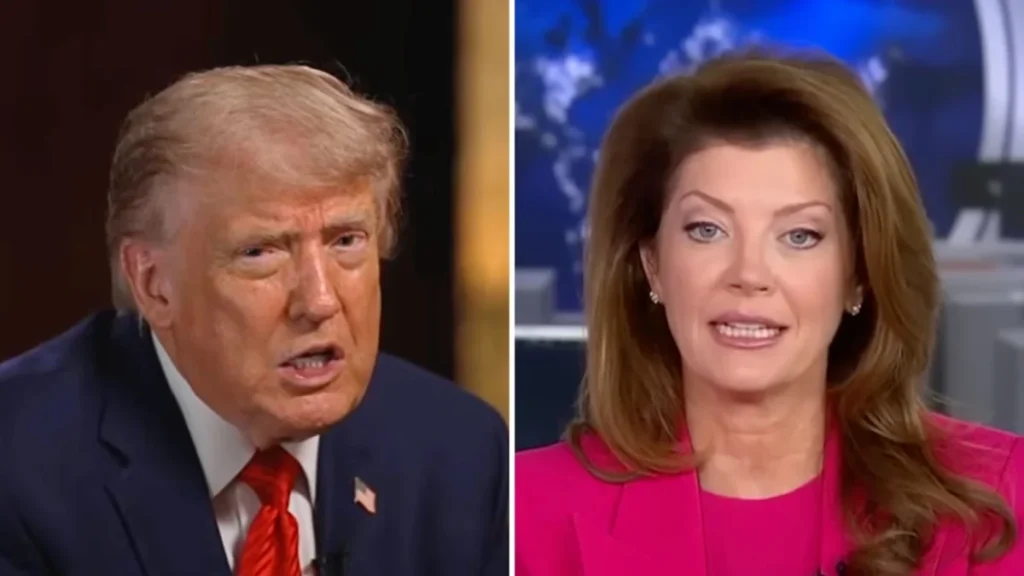

President Donald Trump, during a recent interview with Sean Hannity on Fox News, reignited his criticism of CBS News anchor Norah O’Donnell, referencing a contentious "60 Minutes" interview from April 26. The exchange, which occurred while Trump was in Beijing for meetings with Chinese President Xi Jinping, saw the President deflect questions about trade and instead focus on his perceived dissatisfaction with O’Donnell’s journalistic approach.
The initial clash between President Trump and Norah O’Donnell transpired during a "60 Minutes" segment that aired shortly after a concerning incident at the White House Correspondents’ Dinner. During that interview, O’Donnell read from the alleged manifesto of Cole Allen, the individual accused of attempting to assassinate the President. This act evidently provoked a strong reaction from Trump, leading to a heated exchange that has now resurfaced in his conversation with Hannity.
Trump’s remarks to Hannity, as reported by Mediaite, characterized O’Donnell as a "very bad, you know, stupid reporter" and a "stupid person." He suggested that "anybody off the street" could perform her job equally well, deeming her "very average." This sharp repudiation of O’Donnell’s professional capabilities comes after a period of escalating tension stemming from their prior interview.
A History of Friction: The "60 Minutes" Confrontation
The April 26 "60 Minutes" interview was a pivotal moment that seemingly solidified President Trump’s negative assessment of Norah O’Donnell. The interview, conducted at the White House, delved into various pressing issues, but the tension escalated when O’Donnell presented Trump with a passage from the alleged manifesto of Cole Allen. The manifesto contained inflammatory language, including the statement, "I am no longer willing to permit a pedophile, rapist, and traitor to coat my hands with his crimes."
Upon hearing this quote, President Trump’s demeanor reportedly shifted dramatically. He accused O’Donnell and CBS News of being "horrible people" and expressed his belief that she intentionally read the passage to provoke him. Trump vehemently denied the accusations within the manifesto, stating, "I am not a rapist. I didn’t rape anybody." When O’Donnell gently inquired if he believed the author was referring to him, Trump’s response was emphatic. "I am not a pedophile. You read that crap from some sick person," he declared, further labeling O’Donnell a "disgrace" and urging her to "be ashamed."
This heated exchange was not an isolated incident of criticism from the President regarding O’Donnell’s interview. Following the "60 Minutes" broadcast, President Trump publicly referred to O’Donnell as a "disgrace" on multiple occasions. He reiterated his dissatisfaction during a subsequent phone interview with Hugh Hewitt on "The Hugh Hewitt Show," where he again characterized her as "terrible" and suggested that her salary was disproportionately high given his perception of her performance. "I could get any woman off the street, practically, and they would do just as good a job as her. There’s nothing special," Trump stated during that interview.
Context of the "60 Minutes" Interview: A Volatile Political Climate
The "60 Minutes" interview with Norah O’Donnell took place against a backdrop of significant political and security concerns. The incident at the White House Correspondents’ Dinner, which involved a shooting that led to injuries, had understandably heightened anxieties. The subsequent discovery of a manifesto attributed to the alleged assailant, Cole Allen, introduced a disturbing new dimension to the security landscape surrounding the presidency.
The manifesto’s content, particularly its personal and accusatory nature directed towards unnamed individuals, presented a challenging ethical and journalistic dilemma for interviewers. O’Donnell’s decision to read a portion of this document to President Trump, while likely intended to elicit his direct response to the serious allegations, ultimately proved to be a point of contention that overshadowed other aspects of the interview.
Trump’s Remarks in Beijing: A Strategic Diversion?
President Trump’s decision to bring up the O’Donnell interview during his meeting with Sean Hannity, while in Beijing, raises questions about the strategic intent behind his remarks. The interview occurred as Trump was engaged in high-stakes diplomatic and economic negotiations with China, focusing on critical issues such as trade imbalances, tariffs, and intellectual property theft.
When directly questioned by Hannity about the progress of these discussions, Trump reportedly pivoted away from the substantive trade dialogue. Instead, he used the opportunity to revisit his grievances with O’Donnell. This deflection could be interpreted in several ways:
- Asserting Control Over the Narrative: By controlling the media narrative surrounding his interviews, Trump may have sought to project an image of strength and unwavering conviction, even when faced with challenging questions.
- Appealing to His Base: Criticizing a prominent journalist from a perceived "liberal media" outlet like CBS could resonate with his core supporters, reinforcing a narrative of media bias against him.
- Personalizing a Political Encounter: The intensity of his reaction suggests that the "60 Minutes" interview had a significant personal impact on the President, leading him to dwell on the perceived slight even during an international summit.
Furthermore, Trump’s comments during the Hannity interview, where he stated, "Yeah, I mean, it is progress, but I also tell people that, you know, I was in an interview with a very bad, you know, stupid reporter," could be seen as an attempt to frame his overall engagement with the media and public discourse. By denigrating a specific reporter, he might have aimed to discredit critical reporting in general.
Broader Implications: Media Scrutiny and Presidential Rhetoric
The ongoing public exchanges between President Trump and Norah O’Donnell highlight a recurring theme in contemporary political discourse: the dynamic between political leaders and the press. President Trump has consistently adopted a combative stance towards journalists and news organizations he deems critical of his administration. This pattern of behavior has been well-documented throughout his presidency and his campaigns.
The implications of this persistent criticism extend beyond the personal animosity between the President and a specific reporter. They touch upon fundamental questions about:
- The Role of the Media: The President’s characterization of O’Donnell as a "stupid reporter" and "average" can be interpreted as an attempt to undermine the credibility and importance of investigative journalism and critical questioning.
- Presidential Accountability: The public’s reliance on journalists to hold powerful figures accountable is a cornerstone of democratic societies. When a President openly disparages journalists, it can create a chilling effect on reporting and discourage robust scrutiny.
- The Influence of Presidential Rhetoric: The President’s words carry significant weight and can shape public opinion. His consistent attacks on media figures may contribute to a broader distrust of news institutions and a polarization of perspectives on journalistic integrity.
The incident also brings to the forefront the challenges journalists face when interviewing powerful figures, especially when confronting sensitive or potentially inflammatory material. The decision to read from a manifesto, while ethically justifiable in the pursuit of truth, carries inherent risks of provoking defensive or aggressive reactions from the interviewee.
Analysis of the Manifesto Passage and its Impact
The specific passage from Cole Allen’s alleged manifesto, "I am no longer willing to permit a pedophile, rapist, and traitor to coat my hands with his crimes," is particularly noteworthy. The use of such strong and abhorrent language, directed at individuals perceived as "traitors," immediately raises questions about the author’s motives and the potential targets of his anger.
President Trump’s immediate and vehement denial of being a "rapist" or "pedophile" suggests that he interpreted the statement, or at least its implication, as a direct accusation against him. His reaction, described as becoming "irritated" and later "horrible people," indicates a deeply personal offense. The fact that he felt compelled to address these accusations so forcefully, even during an international summit, underscores the emotional weight of the situation for him.
The broader implications of such manifesto-based questioning involve the delicate balance between reporting on potentially dangerous individuals and avoiding the amplification of their extremist views. Journalists often grapple with how to present such information responsibly, seeking to inform the public without inadvertently glorifying or legitimizing the author’s harmful ideology. In this instance, President Trump’s reaction transformed the discussion from an examination of the manifesto’s content to a public dispute about the interviewer’s competence and intent.
Conclusion: A Lingering Controversy
The continued focus on Norah O’Donnell by President Trump, even during high-level international diplomacy, suggests that the "60 Minutes" interview left a lasting impression. His repeated criticisms, amplified by his appearance on Fox News, serve to reinforce his public perception of the media and his own role as a target of unfair scrutiny. For Norah O’Donnell and CBS News, this ongoing commentary presents a challenge in navigating their journalistic responsibilities while facing direct and sustained criticism from the highest office in the land. The incident serves as a stark reminder of the complex and often contentious relationship between political power and the press in the modern era.
Hannity airs weeknights at 9/8c on Fox News.
60 Minutes airs Sundays at 7/6 c on CBS.