

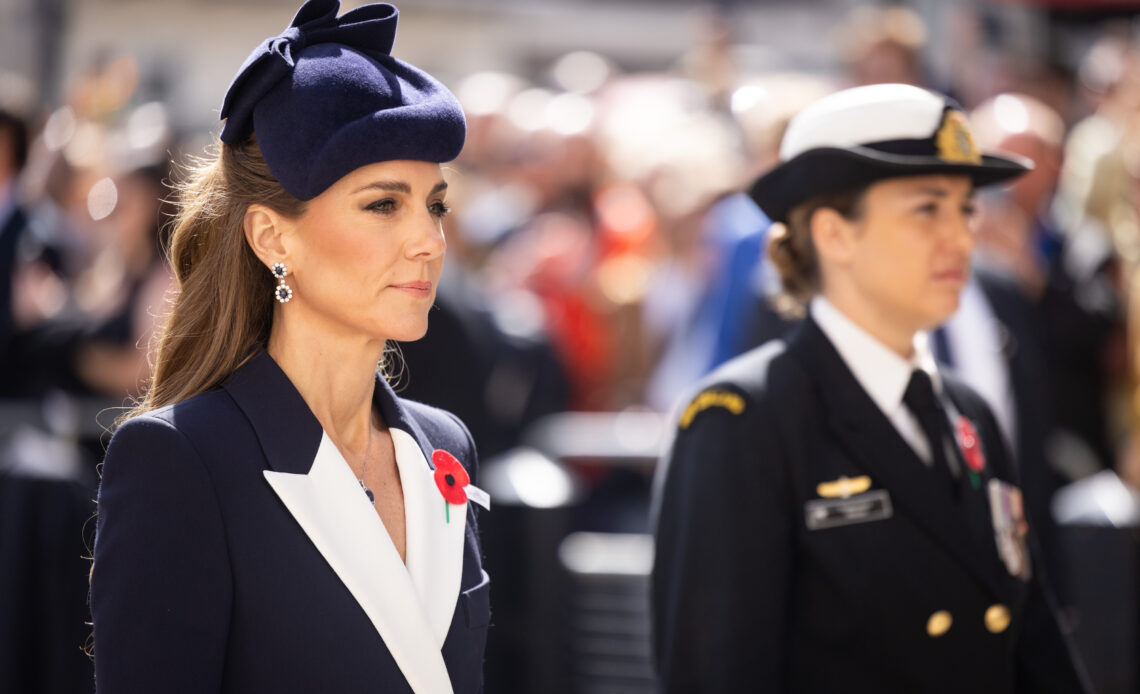
The Princess of Wales, Catherine, undertook a solemn duty on Anzac Day, April 25th, by laying a wreath at the Cenotaph in London, a poignant act of remembrance for Australian and New Zealand military personnel who have made the ultimate sacrifice in conflict. Her Royal Highness’s presence underscored the enduring bond between the United Kingdom and the Commonwealth nations, particularly in honouring the shared history of military service and sacrifice.
The Princess, dressed in a dignified navy coat with contrasting white lapels, placed a wreath bearing the Prince of Wales’s feather onto the step of the iconic monument. The act was accompanied by a respectful bow of her head, a visible manifestation of the profound respect and gratitude felt for the courage and dedication of those commemorated. This significant act of commemoration took place amidst a solemn ceremony attended by a distinguished gathering, including Lord Coaker, the Defence Minister, and senior military representatives from the United Kingdom, Australia, and New Zealand. The presence of these figures highlights the international dimension of Anzac Day and the shared commitment to remembering those who have fallen.
A Day of Solemn Reflection and Shared Heritage
Anzac Day, observed annually on April 25th, marks the anniversary of the first major military action undertaken by Australian and New Zealand forces during the First World War. On this day in 1915, the Australian and New Zealand Army Corps (ANZAC) landed on the shores of Gallipoli, Turkey. While the campaign was ultimately unsuccessful militarily, the courage, resilience, and camaraderie displayed by the ANZAC troops became a foundational moment in the national consciousness of both Australia and New Zealand, forging a unique and lasting legacy of remembrance.
The commemoration in London served as a focal point for acknowledging this shared history. The service at the Cenotaph brought together serving military personnel, veterans, representatives from veteran associations, and dignitaries from Commonwealth nations. Prior to the wreath-laying ceremony, a dignified parade of service personnel, veterans, and representatives marched to the Cenotaph, a visual spectacle of unity and respect. This procession symbolizes the continuity of service and the ongoing connection between past and present generations of military personnel.
A Royal Day of Remembrance: From Dawn Till Dusk
The Princess of Wales’s participation in the Cenotaph ceremony was part of a day filled with royal engagements dedicated to Anzac Day commemorations. Earlier in the morning, the Princess Royal, Princess Anne, represented the Royal Family at the traditional dawn service held at Wellington Arch. As the first light broke, Princess Anne laid a wreath, adorned with a handwritten card, at the memorial. This early morning service, a deeply symbolic act, mirrors the time of the original Gallipoli landings, offering a quiet and contemplative start to the day’s remembrances.
The dawn service itself is characterized by its solemnity and quiet reflection. It typically includes a moment of profound silence, the evocative sounding of the Last Post, and readings of poetry and scripture, often accompanied by somber music. These elements combine to create an atmosphere of deep reverence, allowing attendees, including veterans and their families, to pay their respects in a deeply personal and communal manner. Louise Sandher-Jones, the Minister for Veterans and People, stood alongside Princess Anne at this early commemoration, reinforcing the government’s commitment to honouring the sacrifices of servicemen and women.
Later in the day, the Princess of Wales was also scheduled to attend a service at Westminster Abbey, further demonstrating the Royal Family’s consistent and unwavering support for Anzac Day observances. The duality of these engagements, with Princess Anne leading the dawn service and the Princess of Wales participating in the main Cenotaph ceremony and attending Westminster Abbey, highlights the importance the Royal Family places on this day of remembrance and the coordinated effort to honour the sacrifices made by Commonwealth forces.
The Significance of the Cenotaph and the Poppy
The Cenotaph, meaning "empty tomb" in Greek, stands as a national monument to the fallen in Whitehall, London. Designed by Sir Edwin Lutyens, it was unveiled in 1920 and has since become the focal point for national remembrance ceremonies, including Remembrance Day in November and Anzac Day commemorations. Its minimalist design, devoid of inscriptions, allows it to serve as a universal symbol of sacrifice for all those who have given their lives in service. The act of laying a wreath, particularly one adorned with the Prince of Wales’s feather, is a powerful symbolic gesture of the continuity of royal recognition and support for military personnel and their families.
The red poppy, a ubiquitous symbol of remembrance, gained prominence following the publication of the poem "In Flanders Fields" by John McCrae, a Canadian physician and poet who served in the Second Battle of Ypres. The poem vividly describes the poppies that bloomed on the battlefields of Flanders, becoming a potent metaphor for the blood spilled and the lives lost. Today, the wearing of poppies, particularly around Remembrance Day and Anzac Day, is a widespread practice, signifying solidarity with those who have served and a commitment to remembering their sacrifices. The presence of a poppy on the wreath laid by the Princess of Wales reinforces this deeply ingrained tradition of commemoration.

Supporting Data and Historical Context
The Anzac landings at Gallipoli in 1915 were a critical, albeit costly, engagement in the First World War. Approximately 11,500 Australian and New Zealand soldiers died during the eight-month campaign, with over 26,000 wounded. The sheer scale of loss, coupled with the bravery exhibited by the ANZAC troops, profoundly impacted the national identities of both Australia and New Zealand, shaping their understanding of themselves as distinct nations with a shared history of courage and resilience.
The tradition of royal attendance at Anzac Day ceremonies is well-established, with various members of the Royal Family regularly participating in commemorations in both the UK and Commonwealth countries. In 2025, for instance, the Princess Royal travelled to Gallipoli, Turkey, to mark the 110th anniversary of the landings, a testament to the enduring significance of the event and the Royal Family’s commitment to acknowledging it. The coordinated presence of Princess Anne and the Princess of Wales this year signifies a deliberate and important continuation of this tradition, ensuring that the sacrifices of the ANZACs are continually honoured and remembered by successive generations.
Broader Implications and National Unity
The participation of senior members of the Royal Family in Anzac Day commemorations serves several crucial functions. Firstly, it reinforces the historical and ongoing ties between the United Kingdom and Australia and New Zealand, highlighting shared values and a common commitment to democracy and freedom. Secondly, it provides a focal point for national remembrance, drawing public attention to the importance of honouring military service and sacrifice. For veterans and their families, these ceremonies offer a vital opportunity to feel acknowledged and appreciated, ensuring that their experiences and sacrifices are not forgotten.
The presence of the Princess of Wales at the Cenotaph, in particular, resonates with a growing recognition of her role as a prominent figure in public life and her dedication to supporting various charitable causes, including those related to military families and veterans. Her dignified participation in such solemn occasions underscores her commitment to these important national duties and her understanding of their significance.
The Anzac Day commemorations, from the solemn dawn services to the wreath-laying ceremonies and marches, are not merely historical retrospectives. They are living traditions that foster a sense of national identity, promote intergenerational understanding, and reinforce the values of courage, sacrifice, and mateship. By continuing to participate in these events, the Royal Family plays an integral role in ensuring that the lessons learned from past conflicts continue to inform the present and shape a future that values peace and remembers those who fought to secure it. The enduring legacy of the ANZACs serves as a powerful reminder of the human cost of conflict and the importance of striving for a world where such sacrifices are no longer necessary.