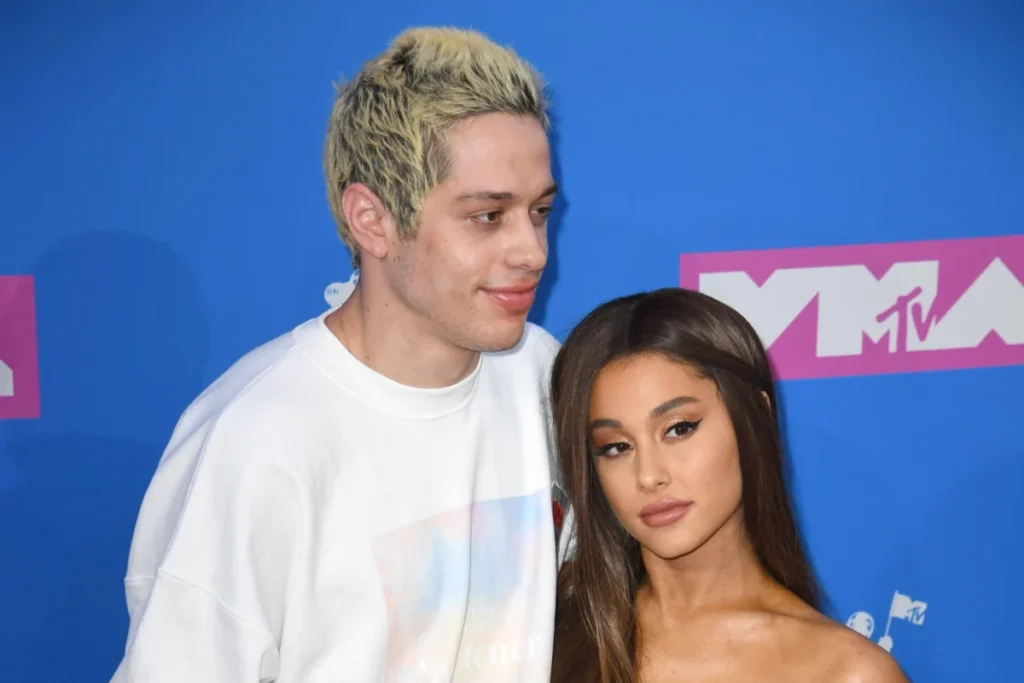

Comedian and actor Pete Davidson has publicly come to the defense of his former fiancée, Ariana Grande, as she faces an unrelenting wave of scrutiny regarding her physical appearance and personal life. The discourse surrounding the 33-year-old singer and actress has intensified in recent months, fueled by her high-profile press tours for the cinematic adaptation of Wicked and its sequel, Wicked: For Good. Davidson, who was engaged to the pop star in 2018, characterized the ongoing negative commentary as deeply unfair and disproportionate to the realities of her life as an entertainer.
A Career Defined by Constant Public Scrutiny
Ariana Grande’s transition from a teenage star on Nickelodeon to one of the world’s most recognizable musical icons has been accompanied by perpetual public interest. Throughout her career, every stylistic shift, relationship, and professional move has been dissected by media outlets and social media users alike. The recent cycle of criticism appears to be a culmination of years of scrutiny, reaching a fever pitch following her critically acclaimed performance as Glinda in Wicked.
Despite the success of the film—which earned both Grande and her co-star Cynthia Erivo prestigious Oscar nominations—the public narrative has often veered away from their artistic contributions. Instead, much of the discourse has focused on their personal rapport and, more specifically, Grande’s physical transformation. Grande has previously attempted to address these comments on social media, issuing a poignant reminder to her millions of followers that speculating about or commenting on a person’s body is inherently harmful and should be avoided.

Davidson’s Stance on Media Interference
In a candid interview with Variety, Davidson expressed his frustration with the way the public treats his ex-fiancée. "I don’t like it at all. It’s not cool," Davidson stated, emphasizing that he has witnessed her resilience firsthand. While he expressed confidence in her ability to navigate these pressures, he did not mince words regarding the toxicity of the situation. "She knows how to handle this stuff, though. She’s been around. So she’ll be OK, but I think it’s f***** up."
Davidson’s defense of Grande is rooted in his own complex relationship with fame. Having been a fixture in tabloid headlines for his high-profile romances with figures such as Margaret Qualley, Kaia Gerber, Phoebe Dynevor, and Kim Kardashian, he is acutely aware of how the public’s fascination with his private life often eclipses his professional achievements. He admitted that the constant focus on his romantic history is "confusing" and noted that while he accepts the consequences of his own choices, the intensity of the "zeroed-in" focus on his life—and the lives of those he dates—remains a source of professional frustration.
The Anatomy of Celebrity Exposure
The pressure of living under a constant microscope is a theme that has persisted throughout Davidson’s career. His nine-month relationship with Kim Kardashian served as a prime example of the extreme nature of modern celebrity exposure. Reflecting on that period, Davidson described the logistical and emotional toll of being perpetually followed by paparazzi, living with constant security, and the necessity of looking over his shoulder.
"The craze of that lifestyle—being followed everywhere, having security and looking over your shoulder—for a guy with mental stuff, and at the time drug problems, was a little too much for me," he explained. He noted, however, that he was never coerced into that lifestyle and maintained that Kardashian remained "super respectful" throughout their time together. His account highlights the often-overlooked mental health implications of high-stakes celebrity, where the boundary between public persona and private identity becomes increasingly porous.

Perspectives on Public Meltdowns and Mental Health
In a broader assessment of the industry, Davidson also reflected on the struggles of other public figures, specifically addressing the recent controversies surrounding Kanye West (Ye). Davidson, who has been transparent about his own struggles with mental health and addiction, suggested that the public often lacks empathy for stars who reach a breaking point under the weight of constant provocation.
"When people are so far up your ass and constantly pushing and provoking you and not showing you love, you want to burn it all," Davidson noted. Regarding West, who has been the subject of significant backlash due to erratic behavior and antisemitic remarks, Davidson offered a nuanced perspective: "I think it got to a certain point where he was like, ‘Leave me the f*** alone. I’m just going to say crazy shit.’ There’s zero way he really feels like that."
Davidson’s comments point toward a growing trend in celebrity discourse: the realization that the "parasocial" relationship between stars and the public can devolve into a form of harassment that exacerbates existing mental health vulnerabilities. When a public figure, like West or Grande, is subjected to relentless judgment, the reaction is often categorized as a "meltdown" rather than a response to sustained pressure.
The Broader Impact: Why Body Commentary Matters
The scrutiny faced by Grande is not an isolated incident but part of a wider cultural conversation regarding the objectification of women in the spotlight. Media analysts have long argued that the focus on a woman’s body—especially as she matures in the public eye—is a mechanism used to diminish her professional achievements. By fixating on weight or physical appearance, the media effectively marginalizes the substantive work an artist has produced, such as a major Oscar-nominated film performance.

Studies on media coverage of female celebrities suggest that when a woman achieves a high level of professional success, the "backlash" often manifests as criticism of her appearance. This serves to "re-center" the narrative on her physical self rather than her professional agency. Grande’s own attempts to pivot this conversation have been met with mixed results, illustrating the difficulty of reclaiming one’s narrative in a digital age where the audience feels entitled to comment on every facet of a star’s existence.
Implications for the Future of Fame
As the entertainment industry evolves, the tension between the public’s "right to know" and the individual’s right to privacy continues to widen. Davidson’s reflections serve as a cautionary tale about the cost of fame. His acknowledgement that his work is "overlooked" because of his public profile underscores a fundamental flaw in how society consumes celebrity content: we prioritize the spectacle of the individual over the quality of their craft.
For Ariana Grande, the decision to step back from the spotlight following her Eternal Sunshine tour is a strategic move to regain agency. It is a common tactic for stars to retreat from the public eye when the discourse becomes unmanageable, allowing them to recalibrate and return on their own terms. However, the ease with which the public engages in negative commentary remains a systemic issue.
Conclusion: A Call for Media Responsibility
Pete Davidson’s intervention, while brief, highlights a critical need for a more empathetic approach to celebrity culture. His defense of Grande and his observations regarding West suggest that the current model of media consumption is unsustainable for those at its center. Whether the discourse involves body shaming or the public monitoring of mental health, the impact on the individual is profound.

As the industry moves forward, the question remains whether audiences will prioritize the artistic contributions of performers over the invasive, and often harmful, narratives created around their personal lives. For now, the sentiment expressed by Davidson remains a poignant reminder of the humanity behind the headlines: these are individuals navigating high-pressure environments, often struggling to maintain their sense of self while the world watches, judges, and critiques.