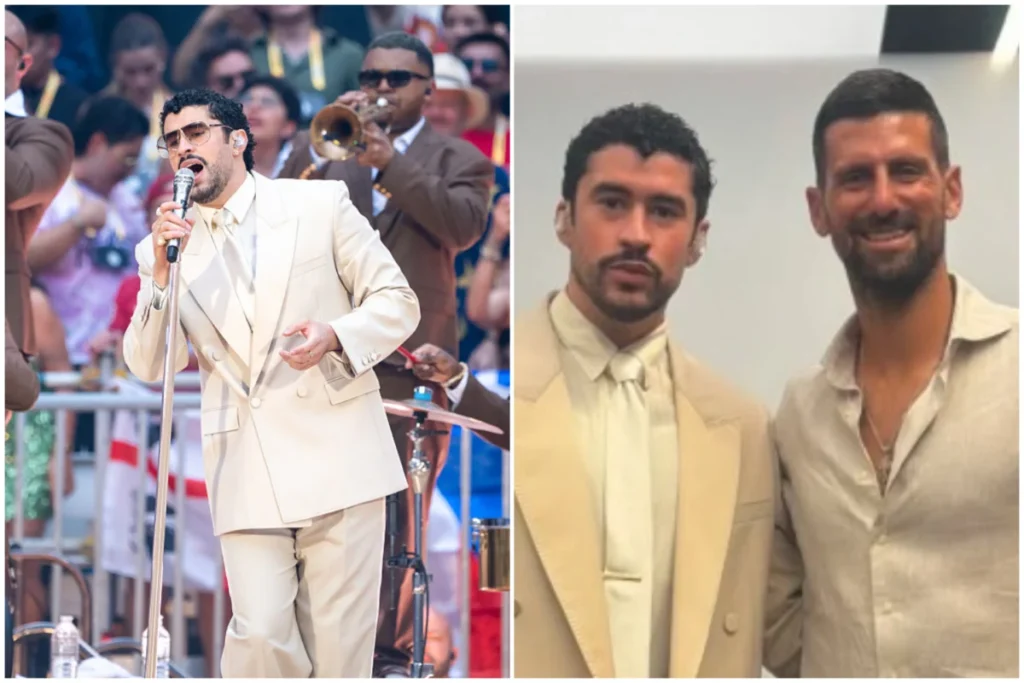

In a significant cultural convergence that underscored the increasing global reach of Latin American music and the multifaceted public persona of elite athletes, tennis icon Novak Djokovic made a high-profile appearance at Bad Bunny’s historic concert at Tottenham Hotspur Stadium. The Serbian superstar introduced a song for the Puerto Rican rapper, who etched his name into music history by becoming the first Latin American artist to headline a UK stadium. This landmark event, held on the first of two sold-out nights on June 28, 2026, drew a colossal crowd of approximately 50,000 attendees, including a constellation of celebrities, as Djokovic prepares to launch his bid for an unprecedented 25th Grand Slam title at Wimbledon.
Bad Bunny’s Historic UK Debut: A Milestone for Latin Music
Benito Antonio Martínez Ocasio, globally recognized as Bad Bunny, delivered a performance that was not merely a concert but a cultural statement. His sold-out engagement at Tottenham Hotspur Stadium marked a pivotal moment for Latin American music, shattering previous barriers and firmly establishing the genre’s mainstream dominance in traditionally non-Latin markets. Bad Bunny, renowned for his innovative blend of Latin trap, reggaeton, and a myriad of other influences, has consistently pushed artistic boundaries since his emergence in the mid-2010s. His discography, boasting critically acclaimed albums like "X 100PRE," "YHLQMDLG," and "Un Verano Sin Ti," has garnered him numerous accolades, including multiple Grammy Awards and Latin Grammy Awards. "Un Verano Sin Ti," released in 2022, notably became the first Spanish-language album to be nominated for Album of the Year at the Grammy Awards and broke streaming records worldwide, solidifying his status as the most streamed artist globally on platforms like Spotify for consecutive years.
This achievement in London represents the culmination of years of relentless artistic endeavor and a testament to the artist’s immense global appeal. For an artist from Puerto Rico to command a stadium of such magnitude in the UK is a powerful symbol of cultural osmosis, demonstrating how authentic artistry transcends linguistic and geographical confines. It sends a resounding message to aspiring Latin American artists that the global stage is not only accessible but conquerable. The decision to embark on a multi-night stadium residency in London, part of his widely acclaimed "Most Wanted Tour," underscored the strategic intent to solidify his presence in the European market, building upon his already formidable success across the Americas.
The Spectacle at Tottenham Hotspur Stadium: A Fusion of Culture and Celebrity
The atmosphere within Tottenham Hotspur Stadium was electric, a vibrant tapestry of diverse cultures converging to celebrate Bad Bunny’s groundbreaking performance. The state-of-the-art venue, primarily known as the home of Tottenham Hotspur Football Club, has increasingly established itself as a premier destination for major international music acts, leveraging its impressive capacity and modern infrastructure. With approximately 50,000 fans filling every corner, the sheer scale of the event was palpable, a testament to Bad Bunny’s draw. The crowd, a mix of ardent Latin music enthusiasts, curious newcomers, and a significant contingent of the Latin American diaspora in the UK, created a unique energy that resonated throughout the stadium.
.jpg?width=1200&&quality=75)
Among the throng of ecstatic fans, several high-profile personalities were spotted, further elevating the event’s cultural cachet. Renowned British singer Adele and popular television presenter Maya Jama were observed enjoying the spectacle, their presence highlighting the broad appeal of Bad Bunny’s music across various demographics and celebrity circles. However, it was the appearance of Novak Djokovic that truly captivated headlines and sparked widespread discussion. Djokovic, a figure synonymous with sporting excellence and intense focus, offered a rare glimpse into his off-court interests, signaling a relaxed demeanor just days before arguably the most significant tournament of his career. His interaction with Bad Bunny, captured in a backstage photograph shared on social media, quickly went viral, illustrating the intriguing crossover appeal between seemingly disparate worlds of global sport and music. The image depicted a jovial Djokovic, exchanging pleasantries with the Puerto Rican star, a moment of shared admiration between two titans in their respective fields.
Djokovic’s Pre-Wimbledon Appearance: A Strategic Display of Serenity
At 39 years old, Novak Djokovic stands at a critical juncture in his illustrious career. His pursuit of an elusive 25th Grand Slam title at Wimbledon, a feat that would further cement his status as the undisputed greatest male tennis player of all time, carries immense pressure. Yet, his decision to attend, and even participate in, Bad Bunny’s concert, offered a compelling insight into his mental preparation. Far from the monastic focus often associated with elite athletes on the cusp of major competitions, Djokovic appeared remarkably relaxed and engaged. This public display of leisure could be interpreted as a deliberate strategy to maintain mental equilibrium, a testament to his understanding that peak performance requires not just physical conditioning but also psychological well-being.
For a player who has consistently demonstrated unparalleled mental fortitude under pressure, this outing suggests a calculated approach to managing the immense expectations. By immersing himself in a vibrant cultural event, Djokovic might be consciously seeking to detach from the immediate pressures of the tennis circuit, returning to his preparations refreshed and invigorated. His willingness to step onto the stage, even for a brief introduction, also humanizes the often-stoic champion, showcasing a side of his personality that resonates with a broader audience beyond the tennis court. It subtly reinforces his global icon status, demonstrating his engagement with contemporary popular culture and connecting him with a younger, more diverse fanbase.
Cultural Fusion and Global Reach: Bridging Worlds
The unexpected collaboration, however brief, between Djokovic and Bad Bunny epitomizes a growing trend of cultural fusion, where the worlds of sport, music, and entertainment increasingly intersect. Both individuals are global phenomena, each commanding massive followings and representing the pinnacle of their respective professions. Djokovic, with his record-breaking achievements and universal recognition, and Bad Bunny, with his revolutionary impact on global music and youth culture, embody diverse forms of excellence. Their interaction at Tottenham Hotspur Stadium served as a powerful symbol of how shared admiration for talent and cultural expression can bridge seemingly disparate spheres.
This cross-cultural moment also highlights the globalized nature of modern celebrity. In an interconnected world, boundaries between different forms of entertainment are blurring, and audiences are increasingly drawn to figures who transcend traditional categories. For Bad Bunny, the endorsement from a sporting legend like Djokovic undoubtedly amplified the visibility of his historic UK concert within new demographics. For Djokovic, it showcased his openness to different cultures and forms of artistic expression, further enhancing his already extensive global appeal. This synergy creates a ripple effect, drawing attention to both artists and their respective fields from unexpected corners of the world.

Bad Bunny’s Message of Solidarity: A Platform for Advocacy
Beyond the dazzling spectacle and celebrity attendance, Bad Bunny utilized his monumental platform to deliver a poignant message of solidarity. During his performance, he addressed the audience regarding the recent devastating earthquake in Venezuela, offering words of comfort and support to the victims. This act underscored his consistent commitment to social consciousness and his role as a voice for Latin American communities facing adversity. The earthquake, which had struck Venezuela earlier in the year, caused significant damage and displacement, prompting international humanitarian efforts. By drawing attention to this crisis on such a grand stage, Bad Bunny not only raised awareness but also reinforced the responsibility that global artists bear in leveraging their influence for humanitarian causes.
This wasn’t an isolated incident for Bad Bunny; throughout his career, he has consistently used his music and public appearances to advocate for social justice, LGBTQ+ rights, and the representation of Latin American culture. His decision to highlight the Venezuelan crisis resonated deeply with many in the audience, particularly those from Latin American backgrounds, who viewed it as a powerful demonstration of empathy and community solidarity. It transformed the concert from a purely entertainment event into a moment of collective reflection and compassion, showcasing the profound impact artists can have beyond their musical contributions.
The Rise of Latin American Music: An Irreversible Global Phenomenon
Bad Bunny’s historic UK stadium debut is not an anomaly but rather a significant marker in the ongoing global ascendance of Latin American music. For decades, Latin music struggled to penetrate mainstream Anglophone markets outside niche communities. However, driven by digital streaming platforms, social media, and a new generation of innovative artists, genres like reggaeton, Latin trap, and urbano have become global juggernauts. Data from industry reports consistently show Latin music as one of the fastest-growing genres globally, with significant increases in listenership and revenue across continents. Artists like Shakira, Ricky Martin, and Luis Fonsi (with "Despacito") paved the way, but Bad Bunny, J Balvin, Karol G, and others have truly cemented Latin music’s irreversible status as a global pop culture force.
The UK, a market historically dominated by British and American pop and rock, has increasingly embraced Latin sounds. Concerts by Latin artists are regularly selling out large venues, and Spanish-language songs frequently chart on the Official UK Singles Chart. This cultural shift reflects a broader global interconnectedness and a growing appreciation for diverse musical expressions. Bad Bunny’s achievement at Tottenham Hotspur Stadium serves as a powerful testament to this evolution, demonstrating that language is no longer a barrier to global musical success and that authentic cultural expression can resonate with audiences worldwide.
Djokovic’s Quest for History at SW19: The Road to 25

As the curtain falls on Bad Bunny’s London spectacle, all eyes now turn to Wimbledon, or "SW19" as it’s affectionately known. For Novak Djokovic, the grass courts of the All England Lawn Tennis and Croquet Club represent the stage for his most ambitious pursuit: a 25th Grand Slam title. Having already surpassed his rivals Roger Federer and Rafael Nadal in the men’s Grand Slam count, Djokovic is now chasing Margaret Court’s all-time record of 24 major singles titles, a benchmark he equaled at the Australian Open earlier in the year. A victory at Wimbledon would not only break this hallowed record but also further solidify his claim as the greatest of all time in tennis history.
Djokovic’s dominance at Wimbledon is well-documented. He has lifted the Gentlemen’s Singles trophy multiple times, his tactical brilliance and unparalleled grass-court movement making him a formidable opponent. His preparation for this tournament is always meticulous, involving precise training regimens and a carefully managed schedule. His appearance at the Bad Bunny concert, therefore, provides a fascinating contrast to his usual pre-tournament routine, suggesting a conscious effort to balance intense professional focus with moments of personal enjoyment and cultural engagement. This psychological approach, prioritizing mental freshness alongside physical readiness, could prove to be a crucial factor in his quest for historical supremacy on the hallowed lawns of Wimbledon. The world will watch with bated breath as he embarks on this historic campaign, aiming to once again rewrite the record books.
Reactions and Broader Implications: A New Era of Global Entertainment
The immediate reactions to Djokovic’s appearance and Bad Bunny’s historic concerts were overwhelmingly positive. Social media platforms buzzed with excitement, with fans from both tennis and music worlds expressing surprise and delight at the unexpected crossover. Official statements from concert organizers and venue management lauded the event as a resounding success, highlighting the seamless execution and the stadium’s capacity to host world-class musical acts. Inferred reactions from Bad Bunny would likely include immense gratitude for the fan support and a sense of pride in breaking new ground for Latin American artists, emphasizing the importance of cultural representation on a global scale. Djokovic, while unlikely to issue a formal statement, would likely convey through his actions and body language a sense of relaxation and enjoyment, reaffirming his diverse interests outside of professional tennis.
The broader implications of this event are significant. For the music industry, it signals a continued shift in global power dynamics, with Latin American artists increasingly dictating trends and expanding their market reach. It challenges traditional notions of what constitutes a "global" superstar and demonstrates the power of authentic cultural expression to transcend linguistic barriers. For the world of sports, it highlights the evolving public image of athletes, who are increasingly engaging with popular culture and showcasing their personalities beyond their athletic achievements. The synergy between Djokovic and Bad Bunny represents a new era of global entertainment, where boundaries are fluid, cultures intertwine, and iconic figures from diverse fields can converge to create moments of shared celebration and cultural significance. This convergence not only enriches the lives of fans but also paves the way for greater understanding and appreciation across different cultural landscapes.