
The Metropolitan Museum of Art’s Costume Institute Benefit, universally known as the Met Gala, stands as an unparalleled confluence of high fashion, celebrity culture, and significant philanthropy, annually drawing the world’s gaze to its iconic red carpet. This year’s highly anticipated event, typically held on the first Monday of May, is poised to once again transform the steps of the Metropolitan Museum of Art in New York City into a global stage for sartorial innovation and artistic expression. With the theme declared as ‘Fashion is Art’, guests are invited to delve into a profound exploration of clothing as an embodied art form, celebrating its countless depictions throughout art history and pushing the boundaries of conventional dress.
Understanding the Met Gala: Fashion’s Foremost Philanthropic Endeavor
At its heart, the Met Gala is the primary annual fundraiser for the Metropolitan Museum of Art’s Costume Institute, officially named the Anna Wintour Costume Center. The institute is a curatorial department dedicated to collecting, preserving, exhibiting, and interpreting dress from across diverse cultures and historical periods. The millions raised each year from the Gala are crucial for the Costume Institute’s operational budget, enabling it to mount groundbreaking exhibitions, acquire significant pieces for its vast collection, and fund scholarly research and publications. Without the Gala’s proceeds, the Costume Institute, uniquely among the Met’s departments, would struggle to maintain its extensive programs and its global reputation as a leading center for fashion scholarship. The event also serves as the grand opening celebration for the institute’s highly anticipated spring exhibition, with the year’s theme often directly correlating to the exhibition’s subject matter. This year’s dress code, "Fashion is Art," encourages attendees to reflect their personal relationship with fashion as a creative discipline, aligning seamlessly with the exhibition’s potential exploration of artistic craftsmanship and historical narratives within attire.
A Rich History: From Society Dinner to Global Spectacle
The Met Gala’s origins trace back to 1948 when it was conceived by fashion publicist Eleanor Lambert. Initially, it was a more modest affair: a midnight dinner that served as a fundraising event for the then-fledgling Costume Institute. Attendees, primarily New York high society, paid a fifty-dollar ticket price to support the institution. For decades, the Gala remained largely a local social event, a fixture on the city’s calendar but without the international media frenzy it now commands.

The event began its significant transformation in the 1970s under the legendary editorship of Diana Vreeland, who joined the Costume Institute as a consultant after leaving Vogue. Vreeland injected theatricality and conceptual themes into the Gala, inviting celebrities and infusing the evening with a vibrant, avant-garde spirit. Her influence shifted the focus from merely a social gathering to a curated cultural event, laying the groundwork for its future prominence.
However, it was under the stewardship of Dame Anna Wintour, editor-in-chief of American Vogue since 1988, that the Met Gala ascended to its current status as a global phenomenon. Wintour took over as chair in 1995 and meticulously reshaped the event. She tightened the guest list, making it one of the most exclusive invitations in the world, and elevated the red carpet into an unprecedented platform for artistic expression and high-stakes fashion. Her vision transformed the Gala from a prominent society dinner into "fashion’s biggest night," a meticulously orchestrated blend of art, commerce, and philanthropy that garners billions of media impressions worldwide. The event typically raises upwards of $15 to $20 million annually, with individual tickets often costing $50,000 and tables sponsored by major brands ranging from $200,000 to $300,000 or more. This substantial financial contribution ensures the Costume Institute’s continued vitality and ability to produce world-class exhibitions.
The Mechanics of the Met Gala: Crafting the Annual Extravaganza
The preparation for the Met Gala is an intricate process that spans months, orchestrated with military precision by Vogue and the Metropolitan Museum of Art. The theme, which guides the dress code and the corresponding exhibition, is typically announced well in advance, allowing designers ample time to conceptualize and create bespoke garments. This year’s ‘Fashion is Art’ theme, for instance, provides a broad yet profound canvas for interpretation, inviting designers and celebrities to explore historical references, abstract concepts, and the very essence of artistic creation through textiles and silhouettes.
The guest list, famously curated by Anna Wintour herself, is perhaps the most exclusive aspect of the event. With approximately 400-600 attendees, invitations are highly sought after and are extended to a mix of established and emerging figures from fashion, film, music, art, sports, and politics. This deliberate curation ensures a dynamic blend of cultural influencers and industry titans, all converging for a shared purpose. Brands often purchase tables, inviting their ambassadors and muses, further intertwining the event with the commercial aspects of the fashion industry.
On the night itself, the proceedings commence with the much-anticipated red carpet arrivals. This is where the world witnesses the interpretations of the theme come to life, often sparking immediate global discourse and setting fashion trends for the year. Following the red carpet spectacle, guests proceed to a cocktail hour, which includes a private viewing of the Costume Institute’s new exhibition. The evening culminates in an elaborate dinner and often features a high-profile musical performance, maintaining the sense of grandeur and exclusivity that defines the event.

The Red Carpet: A Canvas for Artistic Expression and Controversy
The Met Gala red carpet is arguably its most celebrated component, serving as a dynamic runway where celebrities and designers collaborate to present unforgettable, and sometimes provocative, interpretations of the annual theme. These moments often transcend mere fashion, becoming cultural touchstones and sparking widespread debate.
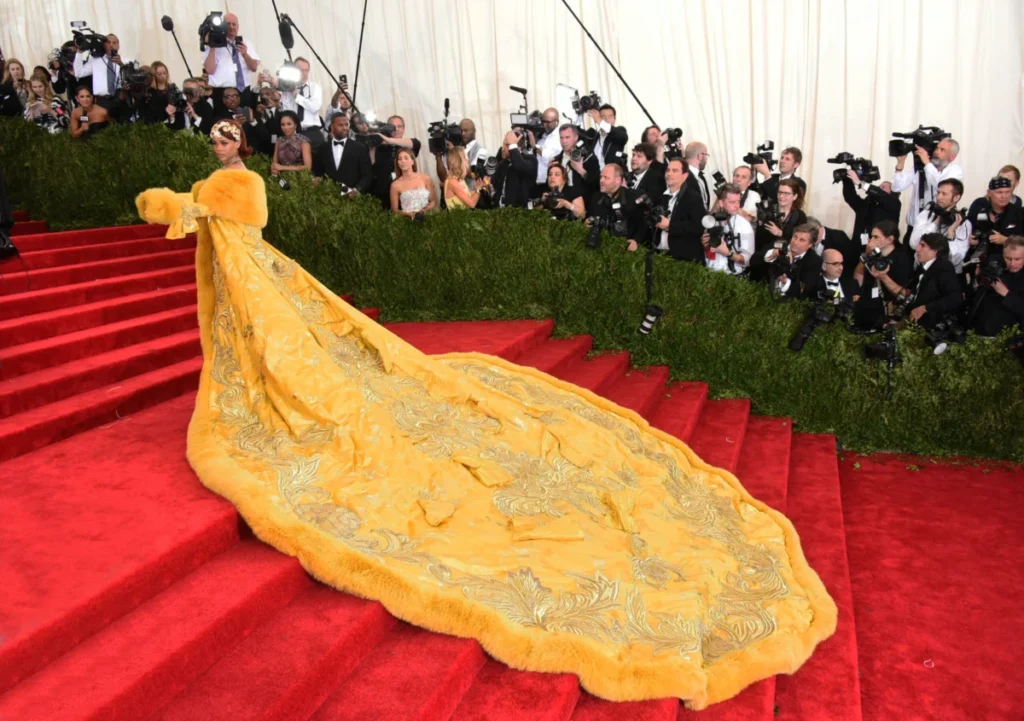
One of the most enduring images belongs to Rihanna, who, for the 2015 "China: Through the Looking Glass" theme, wore a magnificent canary yellow imperial cape by Chinese designer Guo Pei. The hand-embroidered, fur-trimmed garment, which took two years to create, boasted an enormous train that cascaded down the museum steps, cementing its place in Met Gala lore as an epitome of thematic commitment and artistic grandeur.
In 2018, for the "Heavenly Bodies: Fashion and the Catholic Imagination" theme, Rihanna once again commanded attention, this time arriving in a Maison Margiela Artisanal papal mitre and a jewel-encrusted mini dress and matching coat. Her audacious interpretation was widely lauded for its fearless commitment to the theme, though it also ignited conversations about the boundaries of religious appropriation and artistic expression within fashion. This look perfectly encapsulated the Gala’s capacity to both celebrate and challenge cultural norms.
Kim Kardashian, known for her bold fashion choices, created a memorable stir at the 2021 "In America: A Lexicon of Fashion" Gala. She arrived enveloped head-to-toe in a black Balenciaga catsuit, concealing her entire face and body. The controversial look forced viewers to focus purely on her silhouette and the conceptual statement of anonymity in an age of hyper-visibility, becoming an instant meme and sparking intense discussion about celebrity, identity, and the power of fashion to subvert expectations.
Another notable moment was Blake Lively’s transformative Versace gown at the 2022 "In America: An Anthology of Fashion" Gala. Her copper-toned dress dramatically unfurled on the red carpet to reveal a striking teal patina underneath, symbolizing the oxidation of New York City architecture. This illustrative piece demonstrated how fashion can tell a narrative and embody a moment in history with exquisite craftsmanship.

These instances underscore the Met Gala’s unique position as a platform where fashion becomes a performative art, pushing conversations about design, identity, and cultural commentary into the global spotlight.
Behind the Scenes: The Co-Chairs and Host Committee
The success of the Met Gala is also heavily reliant on its carefully selected leadership. Dame Anna Wintour remains the unwavering co-chair, a constant presence whose influence shapes every aspect of the event. Each year, she is joined by a rotating cast of co-chairs—typically a blend of influential figures from the worlds of entertainment, sports, and business—who lend their star power and cultural cachet to the fundraiser. For this year’s iteration, an impressive roster of co-chairs includes iconic artist Beyoncé, Academy Award-winning actress Nicole Kidman, and tennis legend Venus Williams, alongside Amazon founder Jeff Bezos and his wife Lauren Sanchez Bezos, who also serve as key sponsors of the event. Their involvement not only amplifies the Gala’s visibility but also helps to attract a diverse array of guests and financial backing.
Furthermore, Anna Wintour handpicks a host committee, a group of prominent celebrities and industry figures who contribute to the event’s prestige and outreach. This year’s committee features Yves Saint Laurent creative director Anthony Vaccarello and acclaimed actress Zoe Kravitz, alongside pop sensation Sabrina Carpenter, US rapper Doja Cat, and "One Battle After Another" star Teyana Taylor. This diverse group ensures broad appeal and representation across various cultural spheres, reflecting the Met Gala’s ever-expanding reach beyond traditional fashion circles. Their collective presence underscores the event’s role as a nexus where different facets of global culture converge, all united in celebrating fashion’s artistic merit and supporting a vital cultural institution.
How to Watch the Spectacle Unfold
For those eager to witness the glamour and artistry live, the Met Gala is streamed across Vogue‘s official digital platforms, including their YouTube channel and TikTok account. This accessibility allows a global audience to experience the red carpet arrivals in real-time, engaging with the fashion statements and celebrity interactions as they unfold. For viewers in the UK, the live stream typically commences at 11 pm BST, offering a prime-time window to catch the event’s most visually stunning moments. The digital broadcast often includes expert commentary and interviews with the attendees, providing deeper insights into the thematic interpretations and design choices. Vogue‘s red carpet correspondent, Emma Chamberlain, is once again on duty, bringing her distinctive and often humorous perspective to the live coverage, appealing to a younger, digitally native audience.

Broader Implications: Fashion, Philanthropy, and Popular Culture
Beyond the dazzling spectacle, the Met Gala holds significant broader implications across multiple domains. Culturally, it acts as a powerful barometer for fashion trends and artistic discourse, often dictating the sartorial conversations for the year ahead. Designers view it as an unparalleled opportunity to showcase their most imaginative creations, pushing the boundaries of haute couture and challenging conventional aesthetics. The event legitimizes fashion as a serious art form, deserving of academic study and museum preservation, aligning with the "Fashion is Art" theme.
Economically, the Gala generates substantial media value for participating brands and designers, translating into heightened brand recognition and sales. It also provides a significant boost to New York City’s economy, drawing in an international cohort of celebrities, designers, journalists, and fashion enthusiasts. For celebrities, an invitation to the Met Gala is a definitive marker of status and influence, offering a prime platform for personal branding and making bold statements that resonate globally.
The philanthropic model of the Met Gala is also a subject of analysis. It stands as one of the most successful fundraising events for a cultural institution worldwide, ensuring the financial stability and artistic freedom of the Costume Institute. This unique blend of high-octane glamour and dedicated fundraising exemplifies a powerful synergy between popular culture and institutional support, demonstrating how celebrity and fashion can be leveraged for profound artistic and educational impact. The continuous evolution of the Met Gala ensures its enduring relevance, cementing its place not just as a night of extravagant fashion, but as a pivotal cultural event that continually shapes and reflects the ever-changing landscape of art, celebrity, and philanthropy.