

The global streaming landscape has seen a significant shift in the portrayal of Korean content, moving from the traditional romantic tropes of Hallyu to grittier, more provocative psychological thrillers. Netflix’s original K-Drama A Killer Paradox, also known by its webtoon title Murder DIEary, represents the latest evolution in this trend. Released in early 2024, the series immediately garnered attention not only for its high-profile casting and unique premise but also for its bold, graphic content that challenged the expectations of domestic and international audiences alike. Starring Choi Woo Shik and Son Suk Ku, the series explores the thin line between accidental homicide and vigilante justice, anchored by a narrative that is as visually jarring as it is intellectually stimulating.

A New Frontier in Korean Noir
A Killer Paradox is a black comedy-thriller directed by Lee Chang-hee, who previously gained acclaim for the atmospheric horror series Strangers from Hell. The show is based on the Naver Webtoon of the same name by the creator Kkomabi. The premise centers on Lee Tang, an ordinary college student whose life takes a dark turn after he accidentally kills a man. However, the narrative twist lies in Lee Tang’s realization that his victims are, without exception, heinous criminals who have evaded justice. This "supernatural" intuition or luck transforms a simple murder mystery into a complex character study about morality and fate.
The series features Choi Woo Shik, an actor internationally recognized for his role in the Oscar-winning film Parasite and the romantic drama Our Beloved Summer. Opposite him is Son Suk Ku, whose rugged performances in The Roundup and My Liberation Notes have made him a staple of modern Korean noir. The chemistry between these two leads—one playing a reluctant killer and the other a tenacious detective named Jang Nan Gam—forms the backbone of the series’ high-stakes cat-and-mouse game.

Chronology of the First Episode and the Controversial Encounter
The first episode of A Killer Paradox serves as a masterclass in establishing tension and character motivation. The story begins with Lee Tang working a monotonous shift at a convenience store. His life is portrayed as unremarkable, marked by the typical struggles of a young man in contemporary Seoul. The inciting incident occurs when Lee Tang encounters two middle-aged customers. One of the men appears severely intoxicated and eventually passes out on the street.
When Lee Tang attempts to intervene or assist, he is met with hostility from the second man, Yeo Bu Il. Despite Lee Tang’s polite demeanor, Yeo Bu Il quickly becomes aggressive, escalating from verbal abuse to physical violence. The situation triggers a traumatic memory for Lee Tang, who was a victim of bullying during his school years. In a moment of sheer desperation and self-defense, Lee Tang retaliates. He uses a hammer—which he had borrowed earlier that day to hang a painting in his apartment—to strike Yeo Bu Il, resulting in the man’s death.

The aftermath of the killing is depicted with raw realism. Lee Tang is consumed by panic, struggling with the psychological weight of his actions. However, the plot thickens when the police, led by Detective Jang Nan Gam, begin their investigation. Through a series of improbable events and coincidences, the evidence against Lee Tang is neutralized. More shockingly, the police discover that Yeo Bu Il was not who he appeared to be. He was a serial killer living under a false identity, responsible for a string of horrific crimes. This revelation provides Lee Tang with a twisted sense of validation, setting the stage for his descent into vigilantism.
The Graphic Sex Scene: Narrative Purpose and Viewer Shock
One of the most discussed aspects of the premiere was a graphic sex scene involving Lee Tang. Shortly after learning that his victim was a murderer, Lee Tang attempts to find some form of solace or distraction. After a night of drinking with a friend, he returns to his apartment and engages in a sexual encounter with a woman.

The scene was notably explicit for the K-Drama medium, featuring full-body nudity and a level of intimacy that many viewers found startling, particularly given the show’s early runtime. Netizens and critics alike took to social media to debate the necessity of the sequence. Some argued that the scene felt "unsexy" and "disconnected," which, upon closer analysis, appeared to be the director’s intent.
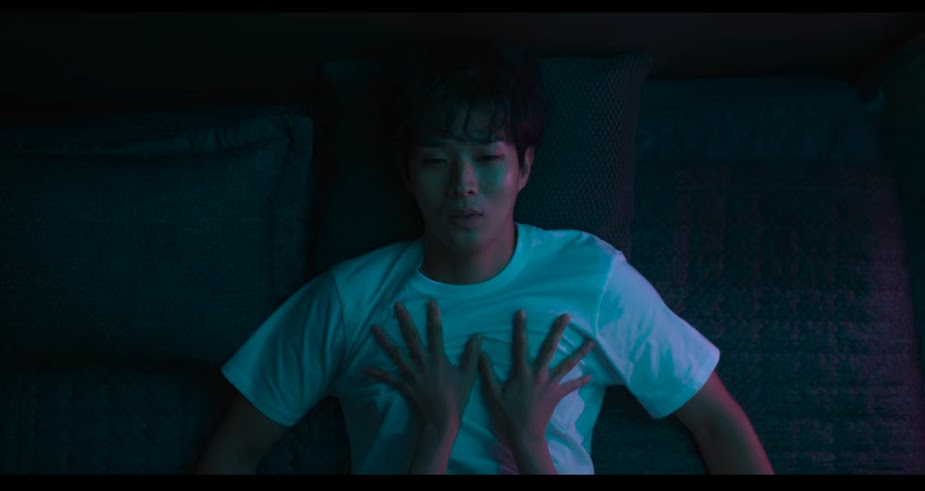
The sequence serves a psychological purpose rather than a titillating one. While Lee Tang is in bed, the woman is shown on top of him, but his expression remains vacant and detached. The experience is interrupted by the haunting voice of Yeo Bu Il, the man he killed. The hallucination taunts him, asking, “Are you consoling yourself, knowing that it was a bad man that you killed? How cunning the human heart is, right?”

The woman suddenly disappears, revealing that the entire encounter may have been a manifestation of Lee Tang’s fractured mental state or a desperate, failed attempt to reclaim his humanity through physical touch. The scene concludes with Lee Tang imagining the victims of the serial killer and symbolically avenging them, cementing his transition from a victim of circumstance to a judge of character.
Production Insights and the Netflix Creative Freedom
The inclusion of such graphic content is a direct result of the creative freedom afforded by global streaming platforms like Netflix. Traditional Korean broadcast networks (such as SBS, KBS, or MBC) are subject to strict regulations by the Korea Communications Standards Commission (KCSC). These regulations often result in the blurring of knives, the censorship of tobacco products, and a significant limitation on sexual content and gore.
By producing A Killer Paradox as a Netflix Original, the creators were able to lean into the "18+" rating, allowing for a more faithful adaptation of the dark and gritty source material. Director Lee Chang-hee has been vocal about his desire to push the boundaries of the thriller genre, focusing on "visual storytelling that reflects the internal chaos of the characters." The use of bold cinematography, including the surreal transitions between reality and Lee Tang’s hallucinations, has been praised for elevating the show above standard crime procedurals.
Supporting Data: The Global Surge of K-Thrillers
The success of A Killer Paradox is part of a broader data trend indicating a high demand for dark Korean content. According to Netflix’s 2023 engagement reports, non-English content accounts for approximately 30% of all viewing on the platform, with Korean dramas consistently occupying the top spots. Thrillers like Squid Game, All of Us Are Dead, and The Glory have paved the way for A Killer Paradox by proving that global audiences are receptive to narratives that explore the darker facets of human nature.

In the first week of its release, A Killer Paradox reached the Top 10 list in over 11 countries, including South Korea, Thailand, and Vietnam. The series currently holds a high rating on platforms like MyDramaList and IMDb, with viewers citing the performances of Choi Woo Shik and Son Suk Ku as the primary draw. The "paradox" of the title—whether it is justifiable to kill those who kill—has sparked widespread discussion on social media, further driving engagement.
Broader Impact and Implications for the Industry
The reaction to the graphic scenes in A Killer Paradox highlights a growing tension within the K-Drama fandom. While international audiences, accustomed to Western standards of television like HBO’s Euphoria or Netflix’s Mindhunter, often find such scenes unremarkable, a segment of the domestic Korean audience remains more conservative. The debate over whether graphic content is "necessary" or "gratuitous" is likely to continue as more Korean creators partner with global streamers.

However, from an industry perspective, A Killer Paradox demonstrates the versatility of Korean actors. Choi Woo Shik’s portrayal of Lee Tang—moving from a wide-eyed student to a cold-blooded vigilante—has been hailed as a career-defining performance. It breaks the "flower boy" mold that many leading men in the industry are often confined to, opening doors for more diverse character work.
Furthermore, the show’s exploration of the "vigilante" theme reflects a recurring societal sentiment in South Korea regarding the perceived leniency of the justice system. Similar themes were explored in Taxi Driver and Vigilante, suggesting that audiences are increasingly drawn to stories where the protagonist takes the law into their own hands to protect the innocent.

Conclusion: The Enduring Paradox
A Killer Paradox is more than just a shocking thriller; it is a sophisticated exploration of guilt, fate, and the ambiguity of justice. While the graphic sequences in the first episode served as an initial "shock factor," they ultimately contribute to a deeper understanding of Lee Tang’s psychological deterioration. As the series progresses, the cat-and-mouse game between Lee Tang and Jang Nan Gam becomes a philosophical debate: Can a person remain "good" while committing "evil" acts for the greater good?
Netflix’s investment in such provocative content ensures that the K-Drama industry will continue to evolve beyond its traditional boundaries. As viewers continue to binge-watch the eight-episode series, the discussions surrounding its themes and its bold creative choices serve as a testament to the show’s impact on the global cultural landscape. Whether one views the graphic scenes as a necessary narrative tool or an unnecessary distraction, there is no denying that A Killer Paradox has successfully captured the world’s attention, cementing its place as a landmark entry in the genre of Korean noir.