
The global hospitality landscape is undergoing a significant paradigm shift as travelers increasingly prioritize the uniqueness of their accommodations over traditional luxury amenities. In an era where "experiential travel" has become the primary motivator for international tourism, the short-term rental market—led by platforms like Airbnb—has evolved to offer homes that are not merely places to stay, but destinations in their own right. This transition from standard hotel rooms to architecturally significant dwellings reflects a broader cultural desire for immersion, privacy, and aesthetic inspiration. From 10th-century fortified castles in the Spanish countryside to avant-garde "organic" structures in the heart of Mexico, the following curated list represents the pinnacle of globally unique stays that challenge the boundaries of residential design and geographical integration.
The Evolution of the Destination Rental Market
According to market data released in 2023, the demand for "unique" categories on short-term rental platforms has outpaced traditional apartment listings by nearly 20%. This trend is driven largely by a post-pandemic desire for seclusion and a growing appreciation for sustainable and culturally resonant architecture. Travelers are no longer satisfied with the sterile uniformity of international hotel chains; they are seeking out properties that tell a story, whether through historical preservation or radical modernism. The "Airbnb Categories" launch in 2022, which highlighted specific architectural styles such as "Design," "Castles," and "OMG!", further accelerated this movement, allowing homeowners with exceptional properties to reach a global audience of design enthusiasts.
Architectural Legacies and Modernist Masterpieces
Among the most prestigious offerings in the global rental market are homes designed by legendary architects. These properties provide a rare opportunity for the public to live within a piece of architectural history.
The Norman Lykes House: Phoenix, Arizona
Designed by Frank Lloyd Wright and completed posthumously in 1967, the Norman Lykes House—also known as the "Circular Sun House"—is one of only 14 circular homes designed by the master of organic architecture. Nestled into the edge of the Phoenix Mountains Preserve, the structure is composed of overlapping concentric circles that mirror the curves of the surrounding desert canyon. The interior features custom Philippine mahogany built-ins and narrow, vertical windows that frame the landscape like living paintings. Recent market analysis suggests that stays in historically significant homes like the Lykes House command a premium, with nightly rates reflecting both the luxury of the amenities and the intellectual value of the architectural experience.
Quetzalcoatl’s Nest: Naucalpan de Juárez, Mexico
In Mexico, the work of Javier Senosiain represents the "Organic Architecture" movement, which emphasizes the harmony between human habitation and the natural world. Quetzalcoatl’s Nest is a sprawling apartment complex shaped like a giant feathered serpent, winding through a 1.2-acre lush park. The design avoids right angles and straight lines, opting instead for undulating tunnels and iridescent mosaics. This property serves as a case study in how imaginative architecture can revitalize urban-adjacent landscapes, turning a challenging topographical site into a world-renowned landmark.
Historical Restorations and Cultural Preservation
As travelers look for deeper connections to the past, the restoration of ancient structures into habitable rentals has become a vital part of cultural tourism. These stays offer a tangible link to medieval and Renaissance history while funding the continued maintenance of heritage sites.
Medieval Castle of Llaés: Ripollès, Spain
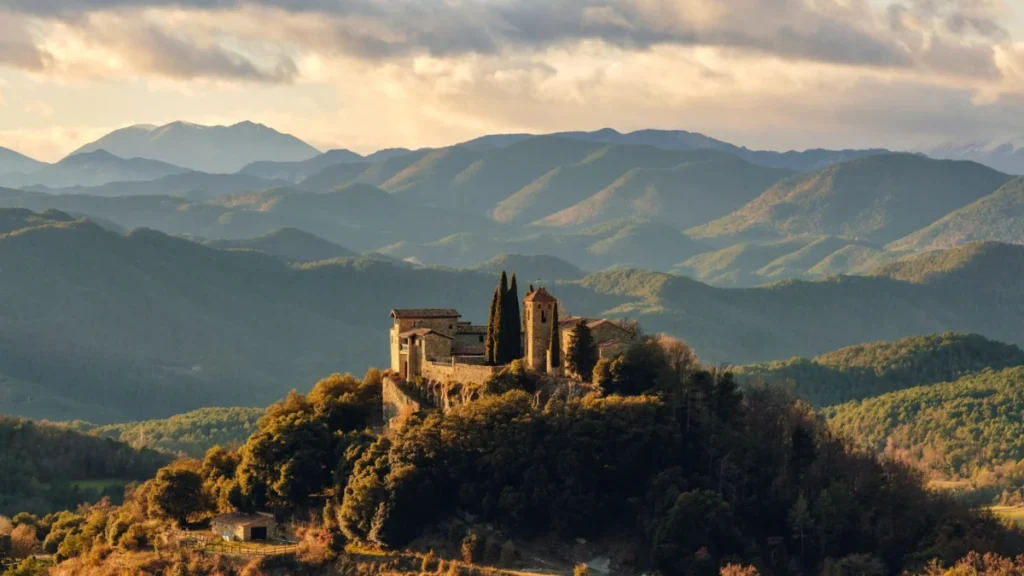
Dating back to the 10th century, the Castle of Llaés in the Catalonia region offers a rare glimpse into Romanesque fortified architecture. Perched on a rocky outcrop with views of the Pyrenees, the castle has been meticulously preserved to maintain its historical integrity. The presence of such listings on modern platforms provides the necessary revenue for private owners to maintain these massive stone structures, which might otherwise fall into ruin.
12th-Century Apartment: Saint-Paul-de-Vence, France
In the walled village of Saint-Paul-de-Vence, a restored 12th-century apartment once served as the home of French poet and screenwriter Jacques Prévert. The property features vaulted stone ceilings and a jasmine-lined terrace overlooking the Côte d’Azur. The inclusion of literary and cinematic history adds a layer of "intellectual tourism" that appeals to a demographic of travelers who value narrative as much as comfort.
Turf Farmhouse: Egilsstaðir, Iceland
In the Icelandic Highlands, the traditional turf house represents a unique solution to extreme climates. These earthen dwellings, which were the standard for Icelandic housing for centuries, are now rare. The turf farmhouse in Egilsstaðir functions as a museum by day and a guest house by night. By offering an "off-grid" experience without electricity, the property provides an educational stay that emphasizes the sustainability and resilience of historical vernacular architecture.
Integration with Nature: The Rise of the Eco-Lodge
The intersection of luxury and ecology is perhaps most evident in properties that utilize their natural surroundings as a primary design element. These homes often feature "biophilic" designs that reduce the boundary between indoor and outdoor living.

Treeful Spiral Treehouse: Nago, Japan
Located in the Yanbaru forest of Okinawa—a region recently designated as a UNESCO World Heritage site—the Treeful Spiral Treehouse is a marvel of sustainable engineering. Built around living trees without harming their growth, the structure utilizes a "sunken seating" design and floor-to-ceiling glass to immerse guests in the subtropical canopy. The property operates with a focus on carbon neutrality, reflecting a growing trend in the Japanese tourism sector toward high-end eco-tourism.
The Birdbox: Gaular, Norway
In Norway, the "Birdbox" represents a minimalist approach to adventure tourism. These small, box-like structures are designed to provide maximum views with a minimum physical footprint. The Gaular location requires a 45-minute hike through the wilderness, positioning the stay as an achievement for the traveler. This "trek-to-stay" model is gaining popularity in Scandinavia, where the concept of friluftsliv (open-air living) is a central cultural tenet.
Atlantic Forest House: Paraty, Brazil
The iF Design Award-winning house in Paraty is situated in the Mata Atlântica, one of the most biodiverse forests in the world. The house utilizes extensive wood paneling and glass to create a "greenhouse" effect, allowing the jungle to serve as the interior decor. The property highlights the potential for modern architecture to coexist with sensitive ecosystems, provided the design prioritizes environmental stewardship.
Radical Whimsy and The "OMG!" Category
Some of the most successful listings on the global market are those that defy logic and tradition, leaning into surrealism and fantasy to attract a social-media-savvy audience.
The Bloomhouse: Austin, Texas
Known as a "giant seashell unicorn," the Bloomhouse was created by two University of Texas architecture students in the 1970s. The structure is made of polyurethane foam and stucco, carved into sinuous, organic shapes that eliminate all corners. In the context of Austin’s "Keep Austin Weird" movement, the Bloomhouse has become a local icon, demonstrating how residential architecture can function as large-scale sculpture.
The Kyoob: Coconino County, Arizona
Located on Navajo land, The Kyoob offers a "glamping" experience that prioritizes indigenous culture and celestial observation. The minimalist, cube-like structure provides a stark contrast to the rugged ranch land of the American Southwest. Stays here often include cultural education, such as Navajo tea ceremonies and stargazing tours, illustrating how unique architecture can serve as a gateway to indigenous heritage tourism.
Market Analysis and Broader Implications
The proliferation of these unique Airbnbs has significant implications for local economies and the global travel industry. Supporting data suggests that "destination rentals" often stimulate local economies more effectively than traditional hotels, as guests tend to stay longer and spend more at local artisanal shops and restaurants rather than on-site hotel amenities.
Furthermore, the success of these properties has influenced the broader real estate market. Architects are increasingly being commissioned to design homes with the specific intent of them becoming high-performing short-term rentals. This has led to a "design arms race" in the rental sector, where property owners compete to offer the most visually stunning and geographically remote experiences.
However, this trend also presents challenges. The popularity of remote stays in sensitive environments—such as the Icelandic Highlands or the Okinawan forest—requires careful management to prevent over-tourism and environmental degradation. Official responses from tourism boards in countries like Norway and Japan have emphasized the need for "low-impact, high-value" tourism, a niche that these unique Airbnbs are perfectly positioned to fill.
Conclusion: The Future of Architectural Travel
As we look toward the future of global tourism, it is clear that the "where" of a trip is becoming as important as the "whither." The homes profiled here—from the Frank Lloyd Wright masterpieces to the Icelandic turf huts—represent a new frontier in travel. They offer more than just a bed; they offer a different way of seeing the world. By turning architecture into an experience, these properties are helping to redefine luxury as something that is not just about price, but about the rarity of the perspective provided. For the modern traveler, the ultimate souvenir is no longer an object, but the memory of a night spent under the stars in a house that defies the ordinary.