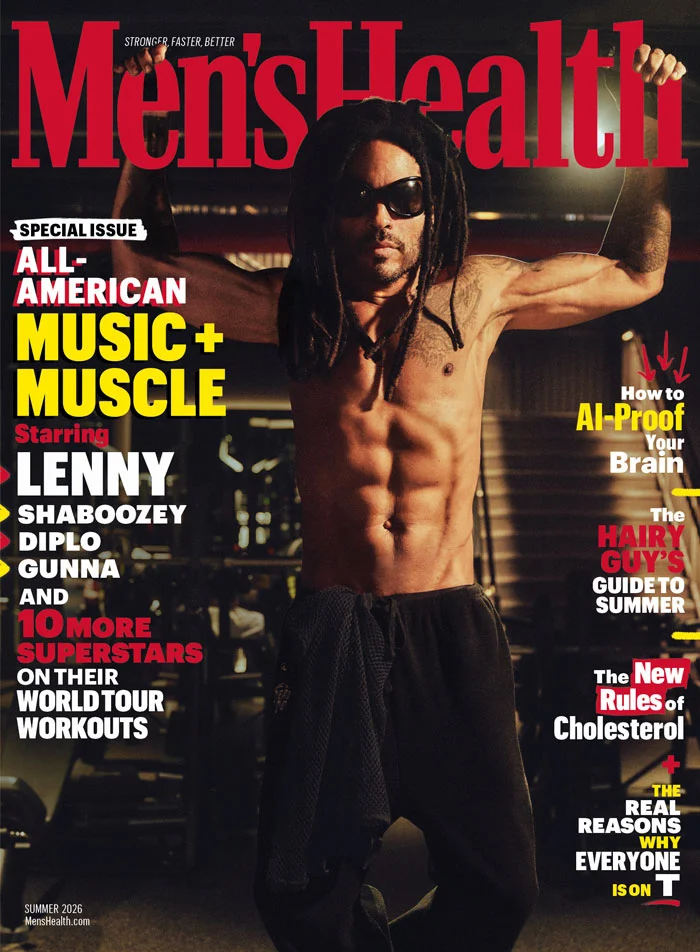

The traditional archetype of the rock and roll lifestyle, long defined by a volatile mixture of substance abuse, sleep deprivation, and dietary neglect, is undergoing a profound cultural transformation. Leading this paradigm shift is Lenny Kravitz, the multi-Grammy-winning musician and style icon, who serves as the centerpiece for the Summer 2026 Music + Muscle issue of Men’s Health. As the music industry moves away from the "live fast, die young" ethos of the 20th century, a new generation of artists is treating their bodies with the precision of elite athletes. This evolution, spurred by the post-pandemic wellness boom, sees performers trading late-night parties for early-morning run clubs and professional nutritionists. Kravitz, appearing on the magazine’s cover with a physique that defies his age, offers an intimate look into the rigorous discipline required to maintain a career and a body that show no signs of slowing down.
The Evolution of the Rock Star Archetype
For decades, the road was synonymous with excess. The logistical and emotional toll of touring often led musicians toward "vice and hedonism" as a means of coping with the rigors of travel and the adrenaline of performance. However, the Men’s Health Summer 2026 issue highlights a burgeoning movement where fitness has become the new backstage currency. Artists are now organizing fan-led run clubs that serve as high-energy "sweaty after-parties" and employing full-time trainers to ensure they can meet the physical demands of high-intensity stage shows.
Kravitz’s inclusion in this "new class" of fit musicians is not a recent development but the result of a decades-long commitment. While many of his peers have succumbed to the physical toll of the industry, Kravitz has cultivated a lifestyle centered on "maintenance as the key to aging." His approach is less about vanity and more about the "foundation" of his creative output. In his view, the physical body is the vessel through which the music flows, necessitating a level of care that mirrors the craftsmanship of his songs.
The Chronology of a Fitness Journey: From the 1990s to Today
Kravitz traces the origins of his serious fitness journey back to the mid-1990s, a period when he was already health-conscious but had yet to integrate structured training into his daily routine. The catalyst for this change was an unexpected encounter with another rock legend: Mick Jagger. During a holiday in the Bahamas, Kravitz observed the Rolling Stones frontman’s unwavering dedication to his training and nutrition.

"I watched how disciplined he was about his training and nutrition and realized that this was a major part of his formula," Kravitz noted. This observation dismantled the myth that rock stars could sustain their energy levels purely on talent and adrenaline. Following this realization, Kravitz began a partnership with trainer Dodd Romero, a relationship that has spanned decades. Romero, known for his analytical approach to body mechanics, treats the human physique with the same scrutiny a producer applies to a master track. Kravitz describes Romero’s ability to detect even minor dietary deviations—such as the consumption of a few chips the night before—as a "gift" that has kept him on a narrow, disciplined path.
The Philosophy of Natural Maintenance and the Spider-Man Aesthetic
In an era where the use of performance-enhancing drugs (PEDs), human growth hormone (HGH), and testosterone replacement therapy (TRT) has become increasingly common in Hollywood and the music industry, Kravitz remains a staunch advocate for natural progression. He acknowledges that while alternatives exist, his choice is rooted in the "100 percent attainable" results of exercise and food. This stance reflects a broader debate within the fitness community regarding the sustainability and ethics of age-defying interventions.
Kravitz’s aesthetic goals are also distinct from the "bulk-heavy" trends often seen in men’s fitness magazines. He describes his ideal physique as a "narrow silhouette," a hybrid of "Spider-Man meets Bruce Lee." This focus on lean muscle tone and graceful movement is designed for functionality on stage. By prioritizing a "thin, cool" look that retains muscle definition, Kravitz ensures he can move fluidly during his performances without the restrictions of excessive mass.
This functional approach extends to his choice of workout attire. Kravitz famously trains in the same materials he wears on stage: leather and denim. This practical decision allows him to "fit in a workout anytime, anywhere," ensuring that his training environment mimics his professional environment. It also reinforces his belief that fitness should not be a separate, isolated activity but a seamless part of one’s identity.

Nutritional Discipline and the Pants Don’t Lie Metric
Kravitz’s dietary habits are equally unconventional. He typically avoids eating until the mid-afternoon, not as a strict adherence to intermittent fasting protocols, but as a natural extension of his body’s rhythm. His daily intake is focused on high-protein, nutrient-dense foods: egg white omelets with vegetables, protein shakes, and large salads. This streamlined diet supports his goal of maintaining a specific waist size, which he uses as his primary metric for fitness.
Citing advice from actor Denzel Washington, Kravitz adheres to the mantra: "The pants don’t lie." For Kravitz, the fit of his clothes serves as a more accurate and immediate indicator of his physical state than a scale or a body fat percentage reading. This "basic but powerful" metric emphasizes the practical reality of his life as a public figure and performer, where his wardrobe is an essential component of his brand.
Redefining the Biological Clock and the Mustang Metaphor
Perhaps the most striking aspect of Kravitz’s philosophy is his rejection of traditional views on aging. He views age not as a chronological decline but as "time on earth," where the outcome is determined by "how you maintained it." He utilizes a vivid automotive metaphor to illustrate this point: a 1964 Mustang can either be a gleaming, high-performance machine or a rusted, non-functional relic, depending entirely on the level of care it received over the decades.
This perspective allows Kravitz to remain optimistic about his future physical capabilities. He asserts that he is in better shape now than he was 20 years ago and predicts that at age 72, he will be even more fit than he is today. This "reverse aging" mindset is supported by modern sports science, which suggests that with proper resistance training and nutrition, the loss of muscle mass (sarcopenia) can be significantly mitigated, allowing for peak performance well into the senior years.

Broader Implications for the Music Industry and Wellness Culture
The spotlight on Kravitz and his peers in the Music + Muscle issue signifies a broader cultural shift. The "wellness wave" that followed the global pandemic has forced a reevaluation of what it means to be a successful artist. Longevity is now prized over the brief, explosive careers of the past. As touring becomes the primary source of income for many musicians in the streaming era, the ability to perform 90-minute sets night after night for months on end requires a level of physical conditioning previously reserved for professional athletes.
Furthermore, Kravitz’s transparency regarding his natural methods provides a counter-narrative to the "quick fix" culture of modern fitness. By emphasizing that his results are "harder" and "take more work," he reinforces the value of long-term discipline over short-term chemical assistance. This message resonates with a demographic that is increasingly skeptical of synthetic enhancements and looking for sustainable ways to age gracefully.
Conclusion and Market Availability
The Summer 2026 issue of Men’s Health, featuring photography by Jonny Marlow, serves as a backstage pass to the "workout wonders" of the modern music scene. Alongside Kravitz, the issue features three other cover stars who embody this new era of fitness-focused artistry. As the music industry continues to evolve, the influence of figures like Kravitz will likely inspire a new generation of performers to view their health as their most valuable asset.
The Music + Muscle issue is scheduled to hit newsstands nationwide on July 21, 2026. It arrives at a time when the intersection of celebrity culture and the $5.6 trillion global wellness economy is more prominent than ever. For Lenny Kravitz, the cover is not just a showcase of his physical results, but a testament to a life lived with "discipline as the foundation," proving that in the world of rock and roll, the most radical act one can perform is taking care of oneself.