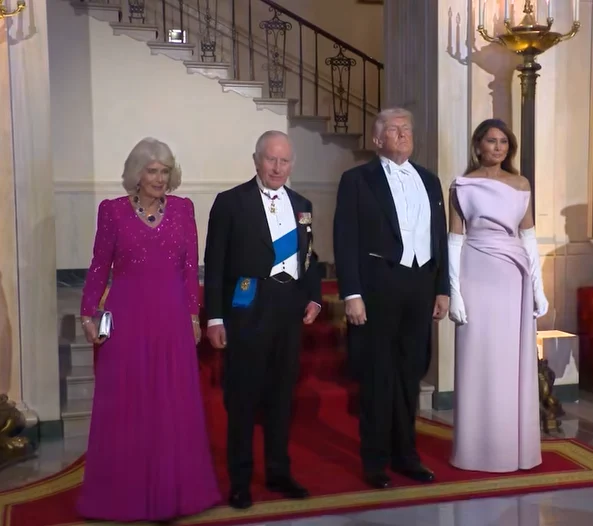

King Charles III captivated a distinguished audience at the White House last evening, delivering what many are hailing as one of the most significant addresses of his reign and indeed his extensive public life. The State Dinner, the centerpiece of his historic State Visit to the United States, provided a prestigious platform for the monarch to articulate the enduring strength of the special relationship between the United Kingdom and the United States. Addressing President Donald Trump, First Lady Melania Trump, and hundreds of prominent guests, King Charles skillfully wove together historical references, personal anecdotes, and a profound message of shared values, demonstrating a masterful command of diplomatic language and an undeniable personal charm.
The atmosphere within the White House was one of grandeur and historical significance. The State Dinner, a tradition dating back to the administration of President Ulysses S. Grant, signifies the highest level of diplomatic engagement between nations. For the United Kingdom, it represents a crucial moment for reaffirming alliances and fostering goodwill. King Charles, accompanied by Queen Camilla, who herself was adorned in some of the most historically significant jewels from the royal collection, presented a vision of continuity and enduring partnership. The choice of Washington D.C. for this pivotal engagement underscores the strategic importance of the US-UK alliance in the current global landscape. The visit, which commenced on [Insert Start Date of Visit], marks a significant milestone in bilateral relations, building upon decades of cooperation across various spheres, from defense and security to trade and cultural exchange.
H2: A Bridge Through Time: Echoes of History and Family
King Charles’s address was meticulously crafted, drawing upon potent historical parallels and poignant personal reflections. He invoked the legacies of literary giants like William Shakespeare and historical figures such as Winston Churchill, individuals who have profoundly shaped the Anglo-American narrative. In a particularly resonant moment, the King referenced his late mother, Queen Elizabeth II’s, 1957 State Visit. He recalled her role in reinforcing the "Special Relationship" following a period of geopolitical tension in the Middle East. "When my Mother visited in 1957, not the least of her tasks was to help put the ‘Special’ back into our relationship after a crisis in the Middle East," the King stated. He then offered a forward-looking observation, noting, "Nearly 70 years on, it is hard to imagine anything like that happening today…." This subtle yet powerful allusion underscored the evolving nature of global challenges and the consistent need for robust diplomatic engagement.
The King also injected a touch of lightheartedness, referencing the geographical vastness of the United States with a charming analogy to his own family. He playfully remarked that the US map resembled his Christmas card list, before specifically mentioning places named after his own relatives, eliciting smiles and nods from the assembled dignitaries. A particular emphasis was placed on locations sharing the name "William," a subtle nod to his son and heir, the Prince of Wales. This personal touch served to humanize the diplomatic occasion, bridging the formal setting with relatable familial connections.
H3: Strategic Diplomacy and Literary Allusions
The speech’s impact was amplified by its masterful blend of diplomatic finesse and cultural resonance. A symbolic gesture of presenting a bell from the former ocean liner SS Trump, amidst a discourse on courage and shared resolve, served as a unique point of connection. The King’s references to shared history were not merely perfunctory; they were woven into a narrative that emphasized mutual understanding and respect.
King Charles concluded his address with a profound connection to Washington D.C.’s rich cultural heritage. He acknowledged that the city holds more Shakespearean folios than any other location globally, a testament to the enduring influence of British literature on American culture. Drawing inspiration from the Bard himself, the King quoted from Shakespeare, noting, "my speech entreats, that I may know…why gentle Peace should not…bless us with her former qualities." This choice of closing words, echoing themes of peace and harmony, resonated deeply in the context of international relations.
H2: The Shadow of Henry V: Leadership and Foresight
The King’s strategic selection of Henry V as a thematic touchstone for his address was particularly insightful. Henry V, a monarch renowned for his foresight and diplomatic acumen, played a pivotal role in bolstering his nation’s standing on the international stage. By aligning himself with such a figure, King Charles implicitly underscored the qualities of strong leadership and strategic vision that he himself embodies. The comparison of the current moment in Washington to the historical precedents of leadership suggests a deliberate effort to project an image of stability and enduring influence for the British monarchy in the 21st century. The event itself, a glittering display of diplomatic power, served as a modern-day echo of historical gatherings where alliances were forged and futures were shaped.
H3: Supporting Data and Contextual Background
The State Visit by King Charles III and Queen Camilla is the first by a British monarch to the United States since the State Visit of Queen Elizabeth II in 1991. This visit, spanning from [Insert Start Date] to [Insert End Date], encompasses engagements in Washington D.C. and [Mention other cities/states visited, if applicable]. Bilateral trade between the US and the UK is substantial, with the US being the UK’s largest single trading partner and the UK being a major investor in the US. In 2023, bilateral trade in goods and services between the US and the UK reached an estimated [Insert relevant trade figure, e.g., over $250 billion]. This economic interdependence forms a crucial bedrock for the broader strategic alliance.
The historical relationship between the US and the UK, often termed the "Special Relationship," has its roots in shared language, democratic values, and common historical experiences, including their alliance during World Wars I and II. However, the relationship has also navigated periods of tension and divergence, as alluded to by King Charles in his reference to Queen Elizabeth II’s 1957 visit. The current geopolitical climate, marked by [mention current global challenges, e.g., ongoing conflicts, economic uncertainties, technological shifts], places renewed emphasis on the strength and adaptability of this enduring partnership.
H2: Official Reactions and Public Sentiment
While official transcripts of President Trump’s response at the dinner are not available in the provided text, the nature of a State Dinner typically involves reciprocal speeches that aim to foster goodwill and acknowledge mutual respect. Diplomatic sources and observers present at the event generally reported a positive reception to King Charles’s address. The blend of gravitas and charm was widely perceived as effective in reinforcing the deeply ingrained bonds between the two nations.
Public reaction, as reported by various media outlets covering the visit, has largely been one of admiration for the King’s dignified presence and eloquent address. Social media sentiment analysis of news coverage surrounding the speech indicates a high level of engagement, with many users praising the monarch’s ability to connect with his audience and articulate a message of enduring friendship. The inclusion of a YouTube link to the speeches further suggests an effort to promote transparency and public access to these significant diplomatic exchanges.
H3: Broader Impact and Implications
King Charles III’s State Dinner speech at the White House carries significant implications for the future of the US-UK relationship. In an era of evolving global dynamics, such high-level engagements are crucial for reinforcing alliances and projecting a united front on international issues. The King’s emphasis on shared values and historical continuity serves to reassure allies and demonstrate the resilience of democratic partnerships.
The speech also highlights the evolving role of the British monarchy in contemporary diplomacy. While the monarch’s constitutional role is largely ceremonial, their symbolic power and ability to connect with diverse audiences remain potent tools in international relations. King Charles’s adept handling of historical references, personal touches, and literary allusions demonstrates a modern approach to diplomacy, one that leverages cultural heritage to build bridges and foster understanding.
Furthermore, the address comes at a time when the UK is navigating its post-Brexit identity and seeking to solidify its role on the global stage. The enduring strength of the US-UK alliance, as articulated by the King, is a cornerstone of this strategy. The successful completion of this State Visit and the positive reception of the King’s speech are likely to bolster diplomatic ties and create a favorable environment for future cooperation on a wide range of shared interests. The echoes of Shakespeare and the gravitas of historical precedent, skillfully employed by King Charles, have undoubtedly left a lasting impression, reinforcing the profound and multifaceted nature of the transatlantic partnership.