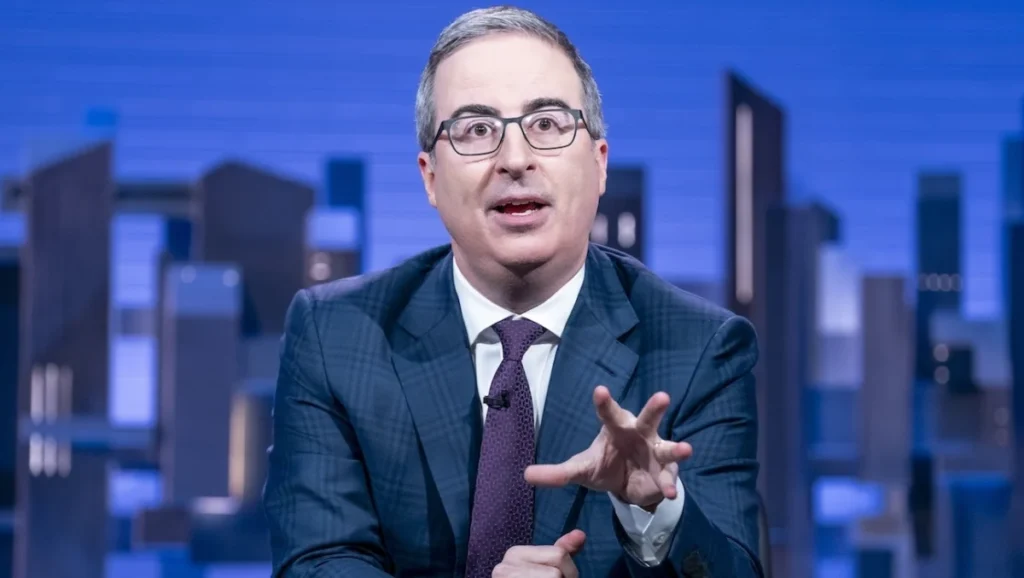

During Sunday’s broadcast of his critically acclaimed HBO satirical news program Last Week Tonight, host John Oliver trained his investigative lens on the deeply controversial practices of major health insurance provider UnitedHealthcare (UHC). However, true to form, the comedian interspersed his meticulous dissection of American healthcare failures with pointed, topical satire aimed squarely at the upper echelons of corporate media leadership—specifically targeting David Ellison, the tech and film entrepreneur whose media conglomerate Skydance is currently navigating regulatory hurdles to acquire Warner Bros. Discovery, HBO’s parent company.
The segment, which quickly generated widespread media coverage and social media engagement, highlighted the structural deficiencies of the United States healthcare system, the life-and-death consequences of corporate claim denials, and the ever-tightening grip of multi-billionaire dynasties over foundational American institutions. By weaving together biting social commentary and structural critique, Oliver underscored the growing public anxiety surrounding both healthcare accessibility and the rapid consolidation of corporate power in the media landscape.
Anatomy of a Healthcare Crisis: UnitedHealthcare Under the Microscope
The core of Oliver’s segment focused on a deep dive into the operational history of UnitedHealthcare, the nation’s largest health insurer. For years, consumer advocacy groups, policy experts, and policyholders have scrutinized the insurance giant over its exceptionally high rates of claim denials for medically necessary treatments, procedures, and prescriptions.
Oliver detailed several harrowing case studies of patients whose lives were upended by bureaucratic denials. Among them was the heart-wrenching story of a young cancer patient whose family was forced to scrape together $95,000 out of pocket after UnitedHealthcare repeatedly refused to cover the costs of vital medical treatments. Although the treatment ultimately succeeded in saving the patient’s life, Oliver used the anecdote to expose a systemic moral hazard within the private insurance market: the reality that survival in the American medical system frequently depends on personal wealth, familial financial backing, or sheer luck, rather than medical necessity or insurance coverage.
"Having access to wealthy parents just cannot be the system to get badly needed healthcare," Oliver told viewers, striking a serious chord before shifting his comedic focus to the corporate governance of his own corporate overseers.
Targeting David Ellison and the Paramount-WBD Merger Context
It was at this juncture in the broadcast that Oliver pivoted to the impending corporate reorganization that stands to impact his own professional home at HBO. Paramount Skydance—headed by CEO David Ellison—is currently pursuing a massive, highly complex merger and acquisition strategy to absorb Warner Bros. Discovery. The proposed multi-billion-dollar consolidation has sent ripples through the entertainment industry, raising significant antitrust concerns, questions about creative autonomy, and anxieties among guild workers and media employees.
Drawing a parallel between the reliance on familial wealth in the healthcare sector and the dynastic fortunes powering the entertainment industry, Oliver flashed a photograph of David Ellison on screen.
"Even if it is apparently the system that lets you be in charge of HBO," Oliver remarked wryly, before delivering the segment’s signature punchline. "Yeah, my soon-to-be business daddy has a literal business daddy."
As the camera zoomed out, the graphic expanded to reveal David standing alongside his father, Larry Ellison, the billionaire co-founder and chief technology officer of tech giant Oracle. Larry Ellison’s immense financial backing is a cornerstone of the current corporate maneuver, having formally agreed to personally backstop an astronomical $40.4 billion in equity financing tied directly to the high-stakes Paramount-WBD transaction.
True to his deadpan comedic persona, Oliver playfully mitigated the barb, adding, "And to be very clear, I deeply respect that and I would never make fun of you for it, unlike that pesky Stephen Colbert."
Chronology and Background of the Ongoing Corporate Shakeup
To fully understand the gravity and context of Oliver’s on-air quip, it is necessary to examine the timeline of events surrounding both the UnitedHealthcare controversy and the massive media consolidation efforts currently playing out in boardrooms across New York and Los Angeles.
The healthcare discussion arrived against a backdrop of intense public scrutiny following the tragic killing of UnitedHealthcare CEO Brian Thompson. Thompson was shot and killed outside a Manhattan hotel in December, an event that sent shockwaves through the corporate and medical communities. In the wake of the tragedy, investigators and media outlets noted a grim and unprecedented wave of public schadenfreude and online sympathy for the suspected shooter, Luigi Mangione—a phenomenon experts attributed to widespread public rage and exhaustion over predatory insurance claim denials, delayed care, and soaring out-of-pocket medical expenses. Mangione’s formal sentencing is scheduled to take place in December, keeping the conversation surrounding health insurance ethics at the forefront of the national consciousness.
Parallel to these social tensions, the corporate media landscape has experienced seismic shifts throughout the past year. David Ellison’s Skydance Media, operating in partnership with major financial backers, entered into aggressive negotiations to merge with Paramount Global before setting its sights further up the corporate food chain toward Warner Bros. Discovery. The financial engineering required to execute these transactions relies heavily on private equity, institutional debt, and substantial guarantees from ultra-high-net-worth individuals—most notably Larry Ellison, whose net worth places him consistently among the wealthiest individuals on the globe.
Regulatory Hurdles and Antitrust Implications
While corporate leaders like David Ellison champion these mega-mergers as necessary evolutions to compete in an increasingly fragmented digital streaming market dominated by tech behemoths, antitrust regulators, labor unions, and consumer advocacy groups have expressed profound alarm.
A merger of the scale proposed between Paramount and Warner Bros. Discovery would consolidate historic Hollywood studios, major cable television networks, premier news divisions, and dominant streaming platforms under a single corporate umbrella. Critics argue that such unprecedented vertical and horizontal integration inevitably leads to mass layoffs, reduced creative diversity, homogenized content, and diminished bargaining power for writers, actors, and production crews.
Furthermore, Oliver’s satirical jab highlights a deeper cultural anxiety regarding modern corporate oligarchy: the concentration of immense cultural and economic power in the hands of a microscopic elite, often passed down through generations. By explicitly naming Larry Ellison and his financial underwriting of his son’s business ambitions, Oliver pointedly reminded viewers of the dynastic nature of contemporary capitalism, where immense capital shields individuals from the systemic vulnerabilities experienced by ordinary citizens.
Broader Industry Reaction and Future Outlook
As of press time, representatives for David Ellison, Paramount Skydance, and Warner Bros. Discovery have declined to formally comment on Oliver’s televised remarks. It is standard industry practice for corporate executives to maintain silence regarding late-night satire, particularly given that HBO operates under the broader Warner Bros. Discovery corporate umbrella—a corporate structure that employs Oliver and has historically afforded its satirical hosts substantial editorial independence.
Nevertheless, media analysts note that Oliver’s commentary reflects a growing willingness among high-profile creators to openly critique the corporate forces shaping their industries. With regulatory reviews for ongoing media mergers expected to stretch well into the coming months, public and political scrutiny over corporate consolidation remains at an all-time high.
As Last Week Tonight continues its current season, the intersection of corporate power, healthcare reform, and media consolidation will undoubtedly remain rich material for Oliver’s brand of investigative comedy. Whether the federal regulators reviewing the Paramount-WBD merger will share the public’s skepticism regarding corporate dynasties remains to be seen, but the cultural conversation sparked by Sunday night’s broadcast has firmly placed the spotlight on the men holding the purse strings of modern media.