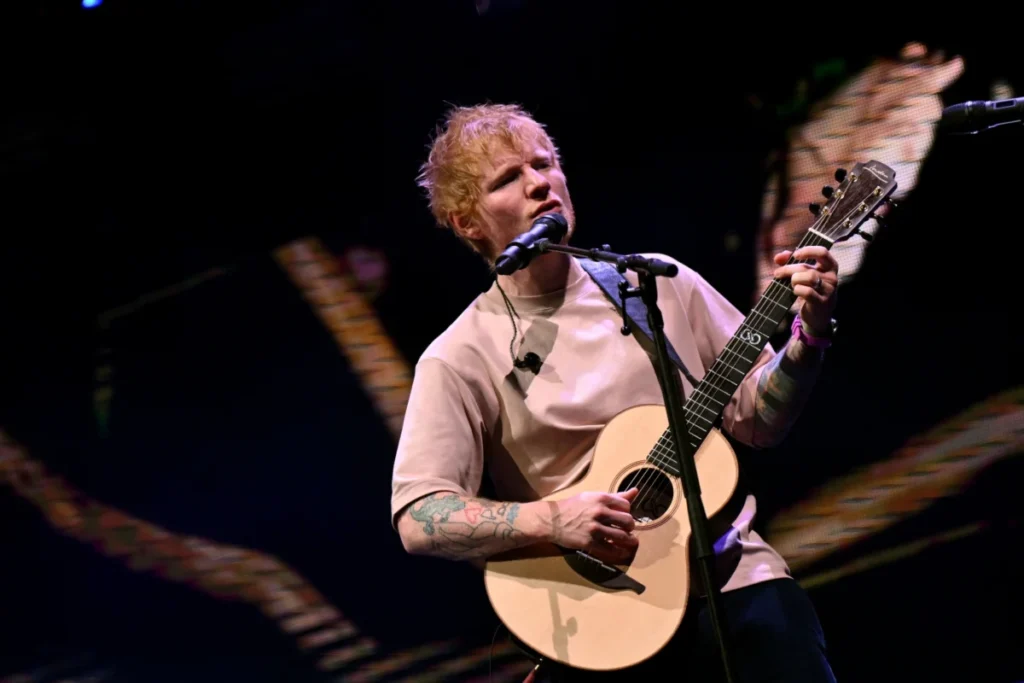

Ed Sheeran surprised concertgoers at Atlanta’s Mercedes-Benz Stadium during his Loop Tour stop on Saturday, October 3, by bringing out former The Fray frontman Isaac Slade as a special guest. The English singer-songwriter integrated Slade into the evening’s proceedings to perform an abbreviated set prior to taking the stage himself. Slade’s performance included acoustic renditions of the band’s landmark hits "How to Save a Life" and "You Found Me." However, the musical performance quickly transitioned into a moment of social and political commentary, with Slade addressing the ongoing war in Gaza and explicitly urging the massive stadium audience to seek common ground amid intense global polarization.
The appearance marked Slade’s second prominent guest spot on Sheeran’s current tour, following a similar collaboration in Toronto during the month of August, where Sheeran noted that he had been a devoted fan of Slade’s songwriting during his formative teenage years. Yet, Slade’s inclusion in Atlanta carried significantly more weight given the turbulent backstage atmosphere surrounding the tour, which has been grappling with artist departures, public friction, and logistical restructuring for weeks.
Chronology of the Tour Controversy and Macklemore’s Departure
The sequence of events leading up to Slade’s appearance in Atlanta traces back to early September during the U.S. leg of Ed Sheeran’s Loop Tour. Seattle rapper Macklemore had been tapped as a supporting act for select dates, including high-profile performances at New Jersey’s MetLife Stadium on September 4 and 5. During those sets, Macklemore performed his politically charged track "Hind’s Hall" and explicitly called for a "Free Palestine," drawing massive media attention and galvanizing public discourse regarding the intersection of mainstream music and geopolitical advocacy.
Following those performances, Macklemore was scheduled to provide direct support for several remaining dates on the itinerary, including the October 3 Atlanta concert. However, tour organizers abruptly dropped the rapper from the lineup. Ed Sheeran subsequently addressed the cancellation, explaining that the decision to remove Macklemore was ultimately made by the tour’s promoters and venue management entities, who indicated that local logistical operations and event clearances would be compromised if the rapper remained on the bill.
The removal sparked a cascading series of protests and withdrawals across the tour’s infrastructure. In solidarity or response to the cancellation, several other scheduled supporting acts—including Aaron Rowe, Finneas, and Lukas Graham—withdrew from their respective obligations on the Loop Tour. Additionally, Sheeran’s long-standing traditional backing band, Beoga, also parted ways with the production.
Faced with a rapidly depleted supporting lineup, Sheeran moved forward independently. During his September 19 headline performance in Philadelphia, which proceeded entirely without an opening act, the Grammy-winning artist addressed the mounting controversy directly. Sheeran told the stadium crowd that his primary objective for the tour was to cultivate an atmosphere centered around "love, hope, and unity," while also pausing to acknowledge the profound human suffering occurring on all sides of the conflict in Israel and Gaza. Meanwhile, Macklemore capitalized on the momentum of his removal by launching a completely independent headlining venture titled the Free Palestine Tour, which promptly recorded a wave of immediate, sell-out dates.
Isaac Slade’s Onstage Message and Call for Nuance
Taking advantage of his platform at Mercedes-Benz Stadium, Isaac Slade used his brief opening set to address the deep divisions dominating international discourse regarding the Middle East. Standing before tens of thousands of concertgoers, the singer cautioned against reflexive tribalism and encouraged listeners to find empathy within complex geopolitical landscapes.

"Everybody seems to be taking sides in this world, and that’s good," Slade told the audience, according to fan-captured footage circulating across social media platforms. "What’s happening over there is wrong, but if we’re going to get through it, we’re going to need people to step into that middle place, that common ground."
Elaborating on his metaphor, Slade described the necessity of acknowledging multiple perspectives without sacrificing moral clarity. "That bonfire in the middle of the field that sees both sides, that understands that peace is not a lack of conflict. Peace is not a blank canvas that we need to guard and be polite," he continued. "It holds enough beauty, enough tragedy, enough sorrow, enough joy and life if we learn how to integrate it and hold each other in balance. We will find a way through this together."
The speech was met with a mixed reception online, reflecting the broader societal debate over whether mainstream musical venues are appropriate spaces for foreign policy commentary or if artists bear a responsibility to use their visibility to highlight humanitarian crises.
Broader Industry Implications and the Intersection of Live Music and Politics
The unfolding events of the Loop Tour highlight a growing trend within the contemporary live music industry, where major tours are increasingly exposed to geopolitical flashpoints and public accountability expectations from both fans and artists. As live entertainment returns to pre-pandemic stadium scales, the margin for error regarding artist selection and corporate promoter oversight has narrowed significantly.
Promoters and venue conglomerates face heightened scrutiny over how they balance freedom of expression for touring musicians with commercial risk management, insurance liabilities, and municipal security concerns. When political statements made on stage lead to sudden lineup terminations—as observed with Macklemore—the ripple effects can destabilize entire tour itineraries, forcing headliners like Ed Sheeran to radically pivot their artistic presentations on short notice.
Furthermore, inviting legacy artists like Isaac Slade to the stage serves multiple strategic functions for a massive production under pressure. It provides nostalgic, crowd-pleasing musical moments that appeal to core demographic segments while allowing the headliner to recalibrate the narrative around collaboration, emotional resilience, and artistic solidarity.
As the Loop Tour continues its scheduled routing, the events in Atlanta demonstrate that while primary headliners attempt to steer public messaging back toward conventional themes of unity and shared humanity, the broader cultural friction surrounding international conflicts remains an inescapable reality for large-scale touring productions in the current socio-political climate.