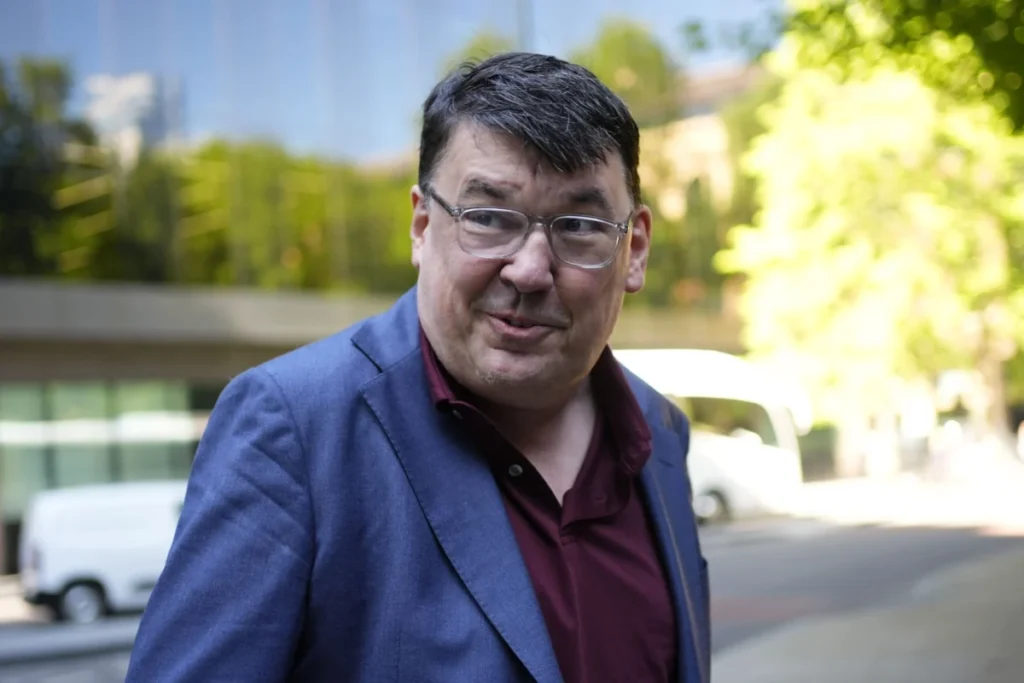

Television writer and prominent activist Graham Linehan is currently appealing his conviction for criminal damage, a case stemming from an altercation outside a conference in Westminster last October where he snatched and threw a trans activist’s mobile phone. The 57-year-old creator of acclaimed shows such as Father Ted and Black Books flew from Arizona to attend the appeal hearing at Southwark Crown Court this week, a proceeding that underscores the deeply polarized discourse surrounding gender identity in the United Kingdom and globally.
The Incident and Initial Verdict
The incident in question occurred on October 19, 2024, outside the Battle of Ideas conference in Westminster. Linehan encountered trans activist Sophia Brooks, who was filming him with her mobile phone. During the heated exchange, Linehan seized Ms. Brooks’ phone and threw it to the ground, causing damage. This act led to his conviction for criminal damage by District Judge Briony Clarke at Westminster Magistrates’ Court last November. While Linehan was cleared of a separate charge of harassment against Ms. Brooks related to a series of social media posts, the criminal damage conviction resulted in a £500 fine, alongside orders to pay £650 in costs and a £200 court fee.
The initial harassment charges alleged that Linehan had branded Ms. Brooks a "domestic terrorist," a "groomer," and an "incel" in social media posts, both before and after the physical altercation. District Judge Clarke, in her verdict on the harassment charge, acknowledged that Linehan’s posts might have been "annoying," "deeply unpleasant, insulting and even unnecessary," but ultimately concluded they did not constitute "oppressive" conduct under the legal definition of harassment. However, regarding the criminal damage, the judge rejected Linehan’s defence that he acted to prevent Ms. Brooks from committing a criminal offence, stating that he could reasonably have foreseen the damage to the handset. She described Linehan as "angry and fed up" at the time of the incident.
The Appeal Hearing: Prosecution’s Case
At the current appeal hearing before Mrs. Justice Amanda Tipples, prosecutor Julia Faure Walker presented the Crown’s case, arguing that Linehan demonstrated "a sense of personal superiority" following the incident. Ms. Faure Walker highlighted a post Linehan made on X (formerly Twitter) on October 22, 2024, just three days after the confrontation. In this post, Linehan referred to Ms. Brooks using male pronouns, stating: "I’m quite proud that I grabbed his phone and threw it across the road. He was furious." The prosecutor asserted, "Clearly, Mr Linehan was pleased by gaining a sense of personal superiority over a transgender activist."
The court was shown footage filmed on Ms. Brooks’ phone leading up to the incident. In the video, Ms. Brooks approaches Linehan outside the venue and questions him: "Why do you think it is acceptable to call teenagers domestic terrorists?" Linehan can be heard responding with a barrage of insults, calling Ms. Brooks a "porn-watching scumbag," a "groomer," and a "disgusting incel." Ms. Brooks retorted, "You’re the incel, you’re divorced." Another video played in court appeared to show Linehan grabbing or slapping the phone out of Ms. Brooks’ hands, corroborating the prosecution’s account of the physical act. Ms. Faure Walker emphasized that while the broader ideological context provides background, the court was "not being invited to take sides in an ideological debate" and should focus primarily on the immediate events leading to the phone being taken.
The Appeal Hearing: Defence’s Stance

Representing Linehan, lawyer Sarah Vine KC contended that Ms. Brooks is "determined" to see Linehan convicted as part of a broader "campaign" against the comedy writer, driven by his outspoken gender-critical views. Ms. Vine argued that Ms. Brooks "is seeking to achieve a victory against Mr Linehan because he is a high-profile opponent, by misusing the justice system."
The defence rooted its argument in the ongoing, contentious debate regarding the legal and social status of sex and gender. Ms. Vine elaborated on Linehan’s philosophical position: "The defendant subscribes to the view that human sex is not only universal, binary and immutable, but that it is a key organising category in society, which should not be subordinated to the subjective assertion of gender identity." She explicitly framed the allegation before the court as "a part of, effectively, a campaign by a number of trans-rights activists – of whom the complainant is one – to discredit gender-critical activists as individuals for political ends." This defence strategy aims to contextualize Linehan’s actions not as simple criminal damage, but as a reaction within a politically charged environment where activists on both sides are engaged in intense ideological struggle.
Background to the Dispute: Linehan’s Activism and Public Profile
Graham Linehan’s journey from a celebrated comedy writer to a polarizing figure in the gender identity debate is central to understanding this case. Known for his sharp wit and observational humour in Father Ted, Black Books, and The IT Crowd, Linehan enjoyed widespread acclaim, including multiple BAFTA awards. However, in recent years, his public persona has been increasingly defined by his vocal opposition to certain aspects of trans rights activism, particularly self-identification and the perceived erosion of sex-based rights for women.
Linehan began expressing these views publicly around 2018, initially on social media platforms like Twitter. His critiques rapidly escalated, leading to accusations of transphobia and harassment. He has become a prominent voice within the "gender-critical" movement, which advocates for the recognition of biological sex as a fundamental category distinct from gender identity. This stance has garnered him support from some feminists and traditionalists but has also led to significant backlash, including being banned from Twitter (though he has since returned under X) and facing public condemnation from former colleagues and much of the entertainment industry. His outspokenness has resulted in the cancellation of projects and significant damage to his professional reputation, effectively ending his mainstream comedy career. The Battle of Ideas conference, where the incident occurred, is known for hosting robust and often controversial discussions, making it a fitting backdrop for such a clash of ideologies.
The Broader Context: Gender Identity Debate in the UK
The legal proceedings involving Graham Linehan are not isolated events but rather microcosms of a much larger, often acrimonious, debate in the United Kingdom concerning gender identity and its societal implications. The UK has been a flashpoint for these discussions, particularly around issues such as proposed reforms to the Gender Recognition Act, access to single-sex spaces, and the rights of trans youth.
The "gender-critical" movement, which Linehan champions, posits that biological sex is immutable and that gender identity should not supersede sex-based rights, particularly for women and girls in areas like sports, changing rooms, and prisons. Proponents argue that the concept of gender identity, if prioritized over biological sex, undermines women’s safety and historical protections. Conversely, trans rights advocates argue for the recognition and affirmation of gender identity, emphasizing that trans people should be able to live authentically and without discrimination. They contend that denying gender identity is discriminatory and harmful, and that concerns about safety can be addressed through inclusive policies rather than exclusionary ones.
This ideological chasm has led to numerous public confrontations, online disputes, and legal challenges. Cases like Linehan’s highlight the difficulty courts face in navigating these emotionally charged debates, often having to distinguish between legitimate free speech, harassment, and criminal acts, all while trying to remain impartial to the underlying political or social arguments. The judiciary is frequently called upon to apply existing laws to novel situations arising from evolving social understandings of identity, creating complex legal precedents.

Legal Precedent and Implications
The appeal hearing at Southwark Crown Court carries significant implications beyond Graham Linehan’s individual case. The outcome could further clarify the legal boundaries of protest, free speech, and personal conduct in the context of highly contentious social debates.
One key aspect is the distinction between harassment and criminal damage. While Linehan was cleared of harassment, demonstrating the high bar for proving "oppressive" conduct in online communication, his conviction for criminal damage highlights that physical acts, even in the heat of a verbal argument, can cross a legal line. The court’s decision on the appeal will further define what constitutes reasonable behaviour when confronted by activists, and the extent to which a person can claim self-defence or a similar justification for damaging another’s property during a public dispute.
Furthermore, the defence’s argument of a "campaign" against Linehan raises questions about how the courts weigh the intentions of complainants in politically charged cases. If accepted, it could set a precedent for defendants to argue that legal actions against them are politically motivated rather than purely based on the alleged crime. However, the prosecution’s counter-argument, urging the court to focus on the immediate act rather than the ideological backdrop, seeks to prevent the judicial system from becoming a battleground for political ideologies, emphasizing the rule of law over partisan disputes. The case also touches upon the responsibilities of public figures and activists in managing their interactions, particularly when they are subjects of public scrutiny and potential provocation. The increasing prevalence of mobile phone footage in such confrontations also means that courts are frequently presented with direct visual evidence, which can be both illuminating and subject to interpretation.
Timeline of Events
- October 19, 2024: Graham Linehan snatches and throws Sophia Brooks’ mobile phone outside the Battle of Ideas conference in Westminster.
- October 22, 2024: Linehan posts on X (formerly Twitter), expressing pride in the act and referring to Ms. Brooks with male pronouns.
- November [2024]: At Westminster Magistrates’ Court, District Judge Briony Clarke clears Linehan of harassment charges but convicts him of criminal damage, imposing a £500 fine and ordering costs.
- Thursday, [Date of Appeal]: The appeal hearing against the criminal damage conviction begins at Southwark Crown Court before Mrs. Justice Amanda Tipples, with prosecution and defence presenting their initial arguments.
- Friday, [Date of Appeal]: The appeal hearing is expected to continue, with further evidence and arguments to be presented.
Conclusion and Outlook
The appeal hearing for Graham Linehan is poised to conclude soon, with Mrs. Justice Amanda Tipples tasked with a nuanced judgment that will not only determine Linehan’s legal standing but also contribute to the ongoing legal interpretation of public conduct in the context of intense social debates. The case encapsulates the friction points between free speech, online behaviour, personal accountability, and the deeply entrenched ideological divides within society. Whatever the outcome, it will undoubtedly be scrutinized by activists and legal observers on all sides, reflecting the broader challenges faced by legal systems grappling with the complexities of identity politics in the digital age.