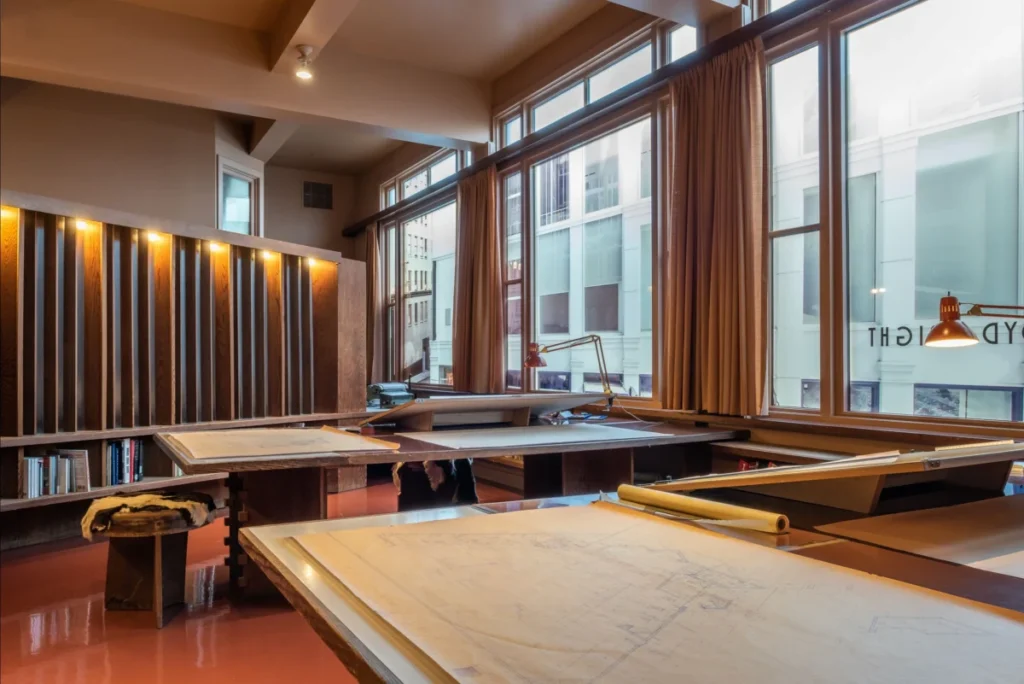

The preservation of architectural history often focuses on the grand facades of skyscrapers or the sprawling layouts of residential estates, yet some of the most profound insights into a creator’s process are found in the intimate spaces where they worked. In a significant cultural acquisition for the Great Lakes region, the Hagen History Center in Erie, Pennsylvania, has officially unveiled the Frank Lloyd Wright Field Office Museum. This 3,000-square-foot immersive education center serves as the permanent home for the architect’s former San Francisco workspace—a structure that traveled a long, circuitous route from the West Coast to a storage facility in Buffalo, New York, before being meticulously reconstructed in Erie.
The arrival of the office in 2020 was described by museum officials as an exercise in high-stakes assembly. Delivered in crates as a collection of redwood plywood planks, the artifact resembled oversized flat-pack furniture. For three decades, these components had been hidden from public view, following their removal from the second floor of a San Francisco building in the late 1980s. Today, through the collaboration of historians, architects, and experiential designers, the office has been restored not merely as a static display, but as a living environment that allows visitors to step directly into the mid-century professional world of America’s most celebrated architect.
The San Francisco Legacy and the Partnership with Aaron Green
To understand the significance of the field office, one must look back to 1951. During this period, Frank Lloyd Wright was experiencing a late-career surge in commissions, particularly in California. Despite being in his 80s, Wright remained prolific, but his primary bases of operation—Taliesin in Spring Green, Wisconsin, and Taliesin West in Scottsdale, Arizona—were geographically removed from his growing roster of West Coast projects.
Recognizing the need for a local presence, Wright partnered with Aaron Green, a respected architect and a former apprentice who had become a trusted associate. Together, they established a joint office on the second floor of a building at 1970 Mission Street in San Francisco. This space was unique among Wright’s workspaces; it was his only formal office outside of his personal residences and the two Taliesin campuses.
The design of the office was a masterclass in Wright’s philosophy of organic architecture and the efficient use of industrial materials. Utilizing redwood plywood, Wright created a workspace that was essentially a self-supporting structure. It sat upon the original floor plate of the existing building without relying on the host structure’s walls for stability. This modular, "room-within-a-room" approach allowed the office to be distinct and purely "Wrightian" despite its location within a conventional urban building.
.jpg)
For nearly a decade, this office served as the nerve center for Wright’s California projects. Following Wright’s death in 1959, Aaron Green continued to operate from the space for another 29 years, maintaining its integrity as a working architectural studio until 1988. Recognizing that the office itself was a work of art, Green oversaw its careful disassembly. Every board was tagged, every joint cataloged, and the entire interior was crated to ensure it could be resurrected for future generations.
A Chronology of Preservation: From San Francisco to Erie
The journey of the field office is a testament to the challenges of architectural conservation. Its timeline reflects the shifting tides of museum interest and private stewardship over the late 20th and early 21st centuries.
- 1951: The office is designed and constructed in San Francisco as a collaboration between Wright and Aaron Green.
- 1951–1959: Wright utilizes the space for major commissions, including the Marin County Civic Center.
- 1959–1988: Aaron Green maintains the office as his primary workspace, preserving Wright’s original design and furniture.
- 1988: The office is disassembled to prevent its destruction during building renovations. It is acquired by a collector.
- 1990s: The office is briefly displayed at the Heinz Architectural Center at the Carnegie Museum in Pittsburgh, Pennsylvania, though it is displayed behind glass as a "look-but-don’t-touch" artifact.
- 2000–2020: The components are moved to a storage facility in Buffalo, New York, where they remain in crates for 30 years.
- 2020: The Hagen History Center acquires the office and transports the crates to Erie, Pennsylvania.
- 2021: Reconstruction begins under the guidance of Kidder Architects and museum staff.
- 2024: The Frank Lloyd Wright Field Office Museum officially opens as an immersive, interactive exhibition.
Caleb Pifer, the president and CEO of the Hagen History Center, noted that the acquisition was a transformative moment for the institution. "The office has this long circuitous path of how it ends up in Erie, Pennsylvania," Pifer said. "But the spoiler is we saved it."
Designing the Immersive Experience
When the Hagen History Center team took possession of the artifacts, they were determined to move beyond the traditional museum model of viewing architecture from a distance. Working with the design firm Zebradog and Kidder Architects, they created a purpose-built 3,000-square-foot space that serves as a protective shell for the original office while providing the necessary context to understand Wright as a human being.
Mark Schmitz, founder of Zebradog and a member of the Board of Trustees for Taliesin Preservation, emphasized that the goal was to "bring the artifact to life." To achieve this, the museum utilizes sensory technology to transport visitors back to the 1950s.
As guests tour the office, they encounter a sophisticated soundscape. The faint sounds of San Francisco street traffic filter through the windows, punctuated by the internal sounds of a busy drafting room: the scratch of pencils on vellum, the ringing of period-appropriate telephones, and the muffled conversations of apprentices. "It’s as if all of the draftsmen had just gotten up and went to lunch and you walked in," Schmitz explained.
.jpg)
One of the most striking features of the new museum is the use of interactive digital media. Upon entering, visitors are greeted by a life-sized video of an actor portraying Wright at his desk. The exhibit uses proximity sensors; as a visitor approaches, the "architect" looks up from his work and addresses them directly, as if they were a prospective client. This interaction allows Wright to explain his theories on nature and organic architecture in a personal, conversational tone, bridging the gap between historical figure and modern visitor.
Architectural Principles and Educational Impact
The office itself serves as a physical textbook for Wright’s most famous architectural techniques. Two primary concepts are on full display: the use of organic materials and the principle of "compression and release."
In many of Wright’s homes, "compression and release" involves a low-ceilinged, darker entryway that opens into a soaring, light-filled living space, creating a psychological sense of expansion. In the San Francisco office, Wright adapted this to the needs of a workspace. While the entry areas are tight and focused, the "release" is directed toward the drafting room. The high ceilings and strategically placed windows draw the eye toward the center of activity—the place where design and labor occur.
To further humanize the architect, the museum includes interactive elements that highlight his early influences. Visitors can engage with Froebel blocks, the geometric wooden toys that Wright famously credited with shaping his early understanding of form and structure. There are also stations for designing digital "art glass" windows, modeled after the stained-glass patterns Wright created for his "Usonian" homes.
"If you don’t understand Wright, his story, theories, and the nuances of organic architecture, can you really appreciate the design?" Pifer asked. "So we really set out to humanize the man."
Broad Implications for Architectural Tourism and Regional Development
The opening of the Frank Lloyd Wright Field Office Museum has significant implications for Erie and the broader "Wright Trail," which connects various sites designed by the architect across the United States. Erie’s location between major hubs like Buffalo (home to the Darwin D. Martin House) and Pittsburgh (near Fallingwater and Kentuck Knob) positions the Hagen History Center as a vital link in a regional architectural corridor.

By securing such a high-profile artifact, the Hagen History Center is transitioning from a local historical society into a destination for national and international architectural tourism. The $14 admission fee and the museum’s expanded hours (Tuesday through Saturday from 10 a.m. to 5 p.m. and Sundays from noon to 5 p.m.) are expected to draw thousands of visitors annually, providing an economic boost to the Erie downtown area.
Furthermore, the museum highlights the breadth of Wright’s late-career work. The exhibit features a re-creation of the smallest structure Wright ever designed—a doghouse for a client’s pet—alongside photos of the Marin County Civic Center, his largest project. Both of these projects were developed within the very walls of the San Francisco office now standing in Erie. This juxtaposition illustrates the "gamut of his work in his later life," showing that Wright applied the same rigorous principles of organic design to a 10-square-foot canine shelter as he did to a multi-acre government complex.
Conclusion: Preserving the Doctrine of Wright
The successful reconstruction of the Frank Lloyd Wright San Francisco Field Office is more than a feat of carpentry; it is a victory for the philosophy of experiential history. By allowing the public to walk the same floors and hear the same sounds as the architect once did, the Hagen History Center has ensured that Wright’s legacy is felt rather than just observed.
As the museum begins its first season of operation, the focus remains on the educational mission. The hope is that guests leave not just with a list of dates and buildings, but with a profound understanding of why Wright remains a towering figure in the world of design. Through the blend of authentic 1950s redwood plywood and 21st-century digital storytelling, the "star power" of the office—as Aaron Green once described it—has been preserved for a new century. In the quiet halls of the Hagen History Center, the draftsmanship and the doctrine of Frank Lloyd Wright have finally found a permanent home.