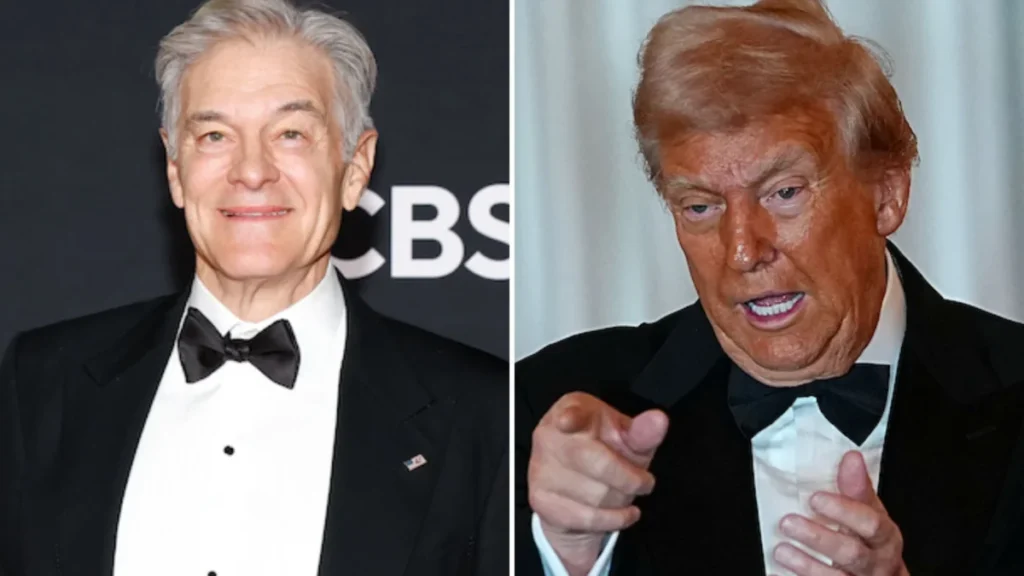

Dr. Mehmet Oz, a prominent figure in health and wellness and now the administrator for the Centers for Medicare & Medicaid Services (CMS), recently shared an anecdote on Donald Trump Jr.’s podcast, Triggered With Don Jr., that has ignited discussion regarding former President Donald Trump’s dietary habits and his peculiar rationale for consuming diet soda. During the podcast appearance, Dr. Oz recounted a conversation with President Trump aboard Air Force One, where the former President asserted that diet soda is beneficial for him because it can kill grass, leading him to believe it must also be effective against cancer cells.
The exchange, as described by Dr. Oz, involved Trump holding an orange soft drink, identified as Fanta, and stating, "You know, this stuff’s good for me. It kills cancer cells." He further elaborated on his belief, adding that because the beverage kills grass, it must possess properties that are advantageous for health, specifically in combating cancerous cells. Trump also reportedly justified his consumption of Fanta by noting it was "fresh squeezed," implying a higher quality or healthier composition.
This assertion from the former President, widely known for his reported daily consumption of multiple diet sodas, presents a stark contrast to conventional medical advice and scientific understanding of nutrition and cancer. The anecdote has drawn attention not only for its unconventional logic but also for the prominent figures involved: a former U.S. President, a media personality with a background in cardiothoracic surgery and a current high-ranking government health official, and his son, a vocal supporter and businessman.
Background of Trump’s Diet Soda Preference
Donald Trump’s affinity for diet soda is well-documented. During his first term in the White House, a dedicated Diet Coke button was famously installed on his desk in the Oval Office, allowing him to summon the beverage with a push. This habit reportedly continued into his second term, with the button being reinstalled in January 2025. This preference has often been a point of discussion among observers of his health and lifestyle.
Dr. Oz, in the same podcast segment, also touched upon Trump’s broader approach to food and health, noting that the former President "doesn’t want to get sick, so he eats junk food, but it’s food made in large, reputable chains because they have quality control." This statement suggests a perceived correlation between established commercial brands and a baseline level of safety or quality, even within the realm of what is commonly considered "junk food."
Scientific Perspective on Diet Soda and Cancer
The scientific consensus on the health effects of diet soda, particularly concerning cancer, is complex and has been the subject of extensive research. While diet sodas are marketed as a calorie-free alternative to regular sugary beverages, and often promoted for weight management, their long-term health implications remain a subject of ongoing investigation and debate.
Many studies have explored potential links between artificial sweeteners, a key component of diet sodas, and various health outcomes. However, definitive causal relationships between moderate consumption of artificial sweeteners and cancer in humans have not been established by major health organizations. Regulatory bodies such as the U.S. Food and Drug Administration (FDA) and the European Food Safety Authority (EFSA) have approved several artificial sweeteners for use, deeming them safe within acceptable daily intake levels.
The logic presented by former President Trump—that a substance’s ability to kill grass equates to its efficacy against cancer cells—lacks any scientific basis. The chemical composition and biological mechanisms that affect plant life are fundamentally different from those that influence human cellular biology, especially concerning the complex processes of cancer development and treatment. Herbicides, for instance, are designed to target specific plant metabolic pathways, and their effects on human cells are not directly analogous.
Donald Trump Jr.’s Defense and "Make America Healthy Again"
In response to Dr. Oz’s account, Donald Trump Jr. offered a defense of his father’s energy levels and overall vitality, suggesting that his father’s approach, unconventional as it may seem, is effective for him. "Maybe he’s onto something," Trump Jr. remarked, highlighting his father’s sustained energy, recall, and stamina, particularly for someone approaching 80 years of age.
Trump Jr. also connected his father’s health philosophy to the "Make America Healthy Again" movement, a concept that seems to align with his father’s public messaging on well-being. He posited that even if his father does not adhere to a perfectly strict diet himself, his intention is to promote awareness and knowledge about health among the public. This perspective frames Trump’s engagement with health-related topics as a broader initiative to encourage healthier lifestyles, irrespective of his personal dietary choices.
Broader Implications and Expert Reactions
The anecdote shared by Dr. Oz raises several important points for public health discourse:
- Misinformation and Health Literacy: The former President’s reasoning, though presented in a personal and perhaps jocular manner, could inadvertently contribute to health misinformation if taken seriously by the public. The gap between anecdotal observations and evidence-based science is crucial to bridge, especially when concerning serious health issues like cancer.
- The Role of Public Figures in Health Messaging: When prominent figures, including former presidents and health officials, discuss health-related topics, their statements carry significant weight. It underscores the responsibility to ensure that such discussions are grounded in scientific accuracy and do not promote potentially harmful beliefs.
- Dietary Habits and Public Perception: Trump’s well-known preference for diet soda and fast food, coupled with his claims of personal well-being, presents a complex narrative. It highlights the public’s interest in the health habits of leaders and the potential for these habits to influence societal perceptions of what constitutes a healthy lifestyle.
While Dr. Oz’s role as CMS administrator places him in a position of significant influence over national health policy, his personal anecdotes, particularly those that might be misconstrued, warrant careful consideration. The scientific community largely advises a balanced diet, rich in whole foods, and limited intake of processed items and artificial sweeteners, pending further conclusive research.
The conversation on Triggered With Don Jr. offers a glimpse into the informal health discussions that can occur among public figures. However, the scientific community remains steadfast in its reliance on peer-reviewed research and established medical guidelines for making health recommendations. The peculiar logic employed by former President Trump regarding diet soda and cancer cells serves as a stark reminder of the ongoing need for robust health education and the clear dissemination of accurate scientific information to the public. The implications of such personal health philosophies, when voiced by influential individuals, extend beyond mere personal preference, shaping perceptions and potentially influencing broader public health conversations.