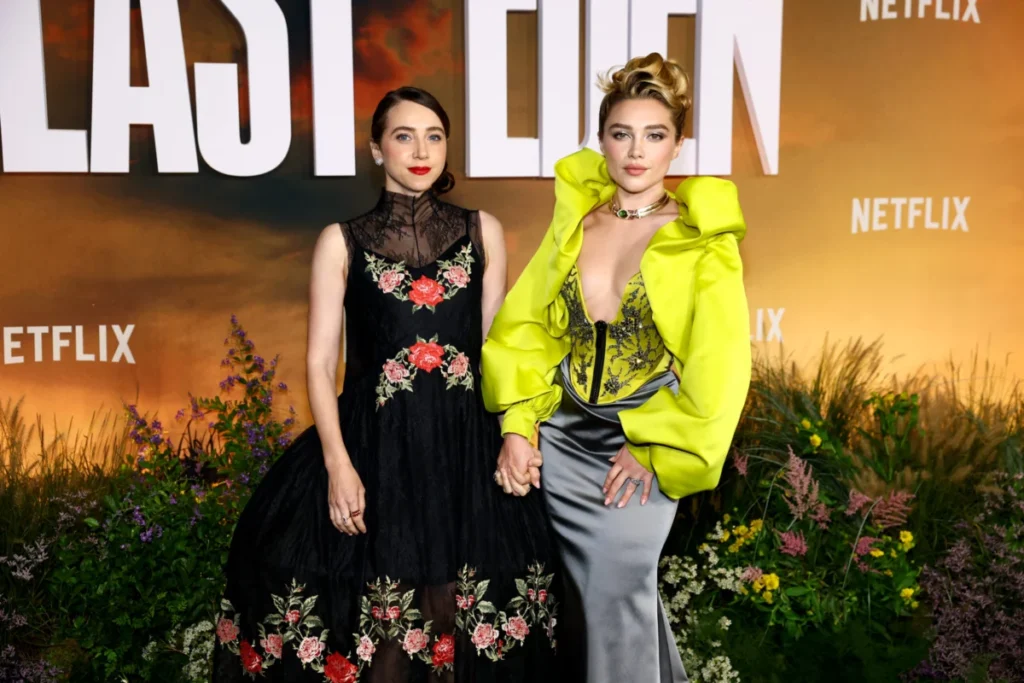

When writer and adaptor Zoe Kazan first envisioned bringing John Steinbeck’s monumental 1952 American classic East of Eden to the screen, she was faced with the formidable task of casting one of literature’s most complex and polarizing antagonists: Cathy Ames. However, according to Kazan, the extensive casting process was effectively non-existent. She had only one actor in mind for the pivotal seven-episode Netflix limited series, and her vision brook no compromise. That actor was Florence Pugh.
Speaking at the star-studded New York premiere of the streaming network’s latest prestige project, Kazan opened up about her uncompromising single-mindedness regarding the role. "I didn’t have a backup," Kazan shared during a previous interview with Netflix’s promotional arm, Tudum. Reiterating her stance on the red carpet, she emphasized that no other contemporary performer possessed the precise blend of vulnerability and menace required to bring Steinbeck’s chilling creation to vivid life. For Kazan, Pugh was not merely an option among many; she was the absolute embodiment of the character.
As audiences and critics alike dissect the early episodes of the sprawling historical drama, the partnership between Kazan and Pugh has emerged as the creative anchor of the entire production. This comprehensive look explores the genesis of the casting decision, the collaborative effort behind the scenes, the critical acclaim surrounding the series, and what this landmark adaptation means for the trajectory of both artists.
Decoding the Antagonist: Why Pugh Was the Sole Choice
Steinbeck’s original novel paints Cathy Ames as a figure of pure, unadulterated malevolence—an individual detached from conventional human empathy, navigating the world with a doll-like exterior masking an icy, calculating interior. Translating such a literary archetype to visual media risks flattening the character into a cartoonish villain, a pitfall Kazan was determined to avoid. She sought to re-examine the narrative through a lens that prioritized Cathy’s perspective, attempting to humanize her motivations without absolving her of her cruelty.
Kazan found the blueprint for this delicate balancing act in Pugh. Reflecting on the physical and psychological duality required for the role, Kazan noted a distinct quality in the Oscar-nominated actress. "The way that Cathy Ames is described in the book is kind of doll-like but with something icy or steely underneath," Kazan explained. "And I felt in Florence this mix of a very feminine presentation with, in a Jungian sense not in a gender sense, of masculinity to her soul. That she had a lot of raw emotion and agency and action, which is very Cathy to me."
Furthermore, Kazan’s conviction was solidified years prior while watching Pugh’s career-defining turn in Ari Aster’s 2019 folk horror masterpiece Midsommar. To Kazan, that performance signaled the arrival of a generational talent capable of executing complex psychological maneuvers. "I feel like that performance announced a generational talent," Kazan said. "I think she’s a genius. It was very clear to me that, even though that character is very different from Cathy, if she can do that magic trick of a performance, she can do this."
A Collaborative Genesis: From Conception to Execution
The journey of bringing East of Eden to Netflix has been a prolonged, meticulous labor of love. The creative pipeline began years prior, with Pugh officially boarding the project as both its leading lady and an executive producer as early as 2020. This behind-the-scenes elevation provided Pugh with unprecedented agency in shaping the narrative architecture of the limited series, transforming her involvement from a standard acting engagement into a deeply personal creative partnership.
When Kazan initially approached her with the proposition, Pugh’s immediate reaction was one of profound disbelief and gratitude. "I couldn’t believe that she was wanting to cast me," Pugh admitted on the red carpet. Yet, the invitation extended far beyond performance; Kazan insisted that Pugh take an active role in the developmental stages of the adaptation.

For Pugh, this collaborative environment proved to be a transformative milestone in her professional and personal life. Stepping into an executive producer role during a critical juncture in her career allowed her to exercise leadership in an entirely new capacity. "She really wanted me to be a part of the process; she wanted to create it with me. And that was just huge," Pugh reflected. "At that time in my career and in my life, I was being given an opportunity that was a massive moment for me to step up and to lead in a different way. Those moments in people’s careers are the beginning of feeling truly confident about yourself. This project has meant a lot to me."
The mutual admiration between the two creatives spilled over into the public sphere when Pugh took to social media to document the grueling, rewarding chronology of the production. In a heartfelt Instagram post commemorating the series’ release, Pugh praised her collaborator, writing: "Zoe Kazan has poured her heart and soul into this project, I wouldn’t have been able to do any of this without her. She was my protector, my work wife, my cheerleader, my confidence. She created something so epic we all wanted to work on it."
Critical Reception and Industry Impact
The high-stakes gamble of reimagining a revered literary classic with a radical shift in perspective has paid substantial dividends for Netflix. Ahead of its wider public rollout, East of Eden has captured the attention of top-tier television critics, currently holding a robust 85 percent freshness rating on Rotten Tomatoes. Industry observers have been particularly effusive in their praise for Pugh’s fearless interpretation of the narrative’s central villain.
Writing for The Hollywood Reporter, chief TV critic Dan Fienberg lauded Pugh’s ability to anchor the series through opacity and quiet menace. Fienberg observed that Pugh "tears into one of fiction’s great and confounding antagonists, a woman so determined and determinedly wicked that she makes Becky Sharp from Vanity Fair look like a Girl Scout." He added that casting an actor who inherently guards her character’s internal truth places a compelling burden on the surrounding ensemble. "Cathy is scary when she lies, but she’s scarier when she tells the truth, with an unobscured honesty that is purely Pugh-ian. She’s so good that even in the second half of the series, when Cathy ages past the point at which Pugh is convincing, it still works."
Other major publications have echoed these sentiments. Esquire declared the performance to be a "career best" for the actress, while USA Today asserted that Pugh’s magnetic presence single-handedly elevates the program into "must see" television status. This wave of universal acclaim positions East of Eden as an early contender in the upcoming awards season conversation, validating Netflix’s investment in high-end, auteur-driven literary adaptations.
Chronology of the Project and Broader Implications
To understand the magnitude of East of Eden’s release, one must trace its development through the changing landscape of prestige television over the past half-decade:
- 2020: Zoe Kazan initiates the adaptation process, conceptualizing a reimagined, character-focused framing of Steinbeck’s novel. Florence Pugh is approached and formally signs on as both the lead actress and an executive producer.
- 2021–2023: The complex scripts are developed and refined through a close creative partnership between Kazan and Pugh, ensuring the psychological depth of Cathy Ames remains central to the narrative.
- 2024–2025: Principal photography takes place, navigating the logistical hurdles of period-accurate production and the intricate aging requirements of the central characters across decades.
- September 30, 2026: The series holds its high-profile New York premiere, drawing widespread media attention and stellar initial reviews.
- October 2026: East of Eden officially premieres on Netflix, instantly generating intense cultural discourse and setting a high benchmark for subsequent literary adaptations on the platform.
The broader implications of East of Eden’s success extend well beyond the streaming metrics for Netflix. By handing substantial creative control to a multi-hyphenate talent like Pugh alongside an adaptor of Kazan’s caliber, the project underscores a growing industry trend: empowering female artists to reclaim and deconstruct historical misogynistic tropes embedded within classic American literature.
Furthermore, the triumphant realization of this vision proves that audiences remain hungry for daring, morally ambiguous storytelling executed with uncompromising artistic vision. As the cultural footprint of East of Eden continues to expand in the coming weeks, the partnership between Zoe Kazan and Florence Pugh will undoubtedly be analyzed as a masterclass in modern adaptation—proving that when an adaptor finds her singular muse, the resulting alchemy can redefine an entire genre.