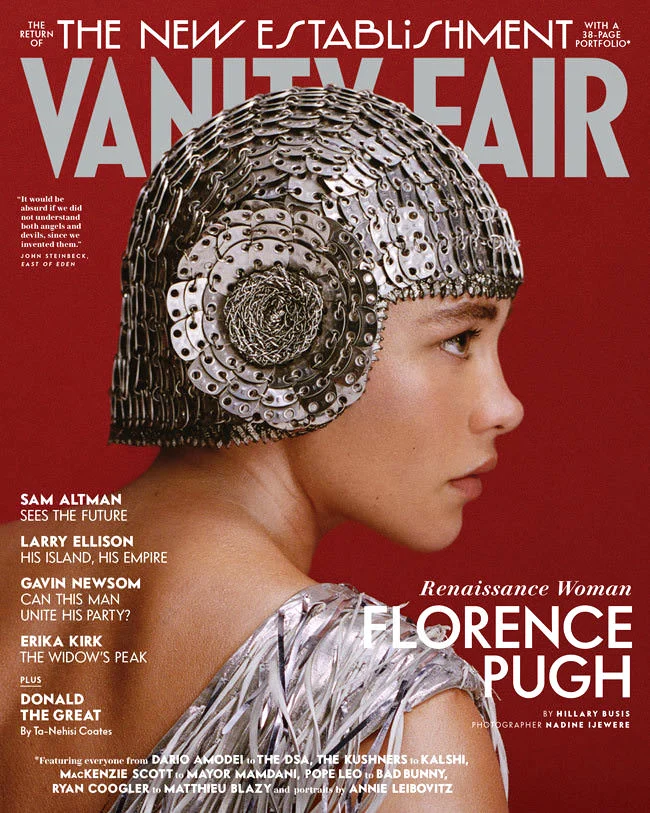

The landscape of contemporary Hollywood cinema is populated by few performers who command both blockbuster box offices and prestige auteur projects with the versatile dexterity of Florence Pugh. Gracing the cover of Vanity Fair’s October 2026 issue, photographed by renowned fashion photographer Nadine Ijewere, Pugh stands at the epicenter of one of the most commercially and critically demanding stretches of her professional life. As she navigates a grueling itinerary featuring high-profile television adaptations and monumental cinematic franchises, the British actor is redefining what it means to anchor modern storytelling while fiercely safeguarding her personal boundaries.
The current career zenith finds Pugh balancing television, independent cinema, and global tentpole franchises simultaneously. Her primary dramatic vehicle of the season is her much-anticipated transformation into the coldhearted, complex Cathy Ames in Netflix’s prestige limited series adaptation of John Steinbeck’s classic American novel, East of Eden. Simultaneously, Pugh is extending her footprint in the sci-fi and superhero genres, reprising prominent roles in two of the most lucrative intellectual properties in contemporary entertainment: Marvel Studios’ ensemble behemoth Avengers: Doomsday and Denis Villeneuve’s epic sci-fi conclusion Dune: Part Three. This triple-threat alignment showcases an actor who refuses to be pigeonholed, transitioning effortlessly from period literary drama to hyper-stylized universes with ease.

Unpacking the Complex Psychology of Cathy Ames
Stepping into the shoes of Cathy Ames—widely regarded as one of American literature’s most chilling and unrepentant antagonists—presented a unique psychological hurdle for Pugh. Rather than shying away from the character’s profound cruelty, Pugh approached the role through a lens of profound empathy, driven by the character’s formative trauma detailed in the screenplay written by Zoe Kazan.
In her interview with Vanity Fair, Pugh elaborated on the necessity of separating her personal morality from the heinous actions of the characters she portrays. She emphasized that her responsibility as an artist is not to condone or replicate the behavior of individuals like Ames, but rather to construct an internal logic robust enough to make their dark choices believable to the audience. The turning point in her connection to the character arrived when exploring Cathy’s harrowing childhood abuse, which Pugh described as a critical window into understanding the shattered psyche of a girl who could never hope to return to innocence. By grounding the character’s monstrous trajectory in profound, early-life trauma, Pugh aims to deliver a multidimensional portrayal that avoids cartoonish villainy in favor of a devastating, psychologically sound portrait of trauma turned outward.
Maintaining Boundaries: Navigating Past Controversies and Personal Life
Despite the relentless public scrutiny that accompanies A-list celebrity status, Pugh has systematically mastered the art of media navigation, deftly deflecting invasive queries while maintaining professional grace. Addressing the persistent, tabloid-fueled rumors regarding alleged onset friction with director Olivia Wilde during the production of their 2022 psychological thriller Don’t Worry Darling, Pugh firmly closed the door on rehashing past drama. Redirecting the conversation toward forward momentum, she focused instead on her career trajectory, offering polite, brief well-wishes when queried about Wilde’s critically acclaimed subsequent project, The Invite, praising both the film’s cast and its creative reception.

A similar boundary-setting philosophy governs her romantic life. Openly addressing her relationship with Peaky Blinders star Finn Cole, Pugh articulated a measured philosophy regarding public visibility in the digital age. Striving for a balance that avoids both total secrecy and overexposure, she emphasized the grounded security her partner provides. Describing her relationship as a sturdy, reliable anchor amidst the turbulence of global fame, Pugh offered a rare, lighthearted glimpse into her domestic reality, noting that Cole had jokingly considered dropping by the magazine interview itself.
Shifting Digital Landscapes and Directorial Ambitions
Beyond her acting portfolio, Pugh is actively orchestrating a recalibration of her relationship with public-facing digital platforms. Once an active and ubiquitous presence across social media channels, connecting directly with millions of fans through cooking videos and candid updates, Pugh admits to a growing detachment from the digital sphere. She characterizes her current social media usage as an evolving, purely professional necessity rather than a personal compulsion. By stepping back from the constant curation of her online persona, she has redirected her energy toward tangible, real-world experiences, noting with evident satisfaction that she frequently forgets to post updates altogether.
This gravitation toward authenticity directly informs her future ambitions within the entertainment industry, specifically her desire to transition into directing. Pugh’s vision behind the camera is heavily informed by her extensive experience on major film sets, where she has witnessed firsthand the impact of set dynamics on cast and crew morale. Articulating a zero-tolerance policy for toxic or chaotic environments, she envisions a directing style centered on mutual respect, professionalism, and the shared acknowledgment that working in film is a profound privilege. In Pugh’s view, disruptive emotional shifts on set are almost always preventable failures of leadership, underlining her commitment to cultivating supportive, emotionally secure working spaces for future collaborators.

The Fickleness of Fame and Personal Accountability
Reflecting on the broader socioeconomic and cultural mechanics of Hollywood, Pugh demonstrates a pragmatic, clear-eyed awareness of the industry’s cyclical nature. Having observed the meteoric rises and sudden public downfalls of numerous peers—particularly women, who frequently bear the brunt of hyper-scrutiny and manufactured tabloid cycles—she remains grounded against the intoxicating fumes of celebrity culture. She acknowledges that public adoration is often precarious, designed to build public figures up only to dismantle them with equal fervor.
This internal equilibrium is mirrored by a strict commitment to personal accountability and self-improvement. Recalling a period earlier in her career marked by unprofessional habits, such as chronic lateness, Pugh spoke candidly about her determination to course-correct. Recognizing that her behavior stemmed from a place of personal unhappiness and poor health, she instituted a rigorous self-reflection at the end of that year, vowing to eliminate traits that did not align with her core identity. Today, that unwavering dedication to personal integrity, professional discipline, and psychological depth ensures that Florence Pugh remains not only one of her generation’s most formidable talents, but one of its most resilient and self-aware cultural forces.