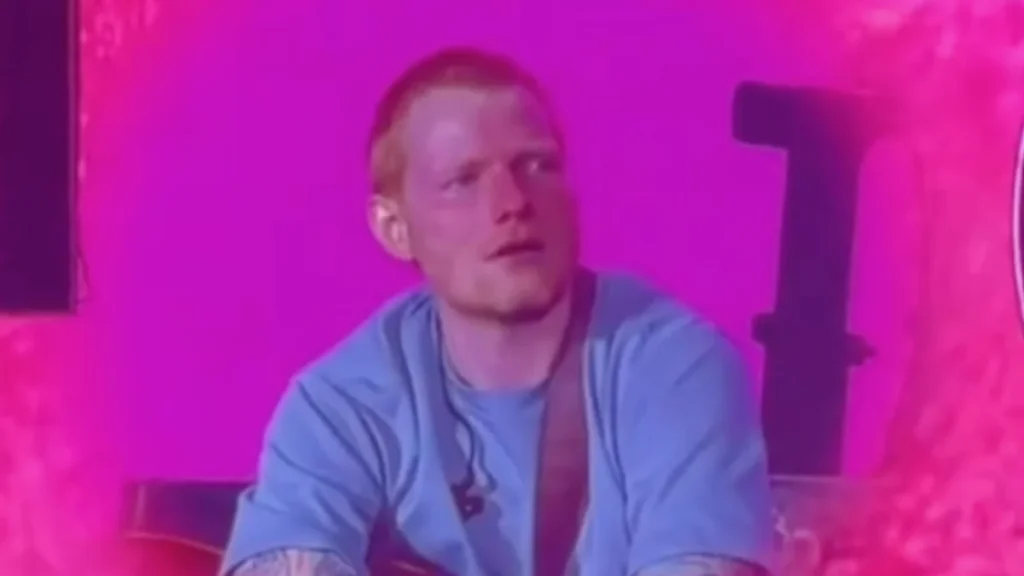

Ed Sheeran’s ongoing "LOOP" tour reached a precarious turning point this past weekend as the global superstar navigated the fallout of a high-profile controversy involving the forced removal of supporting act Macklemore. During a performance at Lincoln Financial Field in Philadelphia on Saturday, September 19, 2026, an visibly emotional Sheeran addressed an audience of 50,000, revealing that the turbulence of the previous week had brought him to the brink of canceling the remainder of his tour and questioning his future as a performer.
The Catalyst: Political Pressure and Contractual Fallout
The crisis originated from a series of statements made by rapper Macklemore regarding the ongoing conflict in Palestine. These remarks, which were highly critical of current geopolitical stances, drew immediate condemnation from influential stadium operators, most notably New England Patriots owner Robert Kraft. Sources indicate that Kraft and several other stadium management entities issued an ultimatum to the Sheeran camp: either remove Macklemore from the lineup or face the cancellation of scheduled performances at their venues.
The situation escalated rapidly throughout the week. Following the confirmation of Macklemore’s removal, the tour experienced a significant loss of internal stability. In an act of solidarity with the rapper and in support of the Palestinian cause, fellow opening acts FINNEAS, Lukas Graham, and Aaron Rowe, along with Sheeran’s own live backing band, Beoga, withdrew from the tour. This sudden exodus left the production team and Sheeran himself in a logistical and emotional vacuum, prompting the singer to re-evaluate his commitment to the remaining tour dates.
A Week of Uncertainty: The Artist’s Perspective
Addressing the crowd during the Philadelphia show, Sheeran was candid about the psychological toll the situation had taken. He described the preceding seven days as among the most difficult of his career, noting that he had been under immense pressure from various associates and peers to shutter the tour entirely.
"I really didn’t know whether this tour would be carrying on," Sheeran told the audience. "I really didn’t know whether I’d even be getting on stage again, whether I even wanted to be an artist at all. In these situations, you really find out who your friends are, and it’s been a weird week. I had so many people telling me to cancel this tour, and so many people coming out of my life that I’ve known for years and years and years just kind of backing away."
The pressure was not merely professional; it was compounded by legitimate security concerns. Reports circulated throughout the week regarding potential threats, leading the production team to implement heightened security measures. Among these adjustments was the controversial decision to scrap the "B-stage," a secondary platform located in the center of the arena floor that allows for closer fan interaction. Sheeran admitted to the audience that he had genuine fears regarding his personal safety and the potential for audience disorder, citing concerns about being booed or having objects thrown at him during the performance.
The Decision to Continue: The Role of Fan Support
Despite the external pressure and the internal dissolution of his support team, Sheeran ultimately chose to proceed with the Philadelphia concert. His decision, he explained, was predicated on the resilience of his ticket-buying audience. Observing that the Philadelphia show had seen no significant drop in attendance or a wave of ticket returns, Sheeran found a renewed sense of purpose.
"I didn’t see cancellations—I saw people buying tickets for this gig," Sheeran remarked. "I see 50,000 people who haven’t abandoned me. I can’t let you guys down. I know how much effort it takes for you guys to get here—the hotels, the flights, the buses, the babysitters. It’s a hell of a lot of effort. And I can’t just bury my head and go, ‘Oh, that doesn’t matter anymore.’"
Sheeran’s performance at Lincoln Financial Field marked his first show since the removal of the support acts. He opened the set by addressing the audience directly, apologizing for the deviation from his usual musical format but emphasizing that the gravity of the events necessitated an explanation. He framed the concert as an act of unity, stating, "My shows are about this: they’re about unity, they’re about love, they’re about family. They’re about people coming together that don’t know each other, that have different beliefs, and jumping around like maniacs with each other and having fun."
Industry Implications and the Debate on Free Speech
The "LOOP" tour controversy has ignited a broader conversation regarding the role of venue operators in determining the artistic content of live performances. The involvement of powerful figures like Robert Kraft in the vetting of an artist’s political speech highlights a growing tension between private venue ownership and the concept of artistic freedom.
Legal analysts suggest that while private stadium owners generally possess the contractual right to curate their stages and enforce "morality clauses" or conduct standards, the trend of preemptive censorship raises questions about the future of touring. When stadium owners exert influence over a headliner’s support acts, the resulting chilling effect can stifle the diversity of voices in the music industry.
Furthermore, the mass withdrawal of supporting acts—FINNEAS, Lukas Graham, and Aaron Rowe—demonstrates a growing trend of "solidarity clauses" and collective action among modern musicians. By choosing to walk away from a lucrative tour, these artists have signaled a shift in industry dynamics, where moral alignment is increasingly becoming a prerequisite for professional collaboration.
Moving Forward: The Future of the "LOOP" Tour
While Sheeran successfully completed the Philadelphia show, the future of the tour remains under observation. The financial and operational strain of replacing a full roster of support acts and managing the logistical fallout of the previous week is substantial. Additionally, the public nature of his emotional disclosure indicates that the strain on his personal relationships and mental well-being is ongoing.
Sheeran concluded his speech in Philadelphia by reinforcing his commitment to his fans, noting that the concert served as a necessary outlet for hope in a polarized climate. "The world is a scary place right now. America is a scary place right now. This gives hope. This gives hope," he said.
As the "LOOP" tour proceeds, the music industry will likely continue to dissect the events of the past week as a case study in the intersection of celebrity, political expression, and the power of venue ownership. For Sheeran, the focus remains on the music, yet the shadow of the controversy persists, leaving observers to wonder how the artist will manage the remaining dates in an environment where he has openly admitted to feeling isolated from his inner circle.
The incident serves as a poignant reminder of the fragility of large-scale touring operations in the current cultural landscape. Whether this event marks a permanent shift in how Sheeran approaches his tours or merely a temporary hurdle in an otherwise storied career, the Philadelphia performance will be remembered as the moment the artist chose to confront the adversity of public opinion head-on, anchored by the loyalty of his fanbase.