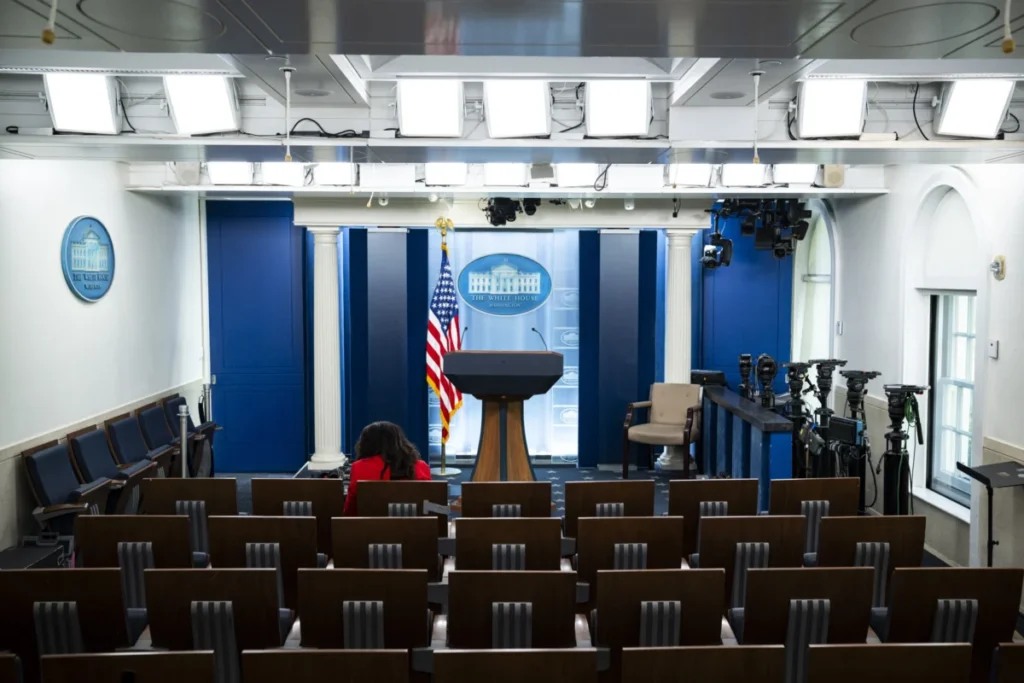

In a high-stakes legal confrontation that directly challenges the boundaries of executive authority and constitutional protections, CNN, MS NOW, and Politico have jointly filed a federal lawsuit against the Trump administration. The legal action was swiftly initiated following a sudden and unprecedented directive from the White House that revoked the press credentials of reporters from all three prominent news organizations, effectively banning their personnel from the executive mansion complex and severely impeding their ability to cover the presidency and its key staff members.
The coordinated lawsuit, spearheaded by renowned First Amendment litigator Ted Boutros, argues that the administration’s actions represent a blatant violation of constitutional guarantees and established legal precedent. The controversy has ignited a fierce national debate concerning press freedom, government transparency, and the fundamental right of independent journalists to scrutinize public officials without facing punitive measures from the executive branch.
Chronology of the Ban: From Social Media Declaration to Physical Lockout
The sequence of events leading to the federal lawsuit unfolded rapidly over a single weekend, catching newsrooms and media observers off guard.
The crisis began when President Donald Trump announced the sweeping ban via a social media post, declaring that CNN, MS NOW, and Politico would no longer be permitted within the White House complex. The announcement generated immediate confusion on the ground, as news crews and correspondents from the affected outlets were still physically stationed on the premises fulfilling their daily reporting duties.
Despite the initial ambiguity surrounding the implementation of the directive, the administration quickly followed through on the president’s stated intent. On the morning following the announcement, journalists attempting to access the White House grounds discovered that their physical and digital press credentials had been summarily deactivated. Security personnel denied them entry, preventing them from carrying out routine journalistic responsibilities, including attending press briefings and covering scheduled official engagements.
The timing of the revocation was particularly disruptive. CNN had been scheduled to serve as the primary television press pool for Monday—a critical logistical role involving the sharing of reporting, video, and audio with the broader media landscape. On that specific day, President Trump was slated to travel to New York City for high-level diplomatic and political meetings, including engagements with New York City Mayor Zohran Mamdani and French President Emmanuel Macron on the sidelines of the United Nations General Assembly. The credential revocation effectively crippled the designated pool structure, forcing news organizations to scramble for alternative coverage methods while locked outside the perimeter.
The Legal Argument: A Direct Assault on Constitutional Principles
Filed early Monday morning, the lawsuit pulls no punches in characterizing the administration’s actions as an egregious breach of fundamental constitutional rights.
“This morning, we notified the government that we are filing a lawsuit today to protect our First Amendment rights and defend the principle that the government does not decide what the press reports or publishes,” the three news organizations stated in a joint press release issued prior to the court filing. “Without notice or process, the White House revoked our journalists’ credentials because it objected to our reporting. Left unchallenged, this threatens press freedom and the public’s right to independent journalism free from government interference.”
The legal brief submitted by Ted Boutros and his legal team outlines a comprehensive constitutional defense, anchoring its arguments in bedrock Supreme Court jurisprudence. The complaint cites the landmark 1964 ruling in New York Times Co. v. Sullivan, which established that public debate on government affairs must remain uninhibited, robust, and wide-open—even when that discourse includes vehement, caustic, or sharply critical attacks on public officials.
Furthermore, the lawsuit emphasizes the specific property and liberty interests associated with press credentials. The filing contends that white house correspondents and their respective employers hold a constitutionally protected interest in the access that credentials provide, serving not merely the private commercial interests of the media companies, but the broader public’s right to be informed.
“No official can deprive Plaintiffs of those interests on a whim—with no notice, no process, and no warning—as the President did here,” the lawsuit states, emphasizing the complete absence of due process in the administrative revocation.
The President’s Rationale and Public Statements
During an appearance in the Oval Office following the implementation of the ban, President Trump defended his decision, framing it as a necessary response to cumulative coverage over several years rather than a reaction to any single, isolated news story.
According to accounts detailed within the lawsuit, the president offered a direct and candid rationale for targeting the three specific media organizations. The legal filing notes that the president characterized it as “wrong” to “allow people to write purposely negative stories,” while complaining at length about coverage he deemed inherently “one-sided” and “never good.” In a remarkable rhetorical moment captured during his remarks, the president reportedly referred to his own unprecedented administrative action using the explicit descriptor of a “ban on the free press.”
Moreover, the president demonstrated an awareness of the impending legal battle, suggesting publicly that the ultimate fate of the credential bans would likely be determined by whichever federal judge happened to draw the case.
Historical Precedent and Past White House Press Disputes
While the current mass revocation involving three major outlets is unprecedented in its scale, it is not the first time the Trump administration has clashed with the press over access to the White House complex.
During his first term in office, the Trump administration similarly revoked the press pass of CNN chief White House correspondent Jim Acosta following a contentious exchange during a post-midterm election news conference. In response, CNN filed a federal lawsuit against the administration. A federal judge ultimately ruled in favor of the network, ordering the immediate restoration of Acosta’s press pass and citing violations of the Fifth Amendment’s due process guarantees.
In a separate historical instance, the Associated Press faced restricted access to certain official events after its corporate style guide declined to adopt terminology favored by the administration regarding a major body of water, leading to a legal challenge over administrative retaliation against specific editorial choices.
Legal analysts point out that while the executive branch maintains broad discretionary authority over property management and security protocols within the White House complex, that authority is legally constrained by the First Amendment. Once the government opens the White House to the press as a public forum for newsgathering, it cannot selectively bar journalists based on the viewpoint or content of their reporting without running afoul of constitutional protections.
Broader Implications for Media Freedom and Good Governance
The unfolding legal battle carries profound implications for the future relationship between the executive branch and the American news media. Media ethics organizations, civil liberties advocates, and press freedom watchdogs have rallied around the plaintiffs, warning that permitting executive officials to unilaterally silence or ban critical reporting outlets establishes a dangerous authoritarian blueprint.
Independent journalism relies heavily on physical access to seats of government to provide accurate, verified accounts of official policy decisions, diplomatic meetings, and administrative actions. When access is weaponized as a tool of political retaliation, the ultimate casualty is the electorate, which depends on unfettered reporting to evaluate the performance of elected leaders.
As the lawsuit proceeds through the federal court system, legal scholars will be closely monitoring how the judiciary balances executive security prerogatives against the robust speech and press protections enshrined in the Constitution. For CNN, MS NOW, and Politico, the immediate objective remains securing an emergency injunction to restore their credentials and re-establish a physical reporting presence inside the White House complex.