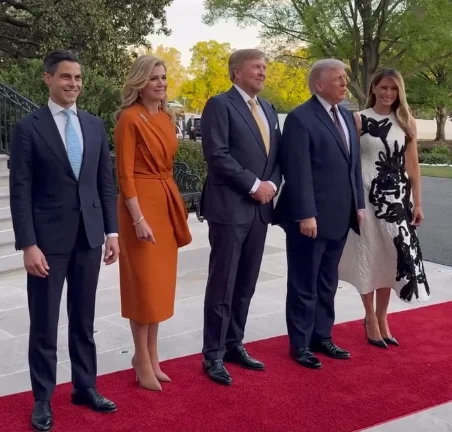

The official visit of King Willem-Alexander and Queen Maxima of the Netherlands to the United States commenced with a significant diplomatic engagement, featuring a formal dinner at the White House with President Donald Trump and First Lady Melania Trump. This high-profile reception marked the Dutch monarch’s first official step onto American soil for this particular tour, setting a tone of bilateral engagement that spans historical ties and contemporary collaborations. The visit, timed as the United States gears up for its 250th anniversary of the Declaration of Independence, underscores the enduring relationship between the two nations and highlights shared values of freedom and democracy.
A "Royal Arrival" at the White House
The White House officially acknowledged the significance of the Dutch royal couple’s arrival, describing it as a "royal arrival" on social media platforms. Images released by the administration depicted the Trumps warmly welcoming King Willem-Alexander and Queen Maxima, underscoring the ceremonial importance of the occasion. The dinner, held on the first evening of their trip, was not a State Dinner, which typically involves more elaborate protocols and attire. Consequently, the gentlemen were dressed in suits, and the ladies in elegant cocktail dresses. Queen Maxima, known for her appreciation of exquisite jewelry, opted for a striking orange ensemble, a color deeply symbolic of the Netherlands, complemented by a sparkling diamond brooch. This choice of attire subtly yet effectively communicated national pride and a diplomatic nod to her host nation.
A Journey Through American History and Modernity
The Dutch royal tour began not in the nation’s capital, but in Philadelphia, Pennsylvania, a city steeped in the very history that the United States is preparing to commemorate. Upon arrival, King Willem-Alexander and Queen Maxima were afforded the opportunity to connect with the foundational narratives of American independence by viewing the Liberty Bell. This iconic artifact, cast in 1752 by a London firm and inscribed with the biblical phrase "Proclaim LIBERTY Throughout all the Land unto all the Inhabitants Thereof," stands as a potent symbol of freedom and independence. The presence of the crack in the bell, a testament to its long and storied existence, only adds to its historical gravitas. The royals’ engagement with this symbol resonated deeply, particularly given the trip’s explicit aim to mark the anniversary of the Declaration of Independence.
During a speech delivered in Philadelphia, King Willem-Alexander eloquently articulated the historical significance of the moment for both nations. He acknowledged that Philadelphia represented "historic ground" for the Dutch as well, recognizing that "with the birth of the United States in 1776, the world’s history changed course." The King lauded the Americans for creating "a beacon of hope for all freedom-loving nations," and proudly stated that "the Netherlands was one of the first countries that understood and embraced the signs of the new age." This sentiment reflects centuries of shared understanding and mutual respect, tracing back to the early days of American nationhood when the Netherlands was among the first to formally recognize the nascent republic. Historical records indicate that the Netherlands was indeed the first country to officially recognize the United States as an independent nation in 1782.
Beyond the historical reflections, the royal couple also delved into contemporary American culture and innovation. Their itinerary included a visit to the Philadelphia Eagles, a professional American football team. Here, they received an introduction to the sport and were presented with personalized jerseys, a gesture of hospitality and cultural exchange. This engagement was not merely ceremonial; it also provided a platform to discuss innovation within the sports sector, aligning with the broader objectives of the visit to foster economic and cultural ties between the Netherlands and the United States. Such interactions highlight a modern approach to diplomacy, bridging historical connections with forward-looking collaborations.
Diplomatic Footprints and Future Engagements
Following their immersion in Philadelphia’s historical and cultural landscape, King Willem-Alexander and Queen Maxima proceeded to Washington D.C. for their scheduled meeting with President Trump. This encounter followed President Trump’s own visit to the Netherlands the previous year, an event that had garnered some media attention due to a reported facial expression by Queen Maxima during their interaction, which she later attributed to misunderstanding. The current visit, therefore, presented an opportunity to reinforce and perhaps smooth over any perceived diplomatic nuances, showcasing a united front between the two nations.
The timing of the Dutch royal visit is particularly noteworthy, occurring just days before the arrival of another significant royal delegation: King Charles III and Queen Camilla of the United Kingdom, who are scheduled to undertake a State Visit to the United States. The presence of two prominent European royal families within such a close timeframe underscores the heightened diplomatic activity and the strategic importance the United States places on its relationships with key allies. This confluence of high-level royal visits serves to amplify the enduring transatlantic bonds and to project a united front on the global stage.
Economic and Cultural Pillars of the Visit
The Dutch royal visit is strategically designed to bolster economic and cultural ties between the Netherlands and the United States. The Netherlands has long been a significant trading partner for the U.S., with substantial investments flowing in both directions. Bilateral trade in goods and services between the U.S. and the Netherlands exceeded $100 billion in 2022, according to U.S. Department of Commerce data, underscoring the economic significance of this relationship. The focus on innovation, as exemplified by the visit to the Philadelphia Eagles, signals a commitment to exploring new avenues for collaboration in sectors such as technology, renewable energy, and advanced manufacturing.
Culturally, the Netherlands and the U.S. share a rich heritage, with Dutch influence evident in early American settlements and a continuous exchange of artistic and intellectual ideas. The royal visit serves to further deepen these connections, promoting cultural understanding and people-to-people exchanges. By engaging with historical sites, cultural institutions, and modern industries, King Willem-Alexander and Queen Maxima are not only representing their nation but also acting as cultural ambassadors, fostering goodwill and strengthening the people-to-people connections that form the bedrock of diplomatic relations. The itinerary, spanning across states like Pennsylvania, Washington D.C., and Florida, demonstrates a comprehensive approach to engaging with various facets of American society and economy.
A Broader Context of Transatlantic Relations
The visit of King Willem-Alexander and Queen Maxima occurs within a broader context of evolving transatlantic relations. As global challenges, from geopolitical instability to climate change, continue to shape the international landscape, the importance of strong alliances and diplomatic cooperation has never been more pronounced. The Netherlands, a founding member of NATO and a key player in European affairs, shares many of the United States’ core foreign policy objectives. This royal visit, therefore, is more than a ceremonial exchange; it is a tangible demonstration of the enduring strength and adaptability of the Dutch-American partnership.
The fact that the visit is taking place in the lead-up to the U.S. celebrating its 250th anniversary of independence lends an added layer of historical resonance. It provides an opportunity for reflection on the shared journey of democratic values and the continuous pursuit of liberty that both nations espouse. By engaging with historical landmarks and contemporary advancements, the Dutch royals are symbolically connecting the past with the future, reinforcing the narrative of a long-standing and dynamic alliance. The strategic importance of this visit is further amplified by its proximity to the State Visit of the British monarchs, suggesting a coordinated effort to reinforce transatlantic solidarity and to reaffirm the vital role of these partnerships in navigating the complexities of the 21st century. The interactions, from formal state dinners to cultural immersions, are designed to leave a lasting impact, solidifying diplomatic ties and opening new avenues for collaboration for years to come.