
The 64th annual New York Film Festival commenced on a triumphant and deeply nostalgic note at Lincoln Center’s Alice Tully Hall, where acclaimed auteur James Gray debuted his latest cinematic achievement, Paper Tiger, as the coveted Opening Night selection. Introduced by festival Artistic Director Dennis Lim as “one of the great living American filmmakers,” Gray stood before a packed, enthusiastic house to present a project that carries both personal resonance and significant commercial momentum. For Gray, whose career has long been defined by critical acclaim yet persistent awards-season snubs, the evening marked a potential turning point, launching a high-profile North American campaign backed by distributor Neon.
The journey of Paper Tiger to this prestigious platform has been closely monitored by cinephiles and industry insiders alike. Following its enthusiastic, albeit ultimately unrewarded, world premiere at the Cannes Film Festival earlier in the year, the crime-drama has been meticulously positioned for the fall festival circuit. Neon, recognized for its astute awards-season navigation, has rolled out the feature with a level of fanfare that routinely eludes Gray’s deeply personal, independent-spirited projects. Presented on a striking 35mm print at Lincoln Center, the screening served as a powerful reminder of traditional cinematic craftsmanship in an era heavily dominated by tentpole blockbusters and international imports.
A Homecoming Rooted in Personal History
The evening carried an undeniable emotional weight for Gray, a native of Queens, New York, who grew up merely miles away from the Upper West Side cultural hub. During his introductory remarks, the director reflected on his formative years, recalling the exact moment he informed his parents of his ambition to direct motion pictures. Their initial, skeptical response—asking how such a feat could possibly be accomplished—provided a poignant contrast to the reality of the evening. Looking out at the sold-out auditorium of industry professionals, critics, and film enthusiasts, Gray delivered a simple, visibly moved acknowledgment: “Well, here I am.”
This deep-seated connection to New York City permeates much of Gray’s filmography, notably echoed in past festival appearances. Gray previously closed the New York Film Festival with his historical exploration The Lost City of Z and contributed to the festival’s milestone anniversaries with special screenings of his autobiographical coming-of-age drama Armageddon Time. However, the reception surrounding Paper Tiger feels fundamentally distinct. Industry analysts and festival organizers have noted that the cultural climate for mid-budget, character-driven American dramas has grown increasingly perilous, rendering the successful financing and execution of Gray’s film nothing short of miraculous.
Narrative Scope and Star-Studded Cast
Set against the gritty backdrop of 1986 Queens, Paper Tiger delves into the harrowing complexities of familial obligation and survival. The narrative centers on Irwin and Gary Pearl, two brothers portrayed respectively by Miles Teller and Adam Driver, who find themselves entangled in a high-stakes criminal scheme that threatens to destroy their family. As the plot tightens, the emotional core of the film shifts toward Irwin’s wife, Hester, brought to life by Scarlett Johansson. Hester is forced to navigate her own profound personal crisis while plotting the best course of action to protect her sons and secure their future.
Gray’s screenplay ingeniously marries the taut, suspenseful mechanics of a classic crime thriller with the textured, emotionally resonant framework of domestic drama. The narrative is anchored primarily through Irwin’s point of view, opening and closing the feature with a framing device that establishes his internal burden. While the filmmakers have confirmed that Teller will campaign in the lead actor category due to his pervasive narrative presence, the supporting turns by Driver and Johansson have already generated substantial critical praise, positioning them as formidable contenders in the upcoming Academy Awards race.

The Awards Strategy and Critical Momentum
The strategic positioning of Paper Tiger for the upcoming awards season represents a calculated maneuver by distributor Neon. Historically, James Gray’s filmography—while cherished by international critics and championed by auteur-driven publications—has struggled to break through the final barriers of the Academy Awards. Despite mounting critical praise for masterpieces such as Two Lovers, The Immigrant, and Ad Astra, major Oscar nominations have remained frustratingly out of reach.
Industry observers suggest that the timing and platform of the New York Film Festival premiere may finally alter this trajectory. Festival Artistic Director Dennis Lim emphasized during pre-festival press engagements that original, director-driven American cinema faces unprecedented economic and institutional hurdles. By framing Paper Tiger as a rare triumph of independent tenacity, Neon is actively cultivating a narrative of overdue recognition for Gray. Furthermore, the powerhouse trio of Teller, Driver, and Johansson provides the film with the requisite star power and promotional momentum needed to navigate a fiercely competitive awards landscape.
Behind the Scenes: A Labor of Love
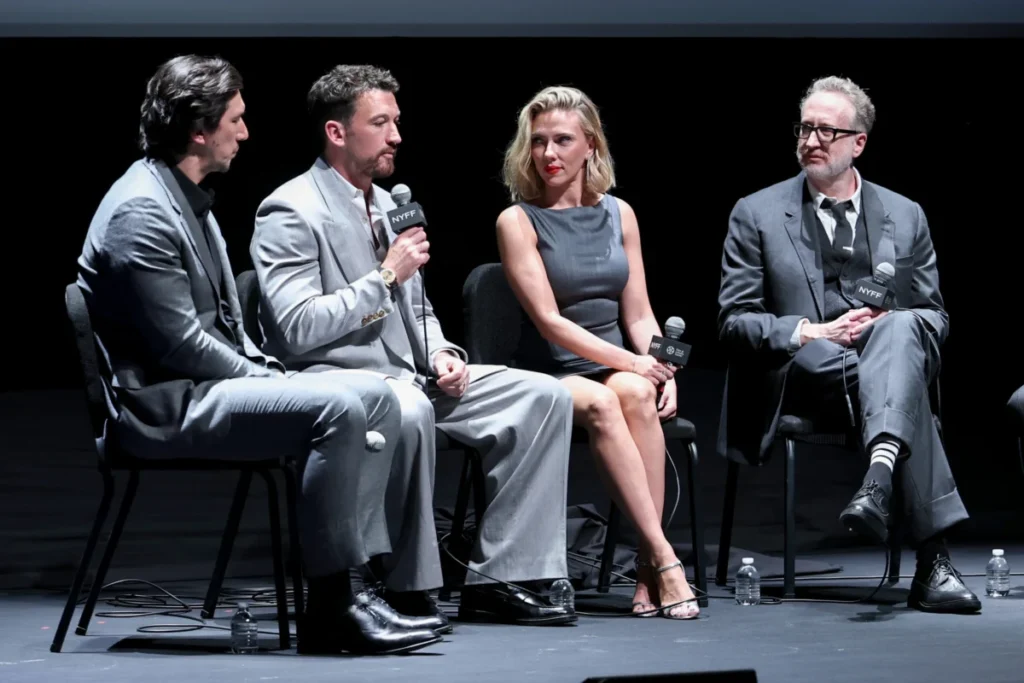
Following the triumphant North American premiere, the core cast joined Gray on stage for an intimate post-screening Q&A session, shedding light on the grueling yet rewarding production process. The actors detailed the intimate, often punishing conditions under which the period piece was brought to life.
“We were on such a small set… and also it was extremely hot, and when you have a group of actors hanging around with everybody on top of each other — honestly, that’s a labor of love. You do it because you love to do it,” Johansson shared with the audience. She elaborated on the camaraderie forged during the difficult shoot, noting that the cast relied on mutual support, shared storytelling, and collective survival to endure the physical and emotional demands of the production. “You have to survive the day, and it’s hard making movies, and it’s very hard making movies [like this],” she added.
Broader Implications for Independent Cinema
The enthusiastic reception of Paper Tiger at Lincoln Center extends far beyond individual awards speculation, touching upon broader questions regarding the viability of adult-skewing, non-franchise American cinema. In an entertainment ecosystem increasingly dictated by intellectual property and global box-office guarantees, the ability of a filmmaker like Gray to secure financing, attract top-tier talent, and deliver a polished 35mm feature remains a vital bellwether for the industry.
As the film rolls out to general audiences and continues its theatrical campaign through the fall, its performance at the box office and within the broader awards ecosystem will be closely monitored. Should Paper Tiger succeed in translating its critical adoration into tangible Oscar recognition, it could serve as a powerful precedent for financiers and studios hesitant to back original American dramas. For James Gray, however, the immediate victory lies in returning to his hometown roots, sharing a deeply personal cinematic vision with an audience that recognizes the enduring power of his directorial voice.