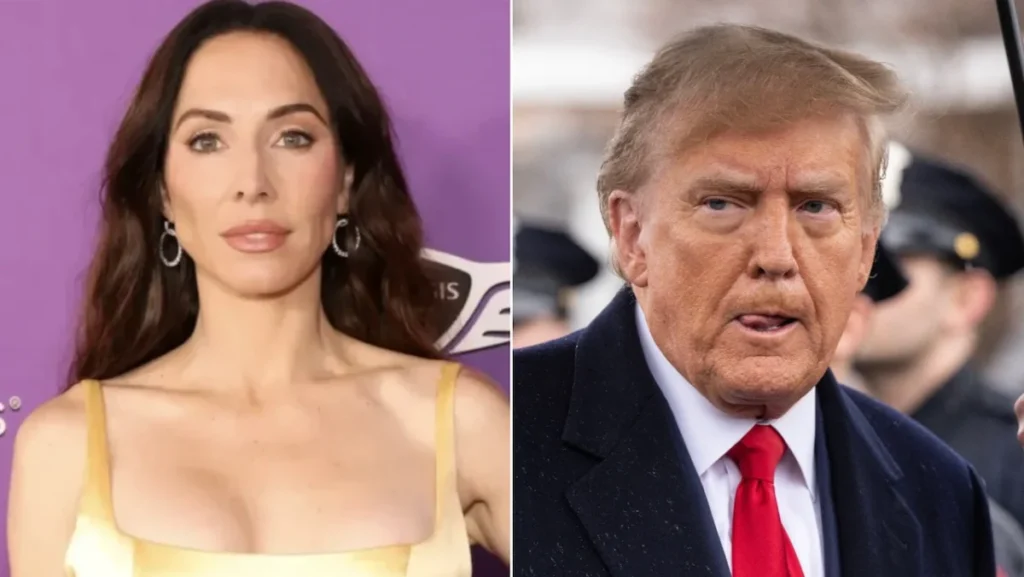

Comedian Whitney Cummings has revealed that two jokes targeting former President Donald Trump, delivered during her performance at the 27th Mark Twain Prize for American Humor honoring Bill Maher, were subjected to censorship, with one removed during rehearsal and another slated for exclusion from the upcoming Netflix broadcast. The incident, unfolding against a backdrop of heightened political sensitivities at the venerable Kennedy Center, has ignited a discussion about artistic freedom, institutional autonomy, and the role of comedy in critiquing political figures. The Netflix special, featuring the June 28th event, is scheduled for release on July 21st.
A Chronology of Comedy and Controversy
The seeds of this controversy were arguably sown months before Cummings took the stage. In December, the Kennedy Center, a national performing arts center in Washington D.C. that receives federal funding and whose board of trustees includes presidential appointees, saw a significant shift in its leadership. Reports indicated that former President Trump had installed several loyalists into key leadership roles at the venue. This move raised concerns among some observers about the potential for political influence to permeate the institution’s artistic programming and operational decisions, challenging its long-held reputation as an independent cultural beacon.
Fast forward to June 28th, 2026, the night of the 27th Mark Twain Prize for American Humor, an event designed to celebrate the legacy of America’s foremost satirist by honoring individuals who have profoundly impacted American society through their comedic work. This year, the recipient was veteran comedian and political commentator Bill Maher, known for his no-holds-barred approach to political satire. Whitney Cummings, a prominent stand-up comedian and actress, was among the lineup of performers paying tribute to Maher.
During rehearsals for her set, Cummings recounted on her "Good for You" podcast, she presented a joke involving Trump and historical figures. The joke, which she later revealed on her podcast, stated: "For Trump to put his name on the Kennedy Center this is even petty for him. But Trump has always hated John F. Kennedy because the Kennedys had Marilyn Monroe k— before he could grab her by the p—." Cummings described the immediate reaction from Kennedy Center staff as one of alarm. "I was practicing my jokes and people were like, ‘We’ll get fired if you say that.’ That is the worst thing you can hear." Faced with the prospect of staff losing their jobs, Cummings made the difficult decision to remove the joke from her planned performance. She explained her attempt to find a compromise, offering to cut other material, but ultimately prioritized the job security of the Kennedy Center employees.
Despite this initial concession, Cummings delivered another Trump-related joke during her live performance. Addressing the audience from the stage, she quipped, "Trump couldn’t make it tonight. He got caught in sex traffic." This joke, a clear jab at the former president, was reportedly met with audience reaction and was subsequently reported by a journalist present at the Mark Twain Prize event, circulating on social media and various news outlets shortly after the performance. The public dissemination of the joke’s content meant that, despite any subsequent editing, its existence and nature were already widely known.
The situation escalated when Cummings learned that this second joke, already delivered and reported, would also be edited out of the official Netflix broadcast of the event. On a subsequent episode of her podcast, Cummings described being "presented with a tricky conundrum" regarding the editing of her performance. She expressed her internal conflict, stating, "I don’t know if I did the right thing or not." She reiterated that the implicit threat of staff losing their jobs or the potential for Trump to pursue legal action against the Kennedy Center or herself were significant factors in the decision-making process.
The Mark Twain Prize: A Bastion of Satire Under Scrutiny
The Mark Twain Prize for American Humor, established in 1998, has consistently celebrated comedians renowned for their social commentary and willingness to challenge authority. Named after Samuel Langhorne Clemens, whose pen name Mark Twain became synonymous with sharp wit and incisive critique of American society, the award’s very essence is rooted in the freedom of expression and the power of humor to hold a mirror to political and social realities. Past recipients like Richard Pryor, George Carlin, Whoopi Goldberg, and Jon Stewart have exemplified this tradition, often pushing boundaries and engaging in pointed political satire.
The irony of censorship at an event designed to honor such a legacy was not lost on Cummings. "This is the Mark Twain prize," she emphasized on her podcast. "This is the only time you shouldn’t get censored because it is about comedians using humor to criticize our elected officials." Her statement underscores a fundamental tension: an institution dedicated to celebrating comedic bravery seemingly succumbing to external pressures that stifle that very bravery. This incident raises questions about whether the institutional integrity and artistic mission of the Mark Twain Prize can be maintained when facing political pressure, particularly from figures with a history of litigiousness or public denunciation of critics.
Official Responses and Broader Implications
Following Cummings’ revelations, attention quickly turned to Netflix and the Kennedy Center for clarification. Matt Belloni of Puck reported that Netflix did not make the decision to cut Cummings’ joke. Instead, he attributed the call directly to the Kennedy Center. In a statement provided to Belloni, Netflix clarified its position: "While it’s our preference not to cut jokes from anyone’s set, the Kennedy Center has the contractual right to do so." This statement suggests that Netflix, as the broadcast platform, was bound by the terms of its agreement with the Kennedy Center, granting the latter final editorial control over the content. This contractual clause effectively transfers the responsibility for the censorship decision to the Kennedy Center.
The Kennedy Center, as of the publication of this article, has not issued a direct public statement regarding the specific cuts to Whitney Cummings’ performance or the reasoning behind them. However, Netflix’s statement implies that the decision was a deliberate exercise of the Kennedy Center’s contractual rights, likely stemming from the concerns articulated by staff during rehearsals – namely, the potential for severe repercussions, including job losses or legal challenges, if the jokes were aired.
This incident is more than just a comedian’s jokes being cut; it resonates with broader discussions about freedom of speech, institutional independence, and the chilling effect of political pressure on artistic expression. The Kennedy Center, as a federally linked institution, operates under a unique spotlight. The appointment of politically aligned individuals to its leadership positions inevitably raises questions about the potential for politicization of its programming and a departure from its role as a neutral cultural arbiter.
The fear expressed by Kennedy Center staff about losing their jobs highlights a critical vulnerability within cultural institutions that rely on public funding or have government affiliations. When artistic choices are perceived to threaten the employment of individuals, it creates an environment conducive to self-censorship, even if tacitly. Cummings herself acknowledged this dilemma, stating, "I was in this jam… I just want to be clear that the people who work there did their jobs well and protected their boss. They protected the president of the United States from me destroying his reputation." Her sarcastic tone in the latter part of the statement underscores her belief that the censorship was an overreaction, but it also points to the real-world anxieties faced by those working within such institutions.
Moreover, the futility of attempting to suppress information in the digital age is starkly evident. The "sex traffic" joke, once delivered live, was immediately reported and circulated online. Cummings’ decision to reveal both censored jokes on her widely listened-to podcast ensured that the content, and the story of its suppression, reached an even larger audience than the Netflix broadcast might have alone. This dynamic suggests that attempts at censorship, particularly in an era of rapid information dissemination, often backfire, drawing more attention to the very content they seek to hide and igniting broader conversations about the reasons for suppression.
The implications extend to the future of the Mark Twain Prize itself. If the award, intended to celebrate irreverent and critical humor, becomes subject to such direct censorship regarding political figures, its credibility and impact could be diminished. It sets a precedent that political jokes, particularly those targeting powerful figures, might be deemed too risky for broadcast, potentially leading to a watering down of future performances and a cautious approach from comedians. This could undermine the very spirit of Mark Twain, who famously challenged authority and societal norms through his satirical writings.
In conclusion, Whitney Cummings’ experience at the Mark Twain Prize has brought to the forefront the complex interplay between artistic freedom, institutional governance, and political power. While the Kennedy Center, through its contractual rights, exercised its prerogative to edit the broadcast, the incident has sparked a necessary debate about the pressures faced by cultural institutions and the enduring importance of comedy as a vehicle for social and political commentary, especially in a polarized public sphere. The final Netflix broadcast on July 21st will be notable not only for the humor it presents but also for the conspicuous absence of the jokes that sparked this significant conversation.