
The grand celebrations marking the Golden Jubilee of King Carl XVI Gustaf of Sweden in September 2023 offered an unprecedented spectacle of European regal pageantry, uniting royal families from across the continent in Stockholm. While the milestone itself was historic—making King Carl XVI Gustaf the longest-reigning monarch in Swedish history—the glittering gala dinner held on September 15 provided an equally captivating visual narrative through high jewelry. Among the dazzling displays of emeralds, rubies, and sapphires, a distinct subset of royal women chose to honor the historic occasion by wearing the very same tiaras they had worn on their respective wedding days. This thoughtful stylistic choice not only added a romantic layer to the national celebration but also highlighted the deep sentimental value, intricate craftsmanship, and dynastic heritage embedded within Europe’s most famous private jewelry collections.
A Historic Milestone Set Against a Backdrop of Scandinavian Splendor
To fully understand the significance of the jewelry on display during the September 2023 festivities, one must examine the monumental nature of the Golden Jubilee itself. Ascending to the throne on September 15, 1973, following the death of his grandfather, King Gustaf VI Adolf, Carl XVI Gustaf weathered five decades of modernization, societal shifts, and technological revolutions while maintaining the continuity of the Swedish constitutional monarchy. By reaching his 50th year on the throne, he achieved a feat unprecedented in the thousand-year recorded history of the Swedish monarchy.
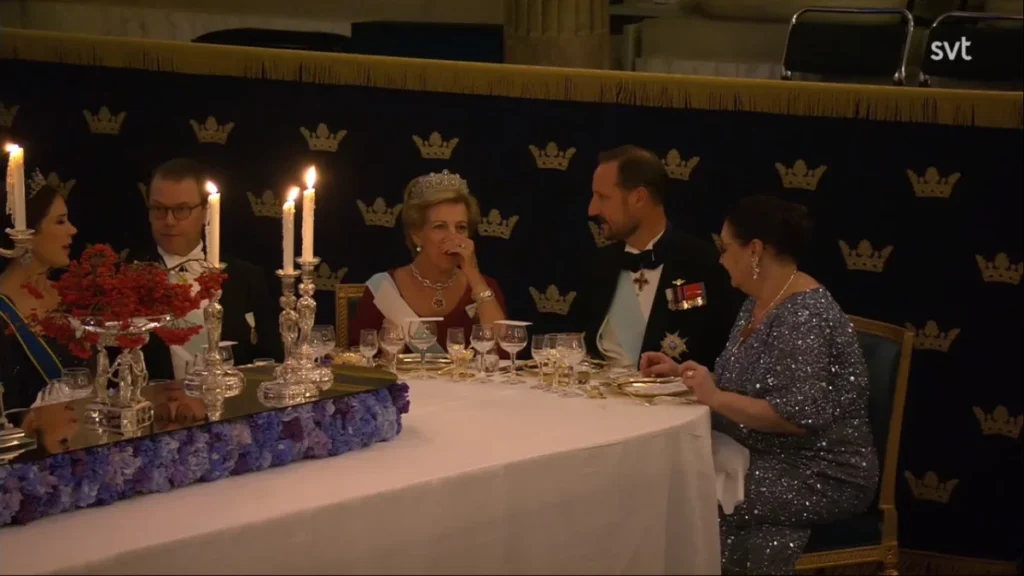
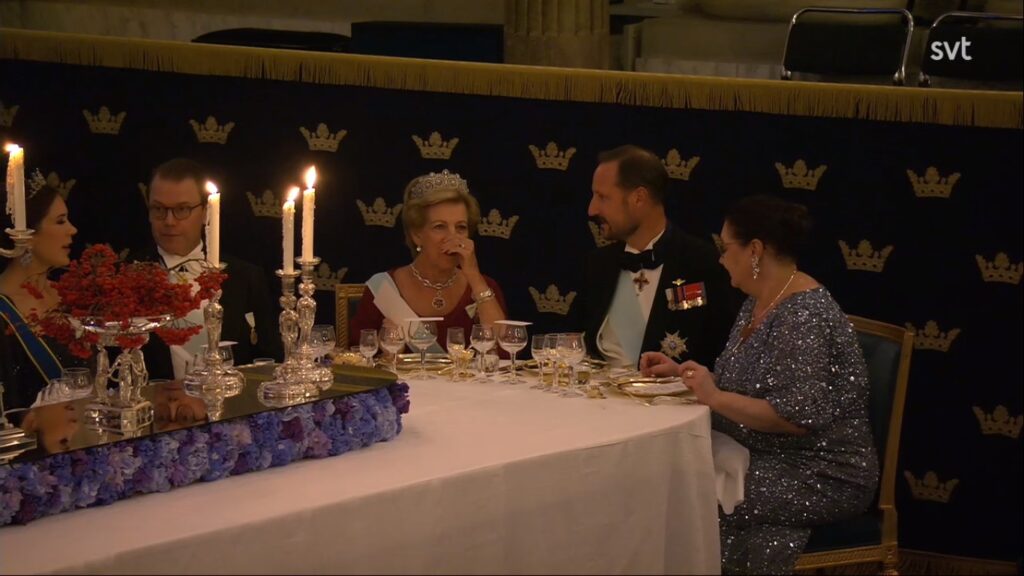
The celebrations spanned several days, drawing reigning monarchs, heirs, and extended family members from Denmark, Norway, Greece, and beyond. The culmination of these events was a high-profile gala dinner hosted at the Royal Palace in Stockholm. Dress codes called for white tie and decorations, prompting royal attendees to draw from the legendary Bernadotte family vault and their own personal collections. While historic pieces with centuries of provenance made their expected appearances, the deliberate choice by several high-profile princesses and queens to re-wear their bridal tiaras introduced a narrative of enduring marital partnership and familial continuity to the proceedings.

Queen Anne-Marie of Greece and the Transgenerational Legacy of the Khedive of Egypt Tiara
Among the most historically significant wedding tiaras on display during the jubilee weekend was the Khedive of Egypt Tiara, worn by Queen Anne-Marie of Greece. Crafted by Cartier at the dawn of the 20th century, this stunning diamond laurel scroll tiara was originally commissioned as a wedding gift for Princess Margaret of Connaught from the last Khedive of Egypt, Abbas Hilmi II, ahead of her marriage to the future King Gustaf VI Adolf of Sweden in 1905.
Following Princess Margaret’s untimely passing in 1920, the tiara was inherited by her only daughter, Princess Ingrid. When Ingrid married the future King Frederik IX of Denmark in 1935, she brought the magnificent piece to the Danish court. Queen Ingrid famously established a family tradition by lending the Khedive of Egypt Tiara liberally to female relatives for their wedding days. Consequently, a remarkable lineage of brides has worn the piece: Queen Margrethe II of Denmark, Queen Anne-Marie herself, Princess Benedikte of Denmark, Princess Alexandra of Sayn-Wittgenstein-Berleburg, Princess Nathalie of Sayn-Wittgenstein-Berleburg, and Princess Alexia of Greece and Denmark.
Queen Anne-Marie wore the tiara for her wedding to the young King Constantine II of the Hellenes on September 18, 1964, when she was just 18 years old. True to family tradition, she paired it with the antique lace veil worn by Princess Margaret in 1905—a textile heirloom utilized by nearly every bride in the lineage. Upon Queen Ingrid’s death in 2000, Queen Anne-Marie inherited the tiara outright. Seeing the Cartier scrollwork gleaming under the Stockholm chandeliers in 2023 served as a living testament to a century of interwoven Scandinavian, Greek, and British royal history.
Queen Mary of Denmark: A Personal Gift and Modern Versatility
Representing the Danish royal house at the jubilee gala, Queen Mary—then serving as Crown Princess—wore the delicate diamond tiara gifted to her by Queen Margrethe II and Prince Henrik for her marriage to Crown Prince Frederik on May 14, 2004. Unlike many institutional pieces held within state or family foundations, this modern diamond headpiece is a personal gift, meaning its permanent ownership rests entirely with Mary rather than the royal jewel vaults.

The provenance of the tiara has remained a closely guarded secret, adding an air of mystery to its exquisite craftsmanship. The piece features delicate diamond motifs incorporating hearts and fleurs-de-lys set upon a slender, low-profile band. Designed with modern versatility in mind, the tiara can be disassembled and worn as a necklace, a configuration Mary has utilized on numerous state occasions.
In 2011, the Crown Princess commissioned Danish jeweller Marianne Dulong to update the piece, adding a discreet row of pearls to the base alongside interchangeable pearl toppers for the smaller elements. This adaptability has allowed the tiara to transition seamlessly from the grand white-tie atmosphere of a Swedish royal jubilee to more understated diplomatic receptions, demonstrating how contemporary royal women curate and evolve their jewelry collections to suit modern lifestyles.
Princess Sofia of Sweden and the Secretly Commissioned Palmette Tiara
Closer to home, the host nation’s own Princess Sofia turned heads at the jubilee gala by donning the striking diamond tiara she received from King Carl XVI Gustaf and Queen Silvia on her wedding day, June 13, 2015. The origin story of Princess Sofia’s tiara remains one of the most intriguing modern tales in royal jewelry lore, rooted in secrecy and careful planning.
Reports indicate that Queen Silvia orchestrated the creation of the tiara in total secrecy, utilizing diamonds reportedly sourced from one of her own personal necklaces. To prevent leaks to the international press that might ruin the surprise for the bride-to-be, the piece was manufactured in Thailand. The resulting headpiece features vertical diamond palmettes and sharp diamond spikes mounted on a delicate frame, creating a striking silhouette that contrasts with traditional floral or scroll motifs.
Much like Queen Mary’s bridal piece, Princess Sofia’s tiara was engineered for maximum versatility. On her wedding day in 2015, it debuted with vibrant emerald attachments at the tips of the spikes. Over the ensuing years, the Swedish Royal Court confirmed that the tiara’s side stones could be swapped out depending on the occasion. Sofia has since styled the piece with pearls, diamonds, turquoise, and, in a debut shortly before the jubilee events, rich yellow citrines. This modular design has allowed the Princess to consistently refresh a single foundational piece of jewelry to match various state gowns and national colors.
Princess Madeleine and the Mystery of the Modern Fringe Tiara
Rounding out the notable bridal tiaras featured at the September 2023 gala was the Modern Fringe Tiara, worn by Princess Madeleine for her wedding to Christopher O’Neill on June 8, 2013. The piece made its first documented public appearance within the Swedish royal family around 1986, leading jewelry historians and royal watchers to speculate that it may have been commissioned as a tenth wedding anniversary gift from King Carl XVI Gustaf to Queen Silvia.
Unlike the historic Bernadotte family foundation tiaras—which are managed by a legal entity responsible for the maintenance and preservation of dynastic heirlooms—the Modern Fringe Tiara is part of Queen Silvia’s private property. The stylized, diamond-set vertical elements closely resemble abstract floral motifs, capturing a distinctly contemporary aesthetic that bridges classic fringe designs with mid-century modern lines.
Like several of its contemporary counterparts, the tiara is convertible and can be worn as a necklace. Over the decades, the piece became increasingly associated with Princess Madeleine, leading the Swedish Royal Court to formally confirm that Queen Silvia and King Carl XVI Gustaf had gifted the tiara to their younger daughter for her personal collection. By choosing to wear it for her father’s Golden Jubilee, Madeleine underscored both her personal connection to the piece and the continuity of the Bernadotte women’s style legacy.

Broader Implications and the Cultural Economy of Royal Jewels
The deliberate choice of these specific historic and bridal pieces during King Carl XVI Gustaf’s Golden Jubilee extends far beyond mere aesthetic appreciation. In the modern era, European monarchies operate under intense public scrutiny regarding transparency, public funding, and relevance. By showcasing jewelry with deep historical roots, personal narratives, and sustainable adaptability—such as transforming tiaras into necklaces or swapping colored gemstones—royal families effectively communicate values of heritage, stewardship, and thoughtful consumption.
Furthermore, these high-profile public appearances drive significant cultural and economic engagement. Fashion and jewelry analysts note that royal events broadcast to millions worldwide generate immense global interest in traditional European craftsmanship, high-end design houses like Cartier, and independent regional artisans. When royals re-wear bridal items, they also challenge the modern throwaway culture, demonstrating that significant personal investments can be cherished, adapted, and passed down across generations.
Ultimately, the glittering display at the Stockholm Royal Palace on September 15, 2023, served as a masterclass in royal communication. Through the silent language of diamonds, platinum, and heirloom lace, Queen Anne-Marie, Queen Mary, Princess Sofia, and Princess Madeleine honored a historic head of state while reinforcing the enduring bonds of family, history, and matrimonial dedication that sustain Europe’s royal houses into the 21st century.