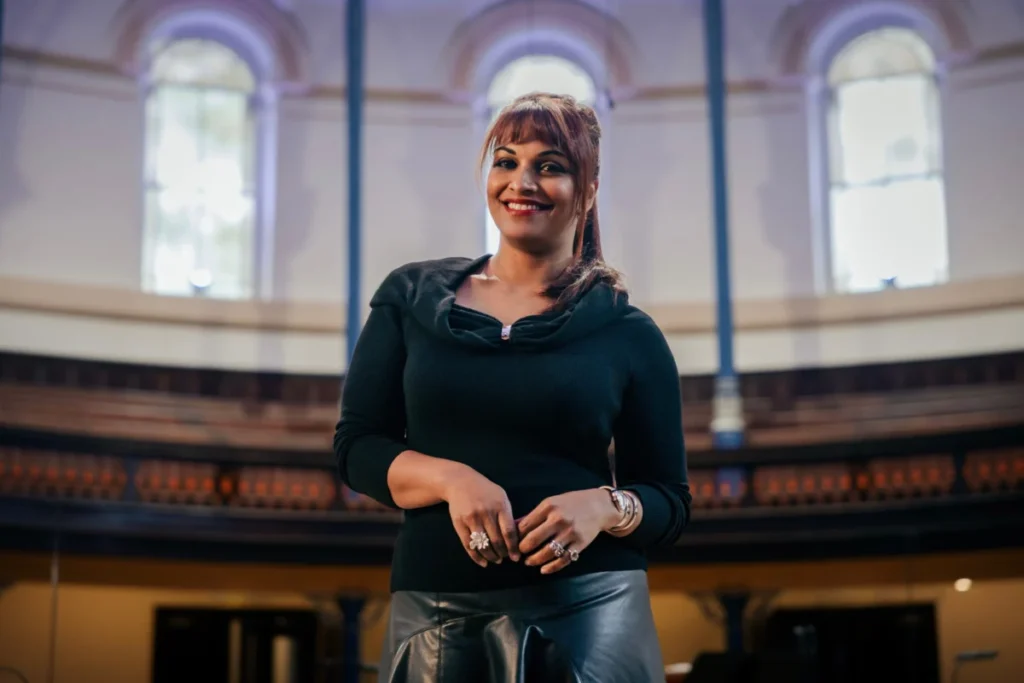

Opera star Danielle de Niese has firmly stated that she will not actively push her children toward a career in the arts, citing the grueling nature of the industry and the emotional resilience required to survive it. The 47-year-old soprano, currently captivating audiences in the musical Hadestown at London’s Lyric Theatre, shares two children, Bacchus and Sheherazade, with her husband, Gus Christie, the executive chairman of the prestigious Glyndebourne Festival Opera. While she remains a stalwart of the stage, her pragmatic approach to parenting reflects a deep-seated understanding of the precarious and demanding professional landscape that defines the performing arts.
A Career Built on Resilience
For de Niese, the decision to avoid steering her children toward the spotlight is not born of a lack of passion for her craft, but rather from a profound respect for the commitment it demands. In an era where the "star" image is often conflated with overnight success, the reality of the opera and theatre world remains defined by years of rigorous training, constant rejection, and the physical toll of live performance.
"I don’t have any desire to push my children into the arts," de Niese stated. "I know that’s a bit of a controversial thing to say, but I know how hard it is. It is such a journey and you have to really want it. To be an artist is one of the most gratifying things if you can withstand all of that. If they want it, I will prepare them to withstand it."

This sentiment is echoed by many veterans in the performing arts who have witnessed the volatility of the industry. The barrier to entry for professional musicians and actors is notoriously high, often requiring decades of investment before achieving a stable, full-time career. De Niese’s philosophy suggests a protective instinct—a desire to ensure that if her children do pursue the arts, they do so from a place of informed autonomy rather than parental expectation.
The Impact of AI on Future Career Choices
Beyond the immediate concerns of parenting, de Niese has engaged with the broader discourse regarding the intersection of technology and the arts. As artificial intelligence continues to disrupt sectors ranging from software engineering to graphic design, the stability of traditional "creative" careers has become a point of contention. However, de Niese offers a distinct perspective, suggesting that the human element of live performance acts as a natural buffer against automation.
"Because of AI replacing so many tech jobs, we might get to a place where a son or daughter could look up to their parent and go, ‘I think I want to do the arts,’ and a parent might go, ‘that’s a good choice,’" she noted. Her analysis posits that while data-driven industries are increasingly vulnerable to algorithmic replacement, the "magical live performance"—the unique, unrepeatable synergy between a performer and an audience—remains an exclusively human domain. This, she argues, may inadvertently lead to a resurgence in the perceived value of the performing arts as a stable, long-term career path in an increasingly automated economy.
Contextualizing the Industry: Challenges and Safeguards
The professional landscape for stage performers today is markedly different from when de Niese began her career. Beyond the artistic demands, performers are now grappling with the rise of digital distraction in theaters. In recent years, high-profile actors, including Cate Blanchett and Rosamund Pike, have taken public stands against audience members recording or texting during live performances.

De Niese acknowledges the necessity of these boundaries. Discussing her current residency in Hadestown, she highlighted the role of venue management in preserving the theatrical experience. "It’s very heavily policed in Hadestown; we have an incredible usher team who are really on it, so it’s very hard to pull out a phone," she explained. "We should always hold on to being present in the moment." This policing of the theater environment underscores a broader industry push to protect the sanctity of the "live" experience against the encroaching demands of a digitally hyper-connected society.
From Opera to Historical Narrative: The Handel Scandal
While her performance in Hadestown keeps her anchored in the contemporary musical theater scene, de Niese’s latest creative endeavor shifts toward historical research and documentary work. Her new project, The Handel Scandal: The Making of the Messiah, explores the life of Susannah Cibber, an 18th-century singer who became a centerpiece of one of the most significant scandals of the Enlightenment era.
The documentary details Cibber’s involvement in the debut of George Frideric Handel’s Messiah—a work that would go on to become one of the most celebrated compositions in Western history—at a time when her personal reputation had been devastated by public shame. For de Niese, the project serves as a reminder of the historical intersection between public scandal and artistic achievement. "It’s a story most people don’t know, and most of the details are jaw-dropping," she remarked. "They’re shocking. You can’t really fathom that it was someone’s actual life."
This documentary, airing on Sky Arts, marks a diversification of her career, highlighting her ability to bridge the gap between performance art and historical scholarship. It also provides a stark contrast to her own modern experience, illustrating how the public scrutiny of artists has evolved over the centuries, even if the core pressures of the profession remain remarkably consistent.

A Comparative Analysis of Artistic Careers
To understand the gravity of de Niese’s comments, one must look at the statistical reality of the arts sector. According to data from various arts councils and labor bureaus, the median income for independent artists remains significantly lower than that of professionals in STEM or business sectors. Furthermore, the "success rate" in the performing arts is often heavily influenced by access to capital, training, and institutional support.
For the children of high-achieving artists, the path is often seen as a double-edged sword. While they possess access to industry networks and mentorship, they also face the burden of comparison to their parents’ legacies. By publicly stating that she will not push her children, de Niese is implicitly acknowledging the "legacy trap" that often causes children of successful performers to feel alienated from their own creative potential.
The Role of Glyndebourne and Institutional Support
The context of de Niese’s career is inseparable from the Glyndebourne Festival Opera, an institution that stands as a pillar of the classical music world. Her marriage to Gus Christie places her at the heart of an organization that has survived economic downturns, global conflicts, and the rapid evolution of audience demographics.
The Festival, founded by John Christie and Audrey Mildmay in 1934, has always been defined by its commitment to artistic excellence, a legacy that her husband continues to oversee. The institution’s survival and success over nearly a century serve as a case study for the endurance of the arts. It is within this ecosystem that de Niese has developed her pragmatism; having seen the inner workings of both the performance and the management sides of the industry, her perspective on the difficulty of the career is grounded in deep institutional knowledge.

Looking Ahead: The Future of the Performing Arts
As the industry moves toward 2030, the conversation surrounding the arts is shifting from questions of viability to questions of purpose. De Niese’s commentary highlights a transition period where traditional performance roles are being re-evaluated in light of technological advancement and social shifts.
If the future of work is indeed being reshaped by AI, the "human" element of the arts—the visceral, emotional connection that occurs when an actor performs on stage—may become a more exclusive and high-value commodity. However, as de Niese suggests, this does not make the path any easier. It remains a path that requires an individual to be fully, uncompromisingly "in" it.
In conclusion, Danielle de Niese’s approach to her children’s futures is not a dismissal of the arts, but an invitation for them to choose their own challenges. By emphasizing the necessity of personal desire and the grueling nature of the industry, she provides a candid look at what it truly takes to survive in the arts. Whether or not her children ultimately follow in her footsteps, her focus remains on ensuring they are prepared for the reality of the journey, rather than the allure of the outcome. As she continues to perform, both on the stage and in her documentary work, she serves as a testament to the endurance of the performer, even as the world around the stage continues to change at an unprecedented pace.