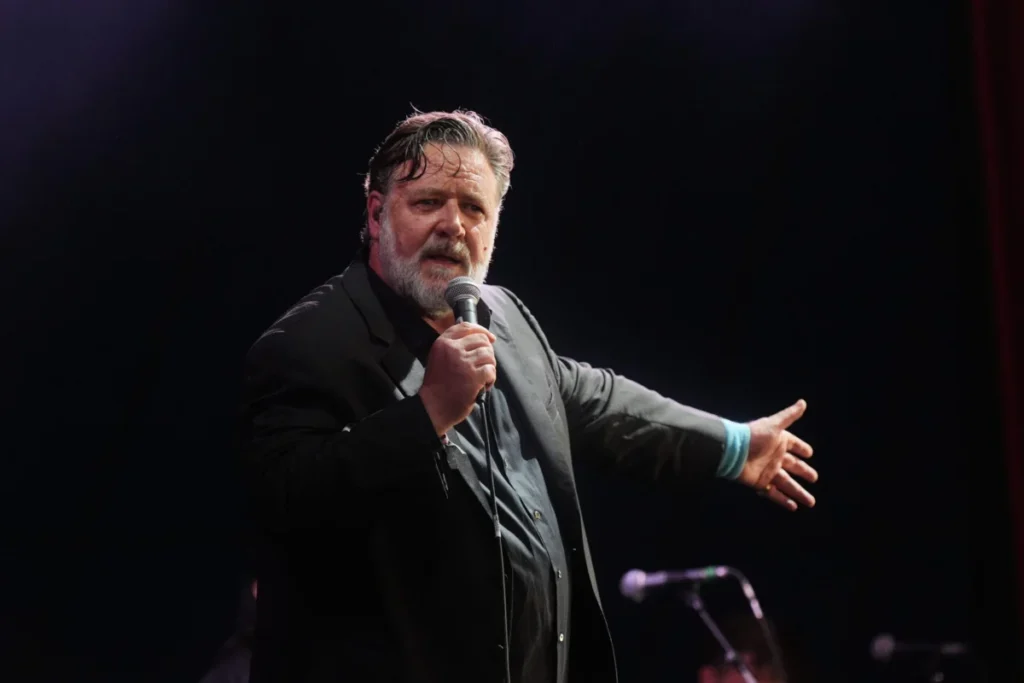

The New Zealand-born actor Russell Crowe, a towering figure in contemporary cinema, has offered a candid assessment of his four-decade career, describing his relationship with the Hollywood studio system as intentionally “mismanaged.” Speaking at the Venice Film Festival during the premiere of his deeply personal documentary, What Love Builds, the 62-year-old Oscar winner reflected on the friction between his antipodean roots and the rigid expectations of the American film industry. His comments provide a rare window into the philosophy of an actor who, despite achieving global superstardom, has consistently prioritized visceral instinct over commercial calculation.
A Legacy Forged in Instinct and Rebellion
Russell Crowe’s journey to the pinnacle of international fame began in the early 1990s. His breakthrough performance in the gritty Australian drama Romper Stomper (1992) established him as an actor of rare intensity and raw, unvarnished talent. That performance served as a catalyst for his transition into the Hollywood machine, where he quickly ascended to A-list status with roles in acclaimed features such as the neo-noir L.A. Confidential (1997) and the political thriller The Insider (1999).
However, it was his collaboration with director Ridley Scott on Gladiator (2000) that cemented his legacy, earning him the Academy Award for Best Actor. His subsequent work in films like A Beautiful Mind (2001), Cinderella Man (2005), and Nuremberg further solidified his reputation as one of the most versatile performers of his generation. Throughout this period, he amassed a prestigious collection of accolades, including a BAFTA award and two Golden Globes, marking him as a critical darling and a commercial powerhouse.

Yet, behind the accolades, Crowe suggests a persistent disconnect existed between his personal values and the expectations placed upon him by the industry. “I think I’ve made it pretty clear that I’ve mismanaged my relationship with Hollywood greatly, but always to my benefit,” Crowe remarked during the Venice press conference. He noted that his initial rise to fame was often met with the assumption that he was American, a misunderstanding that fueled his discomfort with the culture of Hollywood. “I’m not driven by the same things that people who come necessarily from that culture are driven by,” he added, citing his penchant for blunt honesty—a trait he attributes to his upbringing—as a frequent source of friction within the polished, PR-managed environment of the major studios.
The Physicality of Creative Selection
Central to Crowe’s professional ethos is an unconventional, almost somatic approach to script selection. In an era where career trajectories are often meticulously curated by agents, publicists, and algorithms, Crowe relies on a visceral reaction to his material. “I can read 100 scripts, but I’m only going to do the one that when I was reading it—and people always thought I was making this up—I start to feel it on my skin,” he explained.
This intuitive process bypasses traditional career strategy. For Crowe, the connection to a project must be tangible and immediate. Even when he has pre-decided against a role or harbors reservations about a potential collaborator, the physical sensation of “feeling it on his skin” overrides those professional cautions. He admits that this is “not necessarily the right way to construct a career,” but insists it is the only way he can remain authentic to his creative spirit. This approach has led to a varied, and at times unpredictable, filmography that mirrors his refusal to conform to the standard arc of a Hollywood leading man.
A Pivot Toward Music and Personal Narrative
The premiere of What Love Builds represents a significant evolution in Crowe’s career. Written, directed, and produced by the actor himself, the documentary provides an intimate look at his long-standing passion for music, specifically his work with his band, The Gentlemen Barbers, and his role as host of the rotating musical collective known as the Indoor Garden Party.

The documentary serves as a departure from the high-stakes drama of his film roles, offering instead a vulnerable, behind-the-scenes look at the creative pursuits that sustain him away from the spotlight. By moving behind the camera, Crowe is shifting the narrative control back to himself, focusing on projects that are "extremely intimate and extremely personal." This transition reflects a broader trend among veteran actors seeking to define their later careers through self-authored stories rather than studio-mandated roles.
Chronology of an Icon: Key Milestones
- 1992: Breakthrough performance in Geoffrey Wright’s Romper Stomper.
- 1997: International recognition follows his role in L.A. Confidential.
- 1999: Receives first Academy Award nomination for The Insider.
- 2000: Wins Academy Award for Best Actor for his portrayal of Maximus Decimus Meridius in Gladiator.
- 2001: Demonstrates range with A Beautiful Mind, earning a BAFTA and a Golden Globe.
- 2026: Premieres his self-directed documentary What Love Builds at the Venice Film Festival, signaling a shift toward personal storytelling.
The “Euro Dad” Project and Future Outlook
Despite a career that has already spanned decades and produced multiple industry-defining performances, Crowe maintains that he is far from finished. “I have so much to accomplish yet,” he stated in Venice, noting that he has barely “scratched the surface” of the projects he intends to undertake.
However, the nature of his ambition is shifting. The actor is increasingly prioritizing his role as a father to his two sons, Charles and Tennyson. This shift is manifest in what he humorously refers to as the “Euro Dad project.” This personal initiative involves spending significant portions of his year in Europe, a decision that directly influences his availability for film production.
“As I get a little bit older, I am starting to have those thoughts about how many summers I really may have,” Crowe confessed. This realization has led him to be more selective about his location and time commitments, favoring geographical proximity to his children over the demands of a traditional production schedule. He noted that, moving forward, he is more likely to make choices based on being where his sons are rather than being on a film set.

Industry Implications and Analysis
From an industry perspective, Crowe’s recent reflections offer a sobering critique of the "star system." His comments highlight the alienation often experienced by international talent when operating within the American studio ecosystem, where cultural nuances—such as the tendency to "call things as we see them"—are often misinterpreted as being difficult or uncooperative.
Furthermore, Crowe’s shift toward independent, personal filmmaking aligns with a growing movement among established stars who are reclaiming agency. By choosing projects based on internal physical cues rather than commercial viability, he is effectively insulating his creative output from the pressures of the box office. While this may not align with the standard trajectory of a blockbuster movie star, it suggests a sustainable path for an artist who values longevity and personal satisfaction over the relentless pursuit of industry validation.
As the film industry continues to grapple with the changing landscape of global distribution and the shifting priorities of its most prominent figures, Russell Crowe’s transition from a blockbuster staple to a more introspective, self-directed artist provides a blueprint for what a "mismanaged" but deeply authentic career might look like in the modern era. His willingness to trade the prestige of Hollywood sets for the freedom of personal projects and family time in Europe marks a definitive new chapter in the life of one of cinema’s most enduring, and undeniably singular, talents.