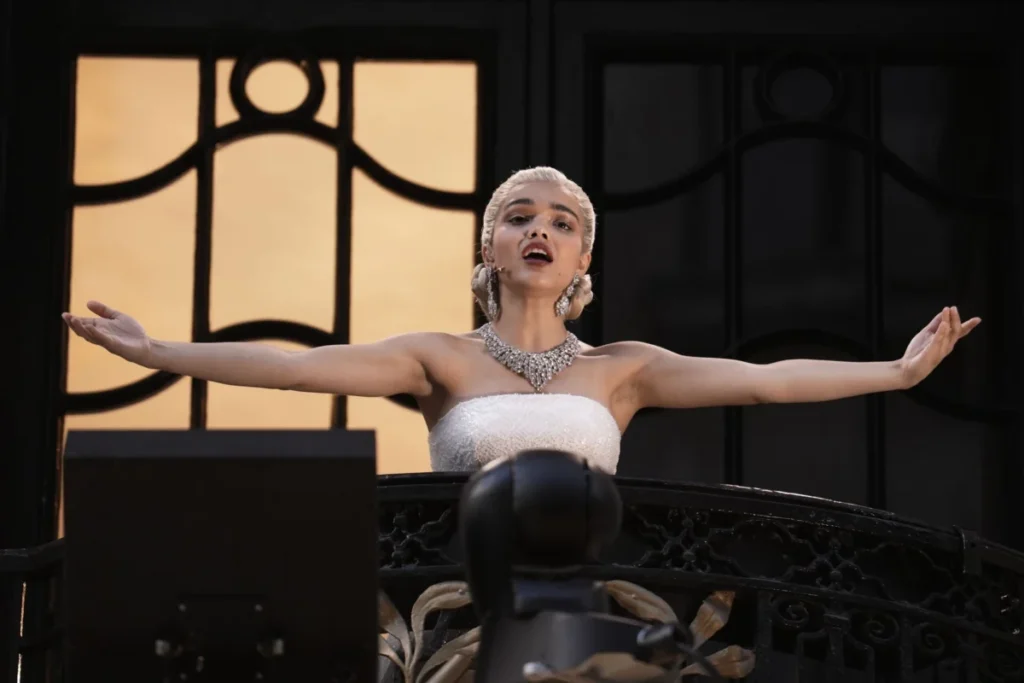

New York City is poised to welcome a critically acclaimed West End sensation as Rachel Zegler, the 24-year-old phenom, prepares to bring her Olivier Award-winning portrayal of Eva Perón to Broadway in Jamie Lloyd’s highly anticipated revival of Sir Tim Rice and Lord Andrew Lloyd Webber’s iconic musical, Evita. The transfer, slated for Spring 2027, follows a triumphant run at the London Palladium that captivated audiences and critics alike, earning Zegler her first Olivier Award for Best Actress in a Musical.
The announcement has sent ripples of excitement through the global theatre community, signaling a major event in the upcoming Broadway season. Zegler’s performance in London was particularly noted for a memorable staging of the musical’s most famous number, “Don’t Cry For Me Argentina,” delivered from the London Palladium theatre balcony to passers-by below. While this specific, visually arresting moment will not be replicated in the Broadway production, director Jamie Lloyd has indicated he will explore new, equally innovative ideas tailored for the New York stage, promising an evolution of the critically lauded interpretation.
A Star’s Ascendance: Rachel Zegler’s Journey to Eva Perón
Rachel Zegler’s rise to prominence has been nothing short of meteoric. Born in Hackensack, New Jersey, Zegler first captured international attention with her star-making performance as Maria in Steven Spielberg’s 2021 adaptation of West Side Story. Her powerful vocals and compelling screen presence garnered widespread critical acclaim, including a Golden Globe Award for Best Actress – Motion Picture Comedy or Musical, solidifying her status as a formidable talent in Hollywood. She subsequently appeared in Shazam! Fury of the Gods and took on the lead role of Lucy Gray Baird in The Hunger Games: The Ballad of Songbirds & Snakes, further cementing her burgeoning film career.
Despite her rapid ascent in cinema, Zegler’s roots lie deeply in musical theatre, having performed in numerous high school productions. Her West End debut in Evita marked a significant return to the stage, showcasing her extraordinary vocal range and dramatic prowess in a role that demands immense gravitas and vulnerability. Portraying Eva Perón, the former first lady of Argentina whose meteoric rise from humble origins to political power fascinated the world, is a demanding undertaking. Zegler, at just 24, delivered a performance that critics hailed as both powerful and nuanced, embodying the complex character with a maturity beyond her years. Her Olivier Award win for Best Actress in a Musical, presented earlier this month, underscored the profound impact of her London performance, cementing her as a theatrical force. The production also received five WhatsOnStage Awards, including Best Musical Revival, with Zegler named Best Performer in a Musical, further attesting to its critical and popular success.
Reimagining a Classic: Jamie Lloyd’s Vision for Broadway

Jamie Lloyd, the visionary director behind the London revival, is renowned for his distinctive, often minimalist, and intensely focused interpretations of classic plays and musicals. His previous work, including acclaimed productions of Harold Pinter’s Betrayal, Edmond Rostand’s Cyrano de Bergerac starring James McAvoy, and Henrik Ibsen’s A Doll’s House with Jessica Chastain, is characterized by its stripped-back aesthetic, raw emotional intensity, and a willingness to challenge conventional staging. Lloyd’s approach typically distills the essence of a work, allowing the performances and the core narrative to shine through with heightened impact.
For Evita, Lloyd’s direction in London was celebrated for its contemporary relevance and daring choices. The iconic balcony scene, where Eva Perón addresses the masses, is a pivotal moment in the musical and a defining image of the character. Lloyd’s decision to have Zegler perform “Don’t Cry For Me Argentina” from the actual balcony of the London Palladium, projecting her voice to the bustling street below, was a stroke of genius that blurred the lines between theatre and reality, creating an unforgettable, immersive experience for both ticket holders and unwitting passers-by. This innovative staging became a hallmark of the production and generated significant buzz.
However, the logistical and architectural constraints of Broadway theatres often necessitate adaptations. Lloyd acknowledged this, stating, “When we started discussing a New York production, it became apparent that our Palladium staging of Don’t Cry For Me Argentina would not be possible. I am really excited to explore a new idea, made especially for Broadway.” This statement offers a tantalizing glimpse into the creative process, suggesting that while the essence of the London production will transfer, American audiences can expect a fresh and unique interpretation of this pivotal moment, specifically designed to resonate within the unique environment of a Broadway house. Lloyd’s track record suggests that any new idea will be equally impactful and thought-provoking, continuing to push the boundaries of theatrical presentation.
The Enduring Legacy of Evita
Evita, with music by Andrew Lloyd Webber and lyrics by Tim Rice, is a monumental work in the history of musical theatre. It began as a rock opera concept album in 1976 before its stage debut in London’s West End in 1978, directed by Hal Prince and starring Elaine Paige. It quickly transferred to Broadway in 1979, where it ran for nearly four years and won seven Tony Awards, including Best Musical, for its original production starring Patti LuPone.
The musical chronicles the extraordinary life of Eva Perón, from her impoverished beginnings in rural Argentina to her controversial rise as the influential and charismatic First Lady. Her journey is depicted with a blend of admiration and critique, exploring themes of ambition, power, populism, and the intoxicating nature of fame. Eva’s tireless work for the poor, her "rainbow tour" of Europe, and her early death from cancer at age 33 cemented her mythical status. The musical, however, does not shy away from the complexities and criticisms surrounding her political actions and personal life, presenting a multi-faceted portrait.
“Don’t Cry For Me Argentina” became an instant global hit, transcending the musical theatre genre to become a cultural touchstone. Its powerful melody and poignant lyrics capture Eva’s appeal and the public’s devotion, embodying the emotional core of the story. Over the decades, Evita has seen numerous revivals and adaptations, including a 1996 film starring Madonna, each attempting to grapple with the enduring fascination with its central figure and its timeless narrative. Its continued relevance lies in its exploration of political charisma, the cult of personality, and the intersection of celebrity and power—themes that remain deeply resonant in contemporary society.

Critical Acclaim and Award Season Triumph
The London production of Evita was met with rapturous reviews. Critics lauded its innovative direction, striking design, and especially the captivating performance of Rachel Zegler. The Olivier Awards, the most prestigious theatrical accolades in the UK, recognized this excellence by bestowing Zegler with the Best Actress in a Musical award. This significant achievement places her among the ranks of legendary performers who have graced the West End stage. The production also received recognition in the WhatsOnStage Awards, an audience-voted ceremony, where it secured five wins, including Best Musical Revival and Best Choreography. These accolades serve as a powerful testament to the production’s artistic merit and its profound connection with audiences, generating considerable anticipation for its Broadway transfer. The success in London provides a strong foundation for its journey across the Atlantic, signaling to American audiences that they are in for a theatrical experience of the highest caliber.
Voices of Anticipation: Cast and Creators Speak
The excitement surrounding the Broadway transfer is palpable among the cast and creative team. Rachel Zegler expressed her profound connection to the project and her eagerness to perform in her home city: “Performing Tim Rice and Andrew Lloyd Webber’s brilliant show in London was a dream come true, but being able to partner once again with Jamie to bring Evita to Broadway is a once in a lifetime opportunity. I can’t wait to perform for my home, New York City.” Her statement highlights not only the artistic fulfillment of the role but also the personal significance of bringing this acclaimed production to an audience she considers her own.
Jamie Lloyd echoed this sentiment of overwhelming success and anticipation. “I was completely overwhelmed by the incredible response to Evita in London. It is an honour to work with Tim and Andrew, and I’m looking forward to revisiting the production with Rachel, whose stellar performance continues to inspire me.” Lloyd’s commitment to re-engaging with the material and Zegler’s performance suggests a dynamic creative process that will continue to evolve and deepen the production’s impact for its Broadway run. His enthusiasm for exploring new staging ideas for Broadway further underscores his dedication to delivering a fresh and impactful theatrical experience.
Sir Tim Rice, the lyricist, heaped praise on Zegler’s portrayal of Eva Perón, describing it as “magnetic,” “electric,” and “charismatic.” His words from one of the musical’s original creators carry significant weight, affirming Zegler’s profound understanding and delivery of the character. Lord Andrew Lloyd Webber added, “It is so exciting to see Tim and my work reimagined in new ways, and the show has a generational talent in Rachel Zegler. I can’t wait for American audiences to experience a production which took the West End by storm.” Both creators express a genuine delight in seeing their enduring work given new life through innovative direction and a captivating lead performance, ensuring its continued relevance for contemporary audiences.
The Road to Broadway: Spring 2027 and Beyond

The transfer of a major West End hit to Broadway is a complex undertaking, involving significant logistical, financial, and artistic coordination. A Spring 2027 opening indicates a meticulous planning process, allowing ample time for theatre booking, casting for supporting roles, technical rehearsals, and marketing campaigns. Broadway is the pinnacle of live theatre, a highly competitive market where only the most compelling productions thrive. The successful London run provides a robust foundation, but a Broadway transfer requires its own strategic approach to resonate with American audiences and critics.
The selection of a Broadway theatre will be crucial, as its architecture and stage capabilities will directly influence Lloyd’s new staging ideas, particularly for the revamped “Don’t Cry For Me Argentina” sequence. The financial investment in such a high-profile transfer is substantial, backed by producers who recognize the immense potential of this production. The anticipation for this transfer will build steadily over the next few years, creating a powerful marketing narrative around Zegler’s Olivier-winning performance and Lloyd’s innovative direction. For New York City, the arrival of Evita in 2027 promises to be a cultural highlight, enriching the vibrant theatrical landscape and offering theatregoers an opportunity to witness a fresh interpretation of a beloved classic.
Broader Implications: A New Chapter for a Timeless Story
The Broadway revival of Evita with Rachel Zegler and Jamie Lloyd holds significant implications for all involved and for the broader theatrical landscape. For Rachel Zegler, this move cements her status as a truly versatile performer, capable of commanding both the silver screen and the live stage with equal brilliance. It establishes her as a leading figure in contemporary musical theatre, a feat for someone still early in her career. Her ability to transition seamlessly between major film roles and demanding stage productions underscores a rare talent and dedication to her craft.
For Jamie Lloyd, this transfer further solidifies his reputation as one of the most exciting and innovative directors working today. His ability to revitalize classic works and make them relevant to modern audiences is a testament to his artistic vision. The success of Evita on Broadway will undoubtedly enhance his international standing and open doors for future high-profile productions.
For Evita itself, this revival ensures its continued vitality and relevance. By offering a fresh, contemporary interpretation, Lloyd and Zegler are introducing the musical to a new generation of theatregoers while also providing a compelling reason for long-time fans to revisit the show. It demonstrates that classic musicals, when reimagined with intelligence and daring, can continue to provoke, entertain, and inspire. This production is not merely a restaging; it is an evolution, promising to add another memorable chapter to the enduring legacy of one of musical theatre’s most powerful and enduring works. The convergence of a generational talent, a visionary director, and a timeless musical is set to create an unmissable theatrical event on Broadway in Spring 2027.