
While much of the Australian entertainment contingent gathered in Sydney for the high-profile Chanel resort showcase—attracting prominent industry figures including Margot Robbie, Kylie Minogue, and Nicole Kidman—acclaimed actress Cate Blanchett was notably absent from the southern hemisphere proceedings. Instead, the multi-Academy Award-winning performer was in London, England, attending the prestigious Harper’s Bazaar Women of the Year Awards. There, Blanchett was honored for her extensive contributions to film, culture, and humanitarian efforts, stepping onto the red carpet in a striking, illustrative creation that immediately drew the attention of international fashion critics and industry observers alike.
Main Facts of the Appearance
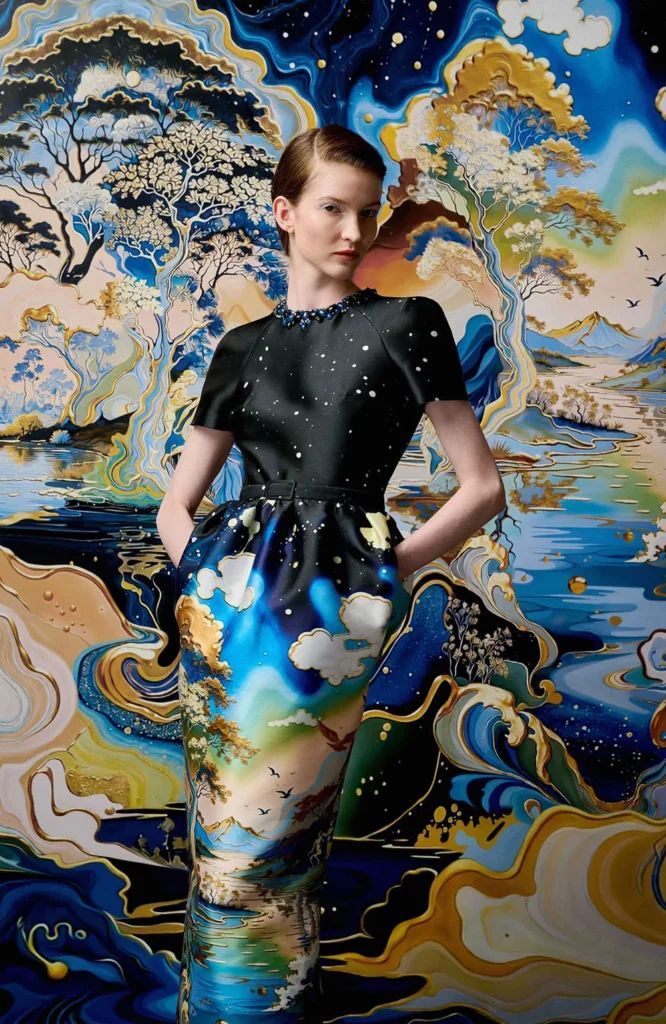
The event, held in the British capital, served as a gathering of global leaders in entertainment, fashion, and activism. Blanchett accepted her Woman of the Year accolade wearing a distinctive garment from designer Mary Katrantzou’s Resort 2027 collection. Styled by Elizabeth Stewart, the ensemble represented a notable departure from Blanchett’s recent red-carpet choices, steering away from minimalist tailoring or heavy texturing in favor of a narrative, pictorial print. The gown featured complex, painting-like graphics across the skirt, paired with footwear by Louis Vuitton.
The choice of designer marked a significant return to the spotlight for Katrantzou, whose distinctively graphic and maximalist aesthetic was once ubiquitous across international fashion weeks and major awards ceremonies, but has maintained a more selective red-carpet presence in recent seasons. By choosing Katrantzou for such a high-visibility engagement, Blanchett provided the designer with a prominent platform to showcase her latest collection to a global audience.

Chronology and Event Context
The Harper’s Bazaar Women of the Year Awards are established fixtures on the British cultural calendar, traditionally held in late autumn to celebrate women who have demonstrated extraordinary leadership and achievement in fields ranging from the arts and literature to business and social activism. The 2026 iteration brought together a curated guest list of international talent, positioned strategically within a busy global fashion week and awards circuit.
Blanchett’s journey to the London stage followed a sustained period of high-profile professional activity. Throughout 2025 and 2026, the actress balanced major cinematic projects with her ongoing duties as a Goodwill Ambassador for UNHCR, the United Nations Refugee Agency. Her appearance in London underscored her dual status as both a cinematic heavyweight and an influential voice in global social causes. The timing of the event also coincided with the Australian fashion circuit’s major international showcases, creating a scheduling conflict that ultimately divided the attention of Australia’s most internationally recognized cultural exports between Sydney and London.
Supporting Data and Fashion Details
The ensemble worn by Blanchett at the Harper’s Bazaar gala represents a specific intersection of art and fashion, a hallmark of Mary Katrantzou’s design philosophy. Known broadly in the fashion industry as the "queen of prints," Katrantzou’s work frequently incorporates trompe l’oeil and digital textile printing that mimics fine art, architecture, and historical artifacts.
- Designer: Mary Katrantzou
- Collection: Resort 2027
- Footwear: Louis Vuitton
- Stylist: Elizabeth Stewart
- Venue: Harper’s Bazaar Women of the Year Awards, London
- Publication Context: Originally highlighted by fashion commentators Tom and Lorenzo, noting Blanchett’s rare foray into narrative, illustrative garments.
The dress itself challenges contemporary red-carpet conventions, which often favor sheer fabrics, metallic finishes, or stark, architectural silhouettes. By opting for a canvas-like surface printed with detailed iconography, Blanchett engaged in a wearable art conversation that contrasts with standard evening wear protocols. Footwear was provided by Louis Vuitton, maintaining Blanchett’s long-standing relationship with the luxury house while grounding the visually complex dress with understated accessories.

Industry Reception and Analysis
Fashion critics and industry analysts noted that Blanchett’s sartorial choices consistently invite public discourse regarding the boundary between costume and high fashion. While the actress has historically favored architectural silhouettes from brands like Giorgio Armani Privé and Louis Vuitton, her endorsement of Katrantzou’s Resort 2027 collection signals a potential shift toward more painterly, expressive styles in contemporary evening wear.
The reception among fashion commentators highlighted a division in how illustrative prints are perceived on the red carpet. Garments featuring direct pictorial representations—such as painted landscapes or narrative scenes—frequently polarize observers who debate whether such designs distract from the wearer or successfully elevate fashion to a fine-art medium. However, Blanchett’s ability to carry complex garments with authoritative poise typically mitigates styling risks, cementing her reputation as one of the industry’s most dependable sartorial risk-takers.
Broader Impact and Implications
Blanchett’s recognition at the Harper’s Bazaar Women of the Year Awards reinforces her enduring influence within the global entertainment industry. Beyond her cinematic output, her ability to dictate fashion conversations simply by choosing an independent or less-ubiquitous red-carpet designer demonstrates the commercial and cultural power she wields.
For Mary Katrantzou, the placement of a Resort 2027 design on an internationally recognized figure at a major global media event provides valuable visibility. As the fashion industry continues to navigate shifting consumer preferences and the evolution of red-carpet presentation, high-profile endorsements of conceptual design play a critical role in maintaining the relevance of avant-garde aesthetic principles.

Ultimately, Blanchett’s appearance in London transcended standard celebrity style reporting, serving as a convergence point for high-concept design, institutional recognition, and international cultural exchange.