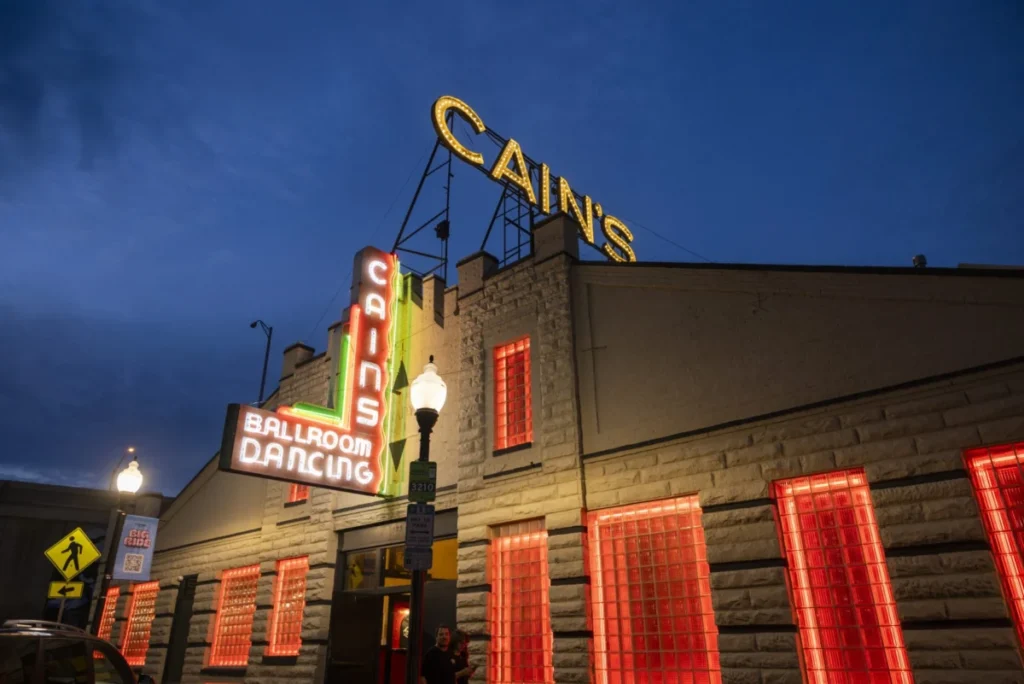

When the Rodgers family embarked on the ambitious restoration of Cain’s Ballroom in Tulsa, Oklahoma, approximately eight months after acquiring the then-dilapidated 1924 building and its storied business, they unearthed a tangible echo of the venue’s earliest days. Amidst the dust and decay, they discovered handfuls of ticket stubs, each bearing the simple inscription, "dime-a-dance." These artifacts dated back to the era when venue founder Madison Cain first opened the space as Cain’s Dance Academy in the 1930s. During this formative period, men who profited from Tulsa’s burgeoning oil and gas industry would pay a mere ten cents for a dance lesson, guided by an instructor named Howard Turner.
"Turner would hold these dances where he would have women… there to provide dances for men who would buy a 10-cent ticket and come in," recounts Chad Rodgers, who now co-owns Cain’s Ballroom alongside his brother, Hunter Rodgers. "Then [he] and the venue would split the proceeds with the women." This early business model, though modest by today’s standards, laid the foundation for a venue that would become a cornerstone of American live music history.
A Living Relic on Route 66
Over a century later, the echoes of Cain’s Ballroom’s past are not confined to dusty ticket stubs. A painted sign inside the venue still advertises dancing on various nights of the week, a testament to its enduring legacy. The iconic log cabin-patterned dance floor, rumored to have been constructed atop truck springs to provide a unique bounce, continues to reverberate with the energy of live performances, much as it did in the 1930s. The ballroom’s walls are adorned with large, sepia-toned portraits of figures who shaped its history and the broader landscape of American music. Among them are Oliver Wheeler "O.W." Mayo, who managed Bob Wills, widely recognized as the father of Western swing, and Howard Turner himself. These portraits also honor luminaries such as Bob Wills and Gene Autry, along with Pat Breene, a pioneering female Western disc jockey, and the renowned big band leader Spade Cooley. Cooley’s inclusion serves as a poignant reminder of the era’s complexities, as his life took a tragic turn when he was convicted of murdering his second wife in 1961.

"When we took over in 2002, it was like, ‘Should [these portraits] still be there?’" says Chad Rodgers, reflecting on the decision to preserve these historical markers. "It gives the building and the performance area such a cool historic thing. A lot of the artists on stage will say it’s so cool to look out there and see all these famous people, or people from the past that have [put] a stamp on either music history or just history."
From Western Swing to Punk Rock: A Diverse Legacy
The Rodgers family’s significant investment in Cain’s Ballroom was fundamentally driven by a commitment to preserving its rich history for the city of Tulsa. In the 1930s, Cain’s emerged as a vital cultural hub, famously broadcasting live radio shows hosted by Bob Wills and his brother, Johnny Lee Wills. These broadcasts were instrumental in popularizing Western swing, according to Julie Watson, Cain’s Centennial coordinator. A banner still proudly displayed above the stage, proclaiming "The Home of Bob Wills," serves as a perpetual homage to this golden era.
However, the venue’s popularity waned by the 1960s. Its fortunes began to shift dramatically in 1976 when promoter Larry Shaeffer took the helm. Shaeffer possessed an ambitious vision, bringing a string of iconic artists to Cain’s, including U2, Van Halen, Tom Petty, Metallica, Eric Clapton, and Elvis Costello. "There’s some good pictures of Van Halen in the Cain’s office when they played here," Chad Rodgers recalls. "They weren’t even the headliner. They were opening for Montrose, and they got paid like $500. I think it was ’82."
Hunter Rodgers elaborates on Shaeffer’s approach, noting, "Shaeffer was just taking anything he could get. He says it was lucky for him to get these acts. He didn’t really know what he was doing at the time, I don’t think." This open-mindedness, bordering on a willingness to book virtually any act, inadvertently positioned Cain’s Ballroom as a significant venue in the burgeoning punk rock scene. In 1978, the Sex Pistols, amidst their famously turbulent U.S. tour, scheduled a performance at Cain’s on January 11th.

"Sex Pistols [were booked because] Shaeffer got a phone call and they said, ‘We’re gonna route this tour, do you want a date?’ And he was like, ‘Sure,’" Chad explains. The band’s notoriously rowdy performance left a physical mark on the venue; an enraged Sid Vicious punched a hole in the wall. This piece of drywall, a tangible artifact of the band’s explosive presence, is now framed and displayed in the venue’s office, a celebrated piece of its counter-cultural history. "The looks of it aren’t great, but it’s the centerpiece of our office. Everyone wants to see it," Chad remarks, adding that he even has a photograph of Bono from U2 posing with the framed hole.
Despite Shaeffer’s success in revitalizing Cain’s and bringing world-class talent to Tulsa, his tenure was reportedly marked by financial instability. By the 1990s, he was reportedly broke due to various business practices. "It was a different time then," Chad notes, referencing anecdotal accounts from patrons recalling "cocaine on the tables, and there’d be beer bottles getting smashed and people dancing on the tables."
The Rodgers Family’s Vision: Preservation and Revitalization
After more than two decades, Shaeffer sold Cain’s in 1999. The subsequent owners proved short-lived, and by 2002, the iconic venue was once again on the market. It was at this juncture that James and Alice Rodgers, parents of Chad and Hunter, recognized the potential of the historic building amidst a revitalizing downtown Tulsa, with an arena (now the BOK Center) on the horizon. James, upon seeing the venue for sale, immediately called his son Chad, declaring, "Let’s go down and look at Cain’s."
The state of the venue was dire. "There was dust all over everything. There were chains on the doors. There had never been central heat and air. There were buckets collecting water coming through the roof," Chad describes. "Most people couldn’t have seen through what luckily our father and mother saw." James and Alice purchased Cain’s, entrusting its future to their sons, Chad and Hunter, who was at the time studying audio engineering in Florida. The family understood that restoring Cain’s to its former glory and solidifying its reputation would require a comprehensive renovation.

"When the news came out that we were going to [restore it], we got a lot of letters," Chad recalls. "People were really concerned that we were going to take away from the history and the authenticity of what Cain’s was."
A Meticulous Restoration for a New Era
In May 2003, Cain’s Ballroom temporarily closed its doors for an extensive restoration project. This undertaking included the installation of the venue’s first-ever fire sprinkler system and central air conditioning. Furthermore, all electrical and plumbing systems were overhauled, new bathrooms were installed, the roof was replaced, outdated drop-down ceilings were removed, and the bar and concessions areas were modernized. A small mezzanine was also added to enhance the venue’s capacity and patron experience.
A significant challenge during the renovation was addressing the legendary "spring-loaded" dance floor. "At the end of the life of that old floor, you could stand at the back of the room, and a four-foot person may be able to dunk on a 10-foot basketball hoop," Chad jokes, explaining that the floor’s unusual flexibility wasn’t due to actual springs but a lack of proper reinforcement over time. "We were very insistent that when we redid it, that it had to flex. It had to still have the same feel because of that rumor of the spring-loaded was there for so long." Hunter adds, "Since then, we have replaced it twice. Now, it is basically concrete, but it does still flex because there’s some neoprene pads throughout the floor."
By October 2003, the initial phase of the venue’s renovation was complete, marked by its grand reopening with a performance by country music icon Dwight Yoakam. "The Rodgers family, when they bought it, put a lot of money in to renovate it, but they kept all of that feel that makes it completely unique," says Watson.

Navigating the Business of Live Music
Despite the family’s dedication, their experience in running a music venue was limited. Chad’s prior experience involved managing a sports bar that occasionally hosted local bands. "We took our lumps until we renovated and even for a little bit, for about a year afterwards," Chad admits. "It took a lot of campaigning getting agents to realize that Cain’s is back. We also had to patch up some wounds because there was an owner that we bought the business from, and they had burnt a bridge with Willie Nelson and his agent."
The Rodgers family had to work diligently to rebuild relationships with artists and their representatives. Willie Nelson, for instance, agreed to return to the venue on the condition of receiving a share of the bar sales. To attract more artists, Chad resorted to cold-calling booking agents, a challenging process that felt like being "blood in the water and sharks just circled us."
The Rodgers family’s commitment to rectifying past transgressions extended to artist riders. Chad recounts an early experience with Bone Thugs N Harmony, where he booked twelve hotel rooms and spent approximately $1,000, exceeding his obligations, only to have the rooms trashed and incur additional damage costs. "I didn’t realize the contract and riders for every artist are pretty much the same, regardless [of whether] they’re playing a 400-cap room or an arena, other than their sound and lighting stuff," he explains. "I’d get a contract that’s like, ‘We want 16 single rooms and we want a limo or a van and all these things,’ and at that time I didn’t realize that this is [a] negotiation."
The Rodgers family eventually engaged legal counsel to navigate these complex contract negotiations. They also discovered old offer sheets and budgets from previous owners, which provided valuable insights into advertising expenditures and deal structures. This diligent approach gradually re-established Cain’s Ballroom on the national live music circuit.

A Flourishing Future: Cain’s Today
The true measure of their success came when Bob Dylan chose to play Cain’s in 2024, a moment Chad describes as realizing they "were doing the right thing." Since then, the venue’s trajectory has been one of continuous growth and acclaim. Under the Rodgers family’s stewardship, Cain’s has hosted an incredibly diverse array of artists, spanning genres and generations, including Snoop Dogg, Jason Isbell, Chappell Roan, Turnpike Troubadours, Beck, The Strokes, Luke Combs, Chris Stapleton, Lainey Wilson, Blake Shelton, Wilco, Brittany Howard, Mavis Staples, The Descendants, Colter Wall, Flogging Molly, Iron and Wine, and Tech N9ne.
Jack White, a devoted admirer of the venue, first performed at Cain’s in 2010 with the supergroup The Dead Weather. His profound connection to Tulsa and Cain’s led him to purchase property in the city. In 2019, his band The Raconteurs made history by being the first act to play Cain’s for three consecutive nights. The subsequent release of live recordings from these shows as a special vinyl package was accompanied by a press statement from White declaring, "This is my favorite place to play in the world."
In 2021, Green Day delivered a surprise performance at Cain’s just days before a stadium concert. More recently, in April, the legendary shock rock band GWAR visited, presenting the owners with a framed poster from their performance at Cain’s 30 years prior. In collaboration with the local Woody Guthrie Center and the Bob Dylan Center, Cain’s has also curated unique events, such as an acoustic set by Bono and The Edge in 2025, marking U2’s return to the venue for the first time since 1982. Chad humorously recalls the band’s reflection on their return: "They said the first time they were at Cain’s, only one person in the band was legal age and could get any alcohol. So, this time when they went on stage, they said, ‘Well, now we can get served.’"
Since acquiring Cain’s Ballroom in 2002, the Rodgers family has embraced the profound responsibility of serving as custodians of such a historically significant venue. This sense of duty, coupled with a drive to innovate and adapt, remains a powerful motivator. As Chad Rodgers aptly puts it, "We like the challenge of trying to stay relevant." Cain’s Ballroom, a testament to resilience and passion, continues to write new chapters in its storied history, ensuring its place as a vital cultural landmark for generations to come.