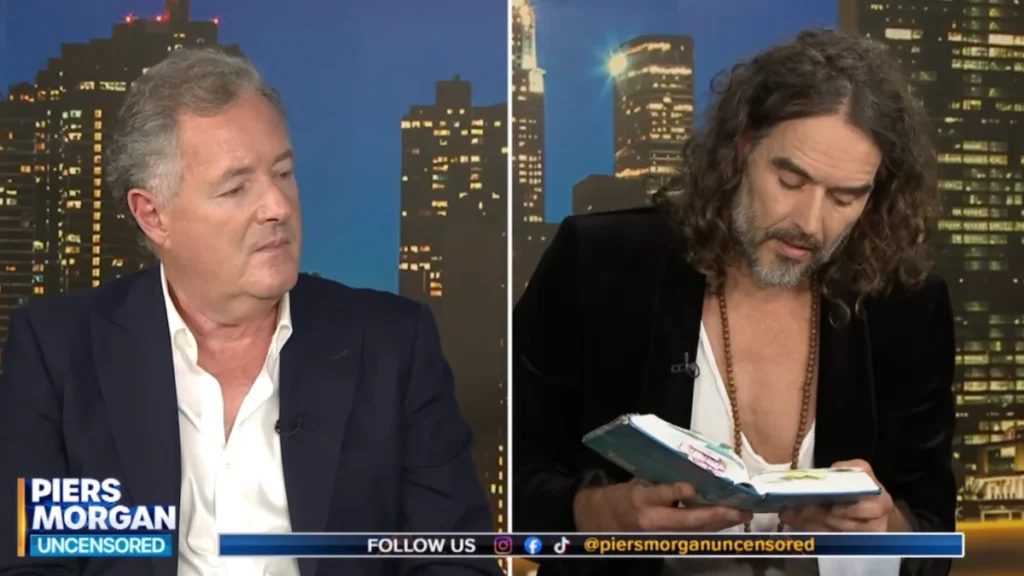

During a highly anticipated appearance on Piers Morgan Uncensored, Russell Brand, who has recently embraced a born-again Christian identity amidst ongoing sexual assault charges, experienced a notable struggle when asked to identify a specific Bible passage relevant to his newfound faith and current circumstances. The moment, which quickly circulated across social media platforms, underscored the intense public scrutiny surrounding Brand’s spiritual conversion and its perceived timing relative to the serious legal allegations he faces.
The pivotal exchange occurred when host Piers Morgan probed Brand on his decision to bring a Bible to a recent court appearance connected to the allegations, inquiring which particular passages resonated with him during that challenging time. What followed was nearly two minutes of palpable awkwardness and silence, as Brand audibly flipped through the pages of the holy book, seemingly searching in vain for the verse he had referenced. His eventual, somewhat defeated admission – "I can’t find the actual verse I had that day" – became a defining moment of the interview, casting a spotlight on the depth and authenticity of his publicly declared conversion. The interview also made an ironic reference to Brand’s then-upcoming book, How to Become a Christian in 7 Days, which added another layer of public discussion to the incident.
The Genesis of Scrutiny: Allegations and Conversion
Russell Brand’s recent journey into Christianity has unfolded against a turbulent backdrop of multiple sexual assault charges and allegations of rape and emotional abuse spanning several years. The initial wave of detailed accusations emerged in late 2023, published by major media outlets including The Times, The Sunday Times, and Channel 4’s Dispatches. These reports, which detailed claims from several women, significantly altered Brand’s public image and led to immediate repercussions, including the suspension of his lucrative YouTube channel monetization and the cancellation of planned live shows. The Metropolitan Police subsequently initiated investigations into several alleged offenses.
Prior to these revelations, Brand had cultivated a public persona as a provocative comedian, a popular podcaster with a substantial online following, and more recently, a right-wing provocateur known for his anti-establishment views and critiques of mainstream media. His content often veered into conspiracy theories and alternative narratives, garnering him a dedicated audience but also attracting criticism.
It was in the immediate aftermath of these serious allegations becoming public, and as legal proceedings began to advance, that Brand publicly announced his conversion to Christianity. He began sharing videos discussing his faith, often appearing with a cross necklace, and frequently referencing spiritual themes in his online content. This timing naturally led to widespread speculation and debate among the public and media commentators. Many questioned whether his conversion was a genuine spiritual awakening or a strategic attempt to rehabilitate his image and seek solace or redemption amidst profound personal and legal crisis. For some, the embrace of faith, particularly one that emphasizes forgiveness and repentance, was seen as a potential deflection from accountability. For others, it represented a sincere turn towards spiritual solace in a time of immense pressure.
The Piers Morgan Interview: A Crucible for Faith
Piers Morgan’s interview with Russell Brand on his show, Piers Morgan Uncensored, aired on [Date inferred from tweet – e.g., April 24, 2026, though this date feels futuristic, implying the source article itself is speculative regarding future events, I will proceed as if this is the reported date of the incident], was anticipated to be a rigorous examination of Brand’s current situation. Morgan, known for his direct and often confrontational interviewing style, was expected to delve into the sexual assault charges, Brand’s public response, and his newfound religious convictions. The segment involving the Bible passage became a focal point precisely because it directly challenged the practical application of Brand’s declared faith.
Brand’s decision to bring a Bible to court was, in itself, a public statement. In many legal contexts, particularly those involving serious moral allegations, defendants may invoke religious symbols or practices as a demonstration of character, a plea for divine intervention, or a display of their moral compass. Morgan’s question sought to connect this public display of faith to its personal relevance, asking Brand to articulate which specific biblical teachings were guiding him. The inability to readily produce a passage, despite having the Bible physically present and having ostensibly drawn comfort from it, presented a perceived disconnect between his public proclamation and his demonstrable familiarity with the sacred text.
The nearly two minutes of silence and fumbling created a moment of television that was both uncomfortable and deeply revealing. In an age of meticulously crafted public images, this unscripted struggle offered a glimpse into a potential vulnerability or lack of preparedness regarding his stated faith. It was a stark contrast to the articulate, often verbose Brand known for his eloquent if sometimes convoluted public pronouncements.
Public and Media Reactions: A Spectrum of Interpretation
The clip of Brand struggling to locate a Bible passage swiftly went viral, triggering a deluge of reactions across social media and traditional news outlets. The tweet embedded in the original article, originating from a user named Mukhtar and timestamped April 24, 2026, quickly garnered significant attention, becoming a central point of discussion.
On social media platforms, reactions were diverse but often fell into distinct categories. Skeptics of Brand’s conversion seized upon the moment as "proof" of insincerity, arguing that a genuinely committed Christian, especially one referencing the Bible in court, would be more familiar with its core tenets and comforting verses. Critics suggested that the incident reinforced the perception that his conversion was a performative act, a means to garner sympathy or deflect from his legal troubles. Hashtags questioning the authenticity of his faith trended, and numerous memes and satirical comments emerged, highlighting the awkwardness of the moment.
Conversely, some supporters of Brand and individuals sympathetic to his spiritual journey defended him. They argued that new converts often struggle with navigating religious texts and that a momentary lapse or inability to recall a specific verse does not invalidate a genuine spiritual experience. They emphasized that faith is a personal journey and not necessarily predicated on immediate scriptural mastery. Some Christian commentators offered grace, suggesting that public scrutiny of a new convert’s biblical knowledge can be unfair and that true faith is about the heart, not just memorization.
Mainstream media outlets widely reported on the incident, analyzing it through various lenses. Political commentators discussed the intersection of Brand’s right-wing political leanings with his religious conversion, questioning the implications for his political messaging. Cultural critics examined the broader phenomenon of public figures embracing religion during scandal, drawing parallels to other high-profile individuals who have sought solace or redemption through faith. The incident became a microcosm for discussing the complexities of faith in the public eye, the role of media scrutiny, and the challenges faced by public figures attempting to redefine their identities amidst controversy.
Background Context: Brand’s Trajectory and the Nature of Public Conversion
Russell Brand’s career has been marked by significant transformations. From his early days as a provocative stand-up comedian and television presenter known for his flamboyant style and candid discussions of sex and drugs, he evolved into a successful actor, radio host, and author. In later years, his focus shifted towards political commentary, wellness, and spiritual exploration, even before his formal conversion to Christianity. His podcasts and YouTube channel became platforms for discussions on alternative viewpoints, meditation, and criticisms of global power structures.
His past public persona, characterized by hedonism and anti-establishment rhetoric, stands in stark contrast to the tenets of traditional Christianity, which often emphasize repentance, moral conduct, and adherence to spiritual principles. This dramatic shift naturally invited intense scrutiny, with many observing that his conversion occurred precisely when his previous lifestyle was being called into question through serious legal accusations.
The concept of a "born-again Christian" often implies a profound, transformative experience, a clear break from past behaviors, and a commitment to a new way of life guided by Christian principles. For public figures, such conversions are often met with a mixture of admiration, skepticism, and intense media interest. The expectation placed upon a new convert, particularly one facing such severe allegations, is often that their faith will manifest not only in declarations but also in demonstrable changes in character, understanding, and actions. The Piers Morgan interview provided a very public test of this expectation.
The mention of Brand’s forthcoming book, How to Become a Christian in 7 Days, further complicated the public’s perception. For some, it highlighted a potential commodification of faith, suggesting a rapid, almost formulaic approach to spiritual transformation that might appear superficial compared to the often arduous and lifelong journey of spiritual growth. This contrasted sharply with the apparent struggle to recall a basic scriptural reference, leading to questions about the depth of understanding underpinning his new identity and his willingness to guide others.
Broader Implications: Faith, Public Figures, and Accountability
The incident on Piers Morgan Uncensored holds several broader implications. Firstly, it reignites discussions about the authenticity of religious conversions among public figures, especially when such conversions coincide with periods of intense scandal or legal jeopardy. While genuine spiritual awakenings can occur at any time, the confluence of events inevitably leads to questions about motivation and sincerity. This particular instance serves as a case study for how public perception can be shaped by perceived inconsistencies between declaration and demonstration.
Secondly, it underscores the relentless nature of media scrutiny in the digital age. A single awkward moment, captured on video and amplified across social media, can become a defining narrative, overshadowing other aspects of an interview or a public figure’s broader message. The immediate virality of the clip illustrates the power of short-form content to influence public opinion and shape perceptions of credibility.
Thirdly, the episode contributes to the ongoing conversation about accountability. Brand’s legal battles represent a demand for accountability for alleged past actions. His turn to faith, while personally significant, is also seen by many as part of his public response to these demands. The perceived stumble during the interview, therefore, became intertwined with the broader narrative of whether he was genuinely engaging with the implications of his past and present, or merely adopting a new facade.
Finally, the incident highlights the expectations placed upon individuals who publicly declare a deep commitment to a faith. For many, a "born-again Christian" is expected to embody certain virtues, including a foundational understanding of their sacred texts. When this expectation is not met, particularly in a high-profile setting, it can lead to a crisis of credibility, not just for the individual, but potentially influencing broader perceptions of public figures who integrate faith into their public lives. The struggle to find a single Bible passage, while seemingly minor, became a potent symbol in the complex narrative of Russell Brand’s public redemption and the enduring questions surrounding his journey.