
Berlin has established itself as a global epicenter for creative expression, where the city’s complex history is mirrored in its architectural diversity and the interior design of its residential spaces. From the stark remnants of the Berlin Wall to the expansive industrial lofts of the former East, the German capital treats space not merely as a commodity but as a medium for artistic intervention. This design-forward identity is increasingly visible in the city’s short-term rental market, where high-end accommodations often serve as living installations. These properties, ranging from Bauhaus-inspired studios to repurposed factory floors, offer travelers a direct engagement with the city’s aesthetic evolution, moving beyond the utilitarian nature of traditional hospitality to provide a curated window into the Berliner lifestyle.
The Historical Context of Berlin’s Architectural Landscape
To understand the current state of Berlin’s design-centric rentals, one must consider the city’s twentieth-century trajectory. The city’s architectural identity is a palimpsest of the 19th-century Gründerzeit era, the revolutionary Bauhaus movement of the 1920s, the scars of World War II, and the subsequent division between East and West. Following the reunification in 1990, Berlin became a "blank canvas," particularly in neighborhoods like Mitte, Kreuzberg, and Friedrichshain. Cheap rents and an abundance of abandoned industrial spaces attracted a global influx of artists and designers, a demographic that laid the groundwork for the city’s modern creative economy.
The "Altbau" apartments, characterized by their high ceilings, ornate stuccowork, and expansive floor plans, represent the bourgeois heritage of the late 1800s. In contrast, the industrial lofts found in Treptow and Friedrichshain reflect the city’s history as a manufacturing powerhouse. Today, these spaces have been reimagined through the lens of contemporary minimalism and eclectic art collection, creating a rental market that caters to aesthetically conscious travelers.
Curated Accommodations: A Survey of Design-Led Rentals
The following properties represent the pinnacle of Berlin’s design-forward short-term rentals, each selected for its unique contribution to the city’s architectural narrative.
Numa Studio in Berlin Mitte
Located in the administrative and historical heart of the city, the Numa Studio exemplifies the efficient use of limited urban footprints. Mitte has undergone significant gentrification since the 1990s, evolving from a gritty artistic enclave into a polished hub of galleries and high-end retail. This studio, measuring approximately 300 square feet, utilizes a neutral palette and textured accents to maximize the perception of space. Its proximity to the Museum Island—a UNESCO World Heritage site—positions it at the nexus of Berlin’s cultural history and its modern, streamlined future.
The Martin: Industrial Scale and Domestic Warmth
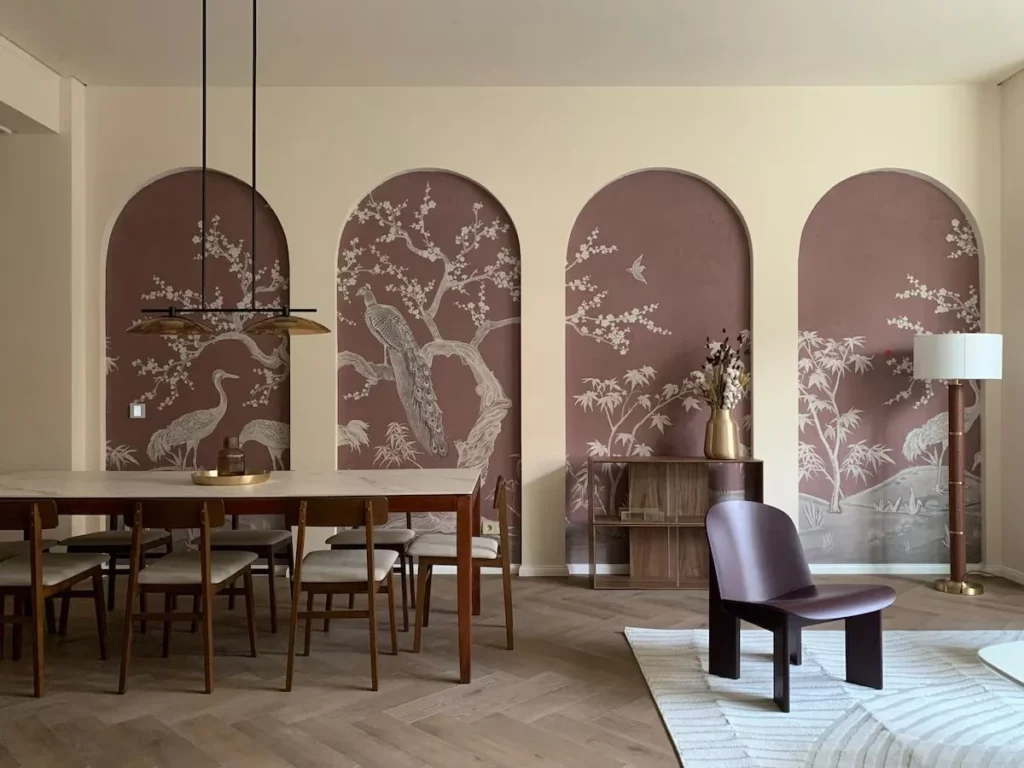
Situated in a former factory along the River Spree in Treptow, The Martin offers a case study in the adaptive reuse of industrial heritage. Spanning nearly 2,000 square feet, the apartment retains its original factory "bones"—high ceilings and oversized windows—while introducing soft architectural elements such as arched alcoves and mural-style wallpaper. This juxtaposition of raw industrialism and curated comfort reflects a broader trend in Berlin’s interior design, where the "cold" aesthetic of concrete is tempered by eclectic, high-quality furnishings.
Designer Global Living Loft
This property highlights the city’s move toward bold, saturated colors and flexible living arrangements. Unlike the minimalist trends that dominated the early 2000s, this loft utilizes graphic patterns and intentional contrasts to create a high-energy environment. The layout is notably non-traditional, featuring integrated living and sleeping areas that mirror the "live-work" philosophy prevalent among Berlin’s creative professional class.
Key Loft 02: The Architectural Interior
In Kreuzberg, a neighborhood historically associated with resistance and counterculture, Key Loft 02 introduces a playful architectural concept: the "sleeping cabin." These house-shaped structures within the loft serve as room dividers, providing privacy without compromising the open-plan integrity of the space. Set within a quiet courtyard—a classic feature of Berlin’s urban planning known as the "Hinterhof"—the property offers a sanctuary from the vibrant, high-traffic streets of one of the city’s most famous districts.
Small Lock Villa of Lanke: Prussian Heritage
Extending beyond the city limits into the Brandenburg countryside, the Small Lock Villa is located on the historic Schloss Lanke estate. The park was designed by Peter Joseph Lenné, a preeminent Prussian landscape architect, while the building itself was designed by Eduard Knoblauch. The interior features a Bulthaup kitchen and vintage furnishings, bridging the gap between 19th-century aristocratic proportions and 21st-century luxury. This property serves the growing market for "slow travel," where visitors seek architectural significance in a pastoral setting.
Enchanting Loft in Friedrichshain
Friedrichshain remains a bastion of Berlin’s alternative scene, and this 1,500-square-foot loft captures that spirit through a mix of vintage furniture and original artwork. The space emphasizes the "unfinished" aesthetic that many associate with Berlin—soaring ceilings and worn wooden floors that suggest a history of creative labor. It provides an immersive experience in a neighborhood defined by its proximity to the East Side Gallery and the city’s world-renowned club culture.
Economic Data and Tourism Trends
The rise of these high-end, design-centric rentals occurs against a backdrop of shifting tourism dynamics in the German capital. According to data from VisitBerlin, the city’s official tourism portal, Berlin recorded approximately 12.1 million arrivals and 29.6 million overnight stays in 2023. While traditional hotels remain the primary choice for many, there is a documented shift toward "authentic" residential stays among high-net-worth travelers and the "creative class."
Market analysis suggests that travelers are increasingly willing to pay a premium for architectural uniqueness. Properties like The Martin or the Enchanting Loft in Friedrichshain command rates between $399 and $440 per night, significantly higher than the city’s average hotel room rate. This indicates a robust demand for accommodations that function as an extension of the travel experience itself, rather than just a place to sleep.
Regulatory Environment and Social Impact
The proliferation of short-term rentals in Berlin has not been without controversy. To address housing shortages and rising rents, the Berlin Senate implemented the Zweckentfremdungsverbot (Ban on Misappropriation of Housing) in 2014, with several tightenings of the law in subsequent years. This regulation requires hosts to obtain specific permits to rent out entire apartments on a short-term basis.
Urban planners and local officials have expressed a dual perspective on the matter. On one hand, these design-led rentals contribute to the city’s "Creative City" brand, attracting international investment and high-spending tourists. On the other hand, the conversion of residential stock into tourist accommodation has been a point of contention for local residents in neighborhoods like Kreuzberg and Neukölln. The properties that succeed in this environment are often those that demonstrate a high level of professional management and architectural merit, distinguishing themselves from the controversial "unregulated" rental market.
The Broader Implications for Berlin’s Identity
The success of design-forward Airbnbs in Berlin reflects a broader global trend where interior design serves as a primary driver of the "experience economy." For Berlin, this is particularly significant as the city transitions from its post-reunification "poor but sexy" phase into a more established, affluent European capital.
These homes, shaped by artists, designers, and curators, act as a bridge between the city’s history and its future. They preserve the architectural bones of the past—the factory windows, the Altbau moldings, the Prussian parklands—while injecting them with contemporary vitality. As Berlin continues to evolve, its residential spaces remain the most intimate galleries for observing the city’s ongoing dialogue with design.
Chronology of Berlin’s Design Evolution
- 1919: Foundation of the Bauhaus school in Weimar (later moving to Dessau and Berlin), revolutionizing modern design.
- 1870s–1910s: Construction of the majority of Berlin’s "Altbau" tenements during the Gründerzeit period.
- 1945–1989: Division of the city; development of distinct architectural styles in East (Plattenbau) and West (Modernism).
- 1990s: Post-reunification artistic boom; "Zwischennutzung" (temporary use) of abandoned spaces in Mitte and Friedrichshain.
- 2014: Implementation of the Zweckentfremdungsverbot to regulate the short-term rental market.
- 2020–Present: Emergence of a professionalized, design-centric rental market catering to "aesthetic tourists."
In conclusion, the best Berlin Airbnbs are those that do not merely mimic international hotel standards but lean into the city’s specific, often idiosyncratic, architectural history. Whether it is a compact studio in Mitte or a sprawling loft in a Friedrichshain factory, these spaces offer a curated immersion into a city that remains one of the world’s most compelling canvases for design.