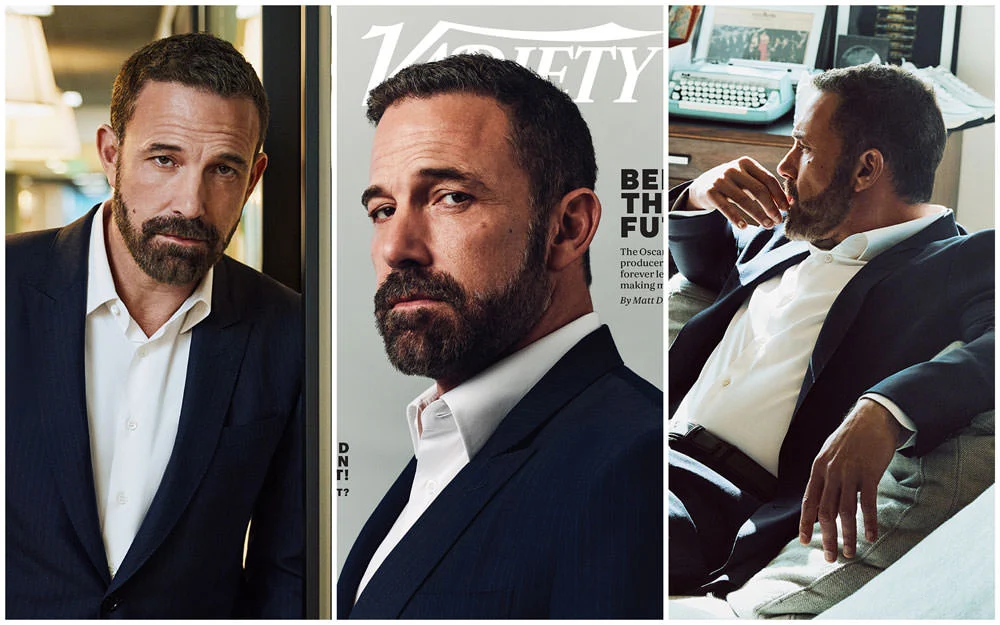

In an expansive and deeply reflective new cover story for Variety, Academy Award-winning filmmaker and actor Ben Affleck sat down with Executive Editor Matt Donnelly for a wide-ranging interview. The feature arrives as Affleck promotes his upcoming film Animals—in which he stars as a complex Los Angeles mayoral candidate—while simultaneously championing a structural revolution in Hollywood through his production company, Artists Equity. Beyond movie-making economics, Affleck addressed the relentless glare of early celebrity culture, the shifting metrics of modern movie stardom in the age of social media, his legacy as the Dark Knight in the DC Extended Universe, and why the prospect of real-world political office holds zero appeal for him.
The interview serves as a rare, unfiltered look at the intersection of Hollywood business and personal survival from a veteran artist who has spent decades navigating the apex of the entertainment industry.
Revolutionizing Hollywood Economics Through Artists Equity
At the core of Affleck’s current professional focus is Artists Equity, the full-service production and content company he co-founded alongside childhood friend and frequent collaborator Matt Damon. Established with backing from RedBird Capital Partners, the studio was conceived to fundamentally alter how creative talent—including writers, directors, actors, and producers—participates in the financial upside of the films they create.
For decades, standard Hollywood accounting has relegated above-the-line talent to fixed upfront salaries supplemented by deferred bonuses tied to net profits, a system famously criticized for leaving creators empty-handed even when a film performs exceptionally well at the box office. Affleck and Damon designed Artists Equity to bypass traditional arcane bonus pools by compensating key contributors as equity partners in the enterprise.

"The history of this business is full of promises of participation that don’t end up coming true," Affleck told Variety, pointing to infamous industry lore where films gross hundreds of millions of dollars while key creators receive no secondary returns.
Affleck acknowledged that introducing this model required the leverage of established star power. However, he emphasized that celebrity clout is ephemeral and cannot be relied upon as a permanent operational strategy. By pioneering the framework with Amazon on the sports-marketing drama Air and continuing the approach with Netflix on The Rip, Artists Equity has aimed to prove that transparent, performance-based compensation is commercially viable.
Building on this momentum, the company recently finalized a deal to launch Artists Equity Independent Pictures, a dedicated indie theatrical film fund designed to nurture next-generation filmmakers while actively maintaining Los Angeles as a vital, sustainable hub for cinematic production. Industry analysts note that if this equity-sharing template gains broader adoption across major studios, it could permanently shift the balance of power between traditional conglomerates and creative workers.
The Death of the Traditional Movie Star and Social Media Pressures
Transitioning from the economics of production to the psychology of contemporary performance, Affleck offered a candid assessment of how the concept of the "movie star" has evolved. In an era dominated by algorithmic content, intellectual property dominance, and viral marketing, the traditional pathways to stardom have fractured.
Reflecting on his conversations with younger actors, Affleck highlighted the immense psychological toll exacted by digital platforms. Today’s rising talent face unprecedented pressure to curate substantial online followings, a metric that casting directors increasingly weigh alongside raw audition performances.

This environment contrasts sharply with the landscape Affleck and Damon entered in the late 1990s following their breakthrough with Good Will Hunting. Discussing his own tumultuous journey through the media landscape, Affleck reflected on the fundamental shift in tabloid culture that occurred at the turn of the millennium.
He recalled how publications like Us Weekly transitioned from traditional celebrity journalism into aggressive gossip aggregators, a demand surge that ultimately birthed entirely new ecosystems, including reality television and algorithm-driven digital gossip columns like Gawker. While Matt Damon managed this era with strategic grace, Affleck admitted that his own actions and experiences often placed him squarely in the crosshairs of sensationalist reporting, creating a public persona that frequently overshadowed his cinematic output.
Reflecting on the DC Extended Universe and the Burden of Batman
Affleck’s cinematic footprint extends deeply into the superhero genre, a domain he revisited during his conversation with Variety. Discussing his tenure as Bruce Wayne/Batman, Affleck expressed fond memories of his work in Zack Snyder’s Batman v Superman: Dawn of Justice, praising Snyder’s uncompromising visual and narrative vision.
However, he acknowledged the turbulent behind-the-scenes hurdles that plagued subsequent team-up projects like Justice League. Affleck touched upon the delicate balancing act comic book adaptations face when negotiating tone—specifically the tension between crafting gritty, mature, hard-R narratives (such as Joker or Logan) and maintaining broad, four-quadrant family appeal akin to the Marvel Cinematic Universe.
Affleck noted that the legacy of graphic novelists like Frank Miller continues to pull Warner Bros. and DC between darker adult storytelling and crowd-pleasing accessibility—a creative tightrope walk the studio has continuously navigated. In praising Marvel Studios chief Kevin Feige as an unmatched producing genius, Affleck underscored the rare, almost supernatural commercial intuition required to consistently decode mass audience desires on a global scale.

On Political Fiction, Reality, and Animals
With his upcoming psychological thriller Animals positioning him as a mayoral candidate navigating high-stakes political maneuvering, the interview naturally drifted toward whether Affleck would ever translate his civic interests into actual public service. His response was swift and unequivocal.
"Would you ever consider public office? I just think that’s enormously—I don’t know, man, that seems terrible," Affleck remarked. He characterized modern political life as inherently tawdry and depressing, viewing it through the lens of moral compromise. To Affleck, political stories serve primarily as parables for the collision between human ideals and harsh institutional realities—a world holding zero personal or professional appeal.
Instead, Affleck remains firmly anchored in storytelling, using his platform at Artists Equity to reshape the mechanics of Hollywood while continuing to tackle complex, character-driven roles on both sides of the camera. As Animals prepares to hit screens, the industry continues to watch whether Affleck and Damon’s structural gamble can successfully rewrite the rules of cinematic finance for the generations of filmmakers to come.