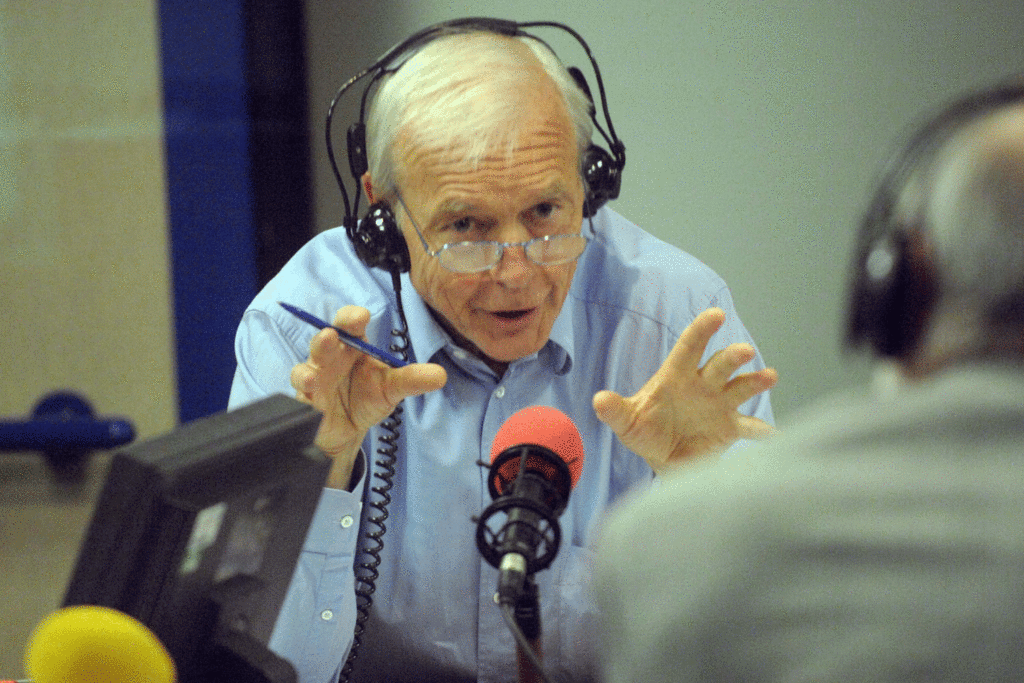

Veteran broadcaster John Humphrys, a formidable voice on BBC Radio 4’s flagship Today programme for over three decades, has launched a trenchant critique of his former colleagues and the current state of the show, describing elements as "profoundly irritating." His candid remarks, penned in an op-ed for The Guardian, come seven years after his departure from the revered current affairs programme in 2019 and coincide with the recent announcement of high-profile presenter Amol Rajan’s decision to step down from his Today role. Humphrys’ observations illuminate a generational and stylistic schism within broadcast journalism, stirring debate about the evolving nature of news presentation on one of Britain’s most influential radio platforms.
A Veteran’s Discontent: The Specifics of Humphrys’ Critique
At 82 years old, Humphrys, known for his incisive interviewing style and unyielding pursuit of clarity, now finds himself on the other side of the microphone, a listener often moved to exasperation. "Having been the one on the radio informing (and possibly sometimes annoying) the listeners for 33 years, I’m now the man shouting at his radio about how irritating the programme has become," he wrote, encapsulating a sentiment likely shared by a segment of Today‘s loyal, often discerning, listenership.
His criticisms are not merely general but pinpoint specific stylistic habits of current presenters. He singled out Justin Webb, Nick Robinson, and notably, Amol Rajan, stating their broadcasting styles frequently provoke him to "harrumphing" at the airwaves. Rajan’s delivery, in particular, drew sharp focus. Humphrys highlighted what he perceives as Rajan’s "insistence on emphasising, without fail, the definite and indefinite articles in any given sentence." He provided a vivid example: "In his world, ‘A’ bomb has exploded in ‘THE’ palace of Westminster." This particular point underscores a broader concern about vocal affectations that, to Humphrys, detract from the gravitas and clarity expected of serious news broadcasting.
Beyond individual quirks, Humphrys extended his critique to more pervasive practices within the programme. He expressed disdain for presenters "gushing" over guests before interviews commence, viewing it as a compromise of journalistic impartiality and a softening of the interviewer’s stance. Furthermore, the overuse of conversational filler phrases such as "y’know" and "I mean" was cited as a major irritant, admitting these habits cause him to "grind his teeth." He also voiced his discomfort with the post-interview discussions where presenters analyse the significance of the conversations they have just conducted, finding these segments "deeply uncomfortable" and perhaps an unnecessary layer between the news and the listener.
Despite the severity of his criticisms, Humphrys offered a backhanded compliment, acknowledging that Webb, Rajan, and Robinson are "as good as they come" in the broadcasting world. This concession suggests that his frustration stems not from a belief in their incompetence but from a perceived deviation from what he considers the gold standard of broadcast journalism. He also demonstrated a degree of self-awareness regarding his position, jokingly remarking that if he were Today‘s editor, the phrase "pain in the arse" might readily come to mind when considering his critique.
The Enduring Legacy and Impact of John Humphrys on Today
John Humphrys’ tenure on the Today programme was legendary, spanning from 1987 to 2019. For over three decades, he was synonymous with rigorous, often confrontational, interviewing. His style was characterised by an unwavering determination to hold politicians and public figures to account, dissecting their statements with forensic precision and rarely allowing evasiveness. This made him a formidable presence, respected and feared in equal measure by those who entered the Today studio. He helped solidify the programme’s reputation as a cornerstone of British public discourse, an essential morning listen for political and business leaders, and millions of ordinary citizens alike.

His departure in 2019 marked the end of an era. At the time, Humphrys stated his desire to spend more time with his family and pursue personal interests, notably "get more involved in trees." He reflected on his long service, acknowledging he probably should have left earlier: "I love doing the programme. I have always enjoyed it. That’s the problem. I should have gone years ago. Obviously, I should have gone years ago." His current critique, therefore, comes from a deeply invested perspective, a former custodian of the programme’s ethos observing its evolution from a distance. It raises questions about whether his criticisms represent an immutable standard of journalistic practice or a veteran’s resistance to inevitable shifts in style and presentation.
A Brief Chronology of the Today Programme and its Presenters
The Today programme, which first aired in 1957, is the BBC’s flagship news and current affairs programme on Radio 4. It occupies a unique and powerful position in British media, often setting the national news agenda with its early morning interviews and reports. Its presenters are among the most recognisable voices in the country, and their interactions with politicians and experts frequently generate headlines.
- 1957: Today programme first broadcast on the BBC Home Service (later Radio 4).
- 1987: John Humphrys joins the Today programme as a main presenter.
- Early 2000s onwards: Presenters like Justin Webb and Nick Robinson become prominent voices on the programme, establishing their own distinct styles.
- 2017: Amol Rajan joins the Today presenting team, bringing a younger, often more energetic approach to the programme.
- 2019: John Humphrys steps down from Today after 32 years, marking the end of a significant era.
- Mid-2020s (implied): Humphrys observes the programme’s evolution from a listener’s perspective, culminating in his recent op-ed.
- Recently (implied by article): Amol Rajan announces his departure from Today to pursue business interests in the creator economy, creating a vacancy and prompting reflection on the programme’s future direction.
Amol Rajan’s Departure: A Confluence of Events
The timing of Humphrys’ critique is particularly poignant given Amol Rajan’s recent announcement that he will be stepping down from his role on Today. Rajan, who joined the programme’s presenting team in 2017, has been a significant figure in the BBC’s efforts to modernise its output and appeal to a broader, younger demographic. His departure is reportedly driven by a desire to focus on his burgeoning business interests in the "creator economy," a rapidly expanding sector of digital content creation and monetisation.
Despite Humphrys’ pointed criticism of Rajan’s specific delivery style, Rajan’s departure has been met with "genuine disappointment" behind the scenes at the BBC. Senior figures within the corporation reportedly viewed his "energetic presenting style" as crucial to keeping Today relevant to modern audiences in an increasingly fragmented media landscape. This highlights a fascinating tension: a veteran broadcaster critiques a successor for perceived stylistic flaws, while the organisation itself values those very qualities for their contemporary appeal. Rajan’s tenure saw him balance Today with other high-profile roles, including the BBC’s Media Editor and host of University Challenge, showcasing his versatility and appeal across different formats. His exit, therefore, represents a loss for the programme’s strategic direction, particularly in its quest for continued relevance.
The Shifting Landscape of Broadcast Journalism and Listener Expectations
Humphrys’ critique can be viewed as more than just an individual’s grumbling; it taps into a broader discussion about the evolution of broadcast journalism. The Today programme, with its historical gravitas, faces the perpetual challenge of balancing tradition with the demands of a rapidly changing media environment.
One key aspect of this shift is the move towards a more conversational and accessible style of broadcasting. While traditionalists, like Humphrys, might value a more formal, detached, and rigorously challenging approach, modern audiences, particularly younger ones, often prefer a more personable and conversational tone. The "gushing" over guests, the use of filler words, and the post-interview analysis could be interpreted not as flaws, but as attempts to create a more engaging, empathetic, and less intimidating listening experience. The emphasis on articles, as noted by Humphrys, might even be a deliberate stylistic choice intended to add emphasis or clarity for some listeners, rather than a mere affectation.

The BBC, as a publicly funded broadcaster, is under constant pressure to justify its existence and appeal to a diverse range of taxpayers. This includes maintaining its core older audience while simultaneously attracting younger listeners who are accustomed to different media consumption habits. Striking this balance is incredibly difficult, and the stylistic choices of its presenters are often at the forefront of this tension. Humphrys’ comments highlight the potential for friction between those who champion the established norms of broadcasting and those who advocate for adaptation to contemporary tastes.
Budgetary Pressures and the Future Outlook
Beyond stylistic concerns, Humphrys also touched upon the very real threat of budget cuts. He warned that he might stop listening altogether if further financial constraints impact the programme, despite acknowledging that Today has historically been better protected than many other BBC shows. Previous rounds of cuts have already seen the programme lose its dedicated correspondents, a move that can undeniably impact the depth and breadth of its reporting.
The BBC operates under constant financial scrutiny, with ongoing debates surrounding the licence fee and the need to deliver value for money. Any further cuts could have tangible effects on the Today programme’s ability to maintain its high journalistic standards, commission in-depth investigations, and retain top talent. A reduction in resources could lead to less comprehensive coverage, fewer specialist reporters, and potentially a decline in the overall quality that has long been its hallmark. Humphrys’ warning underscores the precarious position even flagship programmes find themselves in amidst the broader financial challenges facing public service broadcasting.
Inferred Reactions and Broader Implications
While no official responses have been issued by the BBC or the named presenters, the implications of Humphrys’ critique are multi-layered:
- For BBC Executives: Humphrys’ comments, despite his jocular tone, are unlikely to be entirely dismissed. Coming from such an iconic figure, they serve as a powerful external audit. Executives must weigh the importance of maintaining traditional journalistic rigour, which Humphrys champions, against the imperative to evolve and remain relevant to a changing audience, which Rajan’s style was seen to facilitate. This creates an internal dialogue about editorial direction and presenter training.
- For Current Presenters: While professional broadcasters are accustomed to public scrutiny, criticism from a predecessor of Humphrys’ stature likely resonates. It might prompt internal reflection on their individual styles, although it is unlikely to lead to immediate, drastic changes given the BBC’s broader strategy. Publicly, any response would likely be measured and professional, if offered at all.
- For the Audience: Humphrys’ op-ed will undoubtedly polarise listeners. Many long-time Today listeners may echo his sentiments, feeling validated in their own frustrations with modern broadcasting styles. Others, particularly those who appreciate the current presenters’ approach, might view his critique as an outdated perspective from the "old guard." This public discourse contributes to the ongoing conversation about the BBC’s role and its programming choices.
- For the Journalism Community: The article sparks a wider debate within journalism about the balance between authority and accessibility, the impact of stylistic choices on content delivery, and the perennial challenge of journalistic impartiality in an increasingly personality-driven media landscape.
The Today programme continues to attract a substantial audience, boasting over five million listeners each week. This enduring popularity underscores its vital role in British life. John Humphrys’ latest intervention, coupled with Amol Rajan’s impending departure, places the programme at a critical juncture, prompting reflection on its past, present, and future direction as it navigates the complexities of modern media. The challenge for the BBC will be to honour its legacy of authoritative journalism while continuing to adapt and connect with a diverse and evolving listenership.