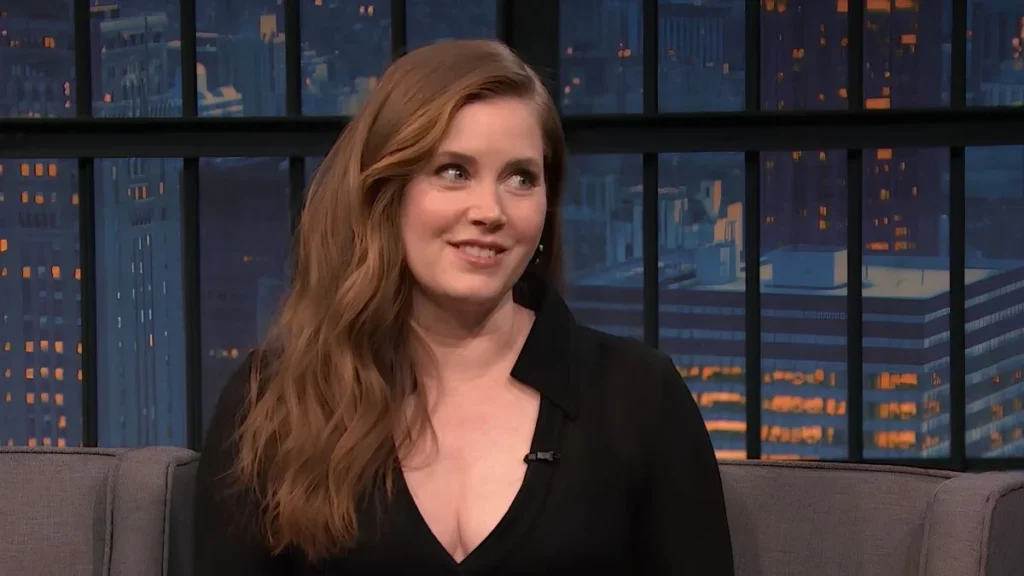

Academy Award-nominated actress Amy Adams recently revisited a pivotal moment in her career during an appearance on Late Night with Seth Meyers, detailing her decision to veto a "graphic" sketch proposed by Andy Samberg during her first hosting stint on Saturday Night Live (SNL). The incident, which took place in early 2008, highlights the delicate balance actors must maintain between the irreverent nature of late-night comedy and the preservation of a professional brand, particularly when that brand is closely tied to family-friendly entertainment. At the time, Adams was basking in the global success of the Disney hit Enchanted, a film that redefined her career and established her as a household name among younger audiences.
During the interview, which aired in June 2024, host Seth Meyers—who was the head writer at SNL during Adams’ 2008 debut—brought up a specific pitch from Andy Samberg and the Lonely Island comedy troupe. Adams confirmed the story, noting that while she appreciated the creativity of the cast, she felt the need to set firm boundaries to protect her image and the expectations of her fan base. The rejection of the sketch has since become a point of reflection for both Adams and Samberg, illustrating the intersection of artistic risk and demographic responsibility.
The Nature of the "Graphic" Pitch
The proposed sketch, as described by Adams, was intended to be a musical number or a high-concept comedic scene involving a tragic yet absurd premise. According to Adams, the pitch involved a couple in a park where the male character, played by Samberg, is bitten by a venomous spider. As he lies dying, he asks his partner, played by Adams, for a final wish. Adams recounted that the "wish" in question was an extremely graphic sexual act that Samberg’s character wanted her to perform before he succumbed to the spider bite.
"I’ll give you the gist without telling you the punchline," Adams told Meyers, maintaining a level of decorum even years after the event. She characterized the content as "the most graphic thing" Samberg could have requested. While SNL is known for pushing the boundaries of network television, particularly in its later time slots, the specific nature of this pitch felt incongruous with Adams’ public persona at the time. The actress noted that the "punchline" of the song was entirely centered on this explicit request, which she ultimately deemed inappropriate for her to execute.
The Enchanted Factor: Brand Protection and Audience Awareness
The primary driver behind Adams’ refusal was her awareness of her audience. Enchanted had been released in November 2007, only months before her March 2008 SNL appearance. The film, which blended live-action and animation, featured Adams as Giselle, a princess-to-be who is transported from her magical kingdom to modern-day New York City. The movie was a massive commercial and critical success, grossing over $340 million worldwide and earning Adams a Golden Globe nomination.
For millions of young girls, Amy Adams was the living embodiment of a Disney princess. "I was so keenly aware of all the, like, young girls that were watching Enchanted," Adams explained to Meyers. "And I didn’t want to be the princess singing about that particular act."
This decision reflects a calculated understanding of "brand integrity." In the entertainment industry, actors often face the "typecasting" dilemma; however, for those associated with major Disney franchises, the transition to adult-oriented content requires careful navigation. Adams’ choice to decline the Samberg pitch was not a rejection of comedy itself, but a strategic move to ensure that her performance on a late-night variety show did not alienate or confuse the families who had just made her a star.
Chronology of Events: From the Box Office to the SNL Stage
The timeline of this event is crucial to understanding the pressures Adams faced.
- November 21, 2007: Enchanted premieres in U.S. theaters, becoming an immediate cultural phenomenon and solidifying Adams’ status as an A-list lead.
- January – February 2008: The 2007–2008 Writers Guild of America strike concludes, allowing SNL to resume production.
- March 8, 2008: Amy Adams hosts Saturday Night Live for the first time (Season 33, Episode 7), with musical guest Vampire Weekend. This is the episode where the controversial pitch occurred during the week-long writing process.
- March 9, 2008: Following the live broadcast, Andy Samberg witnesses an interaction between Adams and a young fan, which changes his perspective on the rejected sketch.
- 2024: Seth Meyers and Andy Samberg discuss the incident on "The Lonely Island and Seth Meyers Podcast," leading to the subsequent discussion on "Late Night with Seth Meyers."
During the 2008 episode, Adams did eventually collaborate with Samberg on a different digital short and various sketches, including a memorable bit where she played a competitive dancer. The episode was well-received, proving that she could be funny and versatile without resorting to the graphic humor Samberg had initially envisioned.
The Lonely Island’s Perspective and Retrospective Realizations
The story gained new life recently when Seth Meyers and Andy Samberg discussed it on their podcast, which focuses on the history of the SNL Digital Shorts. Meyers revealed that Samberg, known for his "absurdist and often ribald humor," eventually felt a sense of relief that Adams had turned down the sketch.
Meyers recounted on the podcast that Samberg had a "lightbulb moment" the very next day. While out in public, Samberg observed a five-year-old girl approach Adams. The child expressed her deep love for Enchanted and told Adams how much the character of Giselle meant to her. According to Meyers, Samberg was struck by the innocence of the fan and the weight of Adams’ influence. He reportedly told Meyers, "Oh, my God, I can’t believe I almost made her do that."
This retrospective realization highlights the often-insular world of the SNL writer’s room, where the goal is frequently to shock or find the most extreme comedic angle. Samberg’s "gracious" response to the rejection, as Adams described it, underscores a mutual respect between the performers. It also serves as a reminder that what may seem like a "hilarious" idea in a late-night brainstorming session can have real-world consequences for a performer’s public image.
Supporting Data: The Impact of Enchanted and Adams’ 2008 Career
To understand the stakes of the 2008 SNL appearance, one must look at Adams’ career trajectory at that moment. In 2008, she was transitioning from an indie darling (following her 2005 Oscar nomination for Junebug) to a major studio powerhouse.
- Box Office Power: Enchanted earned $127.8 million domestically and $212.7 million internationally. It remained in the top ten at the box office for several weeks, meaning it was still fresh in the public consciousness when she hosted SNL.
- Critical Acclaim: Adams was not just a "commercial" star; she was a critical one. In late 2008, she would go on to star in Doubt alongside Meryl Streep, earning her second Academy Award nomination.
- SNL Ratings: The 2007-2008 season of SNL was a high-water mark for the show, largely due to the political climate of the 2008 election and the popularity of the Digital Shorts. The guest hosts were under intense scrutiny.
Had Adams moved forward with the "graphic" spider-bite song, it likely would have gone viral—as many Lonely Island shorts did—but potentially for the wrong reasons. In an era before the nuance of social media discourse was fully developed, such a clip could have easily overshadowed her work in family cinema and complicated her relationship with Disney.
Broader Implications for Guest Hosts and Comedy Standards
The interaction between Adams and Samberg serves as a case study in the collaborative but sometimes friction-filled relationship between guest hosts and the SNL cast. While the cast and writers are responsible for generating content, the host has the final say on what they are comfortable performing. This "veto power" is a critical tool for actors who must protect their professional interests.
Furthermore, the incident illustrates a shift in comedy standards. The late 2000s were a period where "shocker" humor and digital viral content were becoming the primary currency of late-night television. However, Adams’ refusal demonstrates that even in a medium designed for risk-taking, there is a place for personal and professional boundaries.
The fact that Samberg later acknowledged his error in judgment suggests a growing awareness within the comedy community regarding the "context" of their guests. A sketch does not exist in a vacuum; it is performed by an individual with a specific history, audience, and future career path.
Conclusion
The revelation of this rejected SNL sketch provides a fascinating glimpse into the behind-the-scenes decision-making of one of Hollywood’s most respected actresses. Amy Adams’ decision to prioritize her young fans and her professional reputation over a potentially viral comedic moment proved to be a wise one. Her career continued to flourish across multiple genres, from family musicals to intense dramas, without the baggage of a controversial "graphic" viral clip.
Ultimately, the story is a testament to Adams’ professional foresight and Andy Samberg’s ability to recognize the validity of a colleague’s boundaries. As late-night comedy continues to evolve, the balance between creative edge and brand responsibility remains a central theme for every performer who steps onto the stage at 30 Rockefeller Plaza.