
The volatile media landscape surrounding conspiracy theorist Alex Jones and his Infowars platform has taken an unprecedented turn, with satirical news titan The Onion securing a deal to assume creative control of the Infowars website. This strategic maneuver, emerging from a protracted legal battle, has ignited a series of public meltdowns from Jones, particularly centered on the appointment of comedian Tim Heidecker as the new creative director. Jones’s increasingly frantic online posts reveal a profound inability to distinguish Heidecker’s long-standing, often absurdist comedic work from reality, leading to a bizarre and highly public collision of satire and misinformation.
The Genesis of a Hostile Takeover: Infowars’ Legal Entanglement
The roots of The Onion‘s intervention into the Infowars empire trace back to a complex and devastating series of legal judgments against Alex Jones. For years, Jones leveraged Infowars to propagate numerous conspiracy theories, most infamously asserting that the 2012 Sandy Hook Elementary School shooting was a hoax, and that the victims’ families were actors. These defamatory claims led to multiple lawsuits from the grieving families, culminating in substantial judgments against Jones and his Free Speech Systems company.
In 2022, Jones was ordered to pay over $1.4 billion in damages to the Sandy Hook families across two separate trials in Texas and Connecticut. Facing imminent financial ruin, Jones and Free Speech Systems filed for Chapter 11 bankruptcy. This legal maneuver was intended to reorganize his finances and potentially limit his liability, but it instead opened the door for creditors and other entities to exert influence over his assets, including Infowars. The bankruptcy proceedings became a protracted affair, with courts scrutinizing Jones’s assets and income, and his attempts to shield wealth.
It was within this intricate legal and financial morass that The Onion saw an opportunity. Known for its incisive, often biting satire of news and current events, The Onion positioned itself to acquire a licensing deal for the Infowars website, with the explicit intention of transforming it into a self-parody. This move, while seemingly audacious, is a logical extension of The Onion‘s mission: to hold a distorted mirror up to contemporary media and public discourse. The concept of turning a bastion of conspiracy theories into a satirical echo of itself represents a meta-commentary on the nature of truth in the digital age. The deal, reportedly financed in part by billionaire Michael Bloomberg, underscores the significant financial backing required to navigate such a complex acquisition, highlighting the unique nature of this corporate-satirical venture.
Tim Heidecker: The Architect of Absurdity Meets the Conspiratorial Mind
The choice of Tim Heidecker as the creative director for the revamped Infowars is a stroke of strategic brilliance from The Onion, specifically designed to provoke and exploit Jones’s vulnerabilities. Heidecker, a comedian, writer, director, and musician, is renowned for his work alongside Eric Wareheim in the Adult Swim series Tim and Eric Awesome Show, Great Job! and his equally perplexing, long-running web series and film project On Cinema at the Cinema. His comedic style is characterized by deadpan delivery, cringe humor, surrealism, and elaborate, multi-layered performance art that blurs the lines between character and reality.
Heidecker’s characters often embody flawed, delusional, or morally ambiguous individuals, existing within highly stylized, low-budget, and often unsettling fictional worlds. This makes him a perfect foil for Alex Jones, whose own public persona often treads a similar line between performance and genuine belief. The Onion likely understood that Heidecker’s brand of humor, steeped in irony and the subversion of expectations, would be inherently incomprehensible to someone like Jones, who operates in a literal, often paranoid, and aggressively anti-intellectual framework. The appointment was a calculated provocation, designed to elicit precisely the kind of confused and outraged response that has since unfolded.
Alex Jones’s Descent into Interpretive Chaos: A Chronology of Meltdowns
The announcement of Heidecker’s appointment sent shockwaves through Jones’s already beleaguered Infowars operation, triggering a series of public outbursts that have intensified throughout the week. His reactions provide a fascinating, if concerning, case study in the collision of performance art and literal interpretation.
Wednesday, April 23, 2026: The Initial Rant
Jones initiated his public campaign against Heidecker with a capitalized-case rant on X (formerly Twitter). In a post that quickly garnered widespread attention, Jones declared: “The Man Hired By The Onion To Take Over Infowars Produced Pro-Pedophile / Child Torture & Murder Shows For Adult Swim In Conjunction With Will Ferrell Who Took Part In Satanic Rituals With Spirit Cooking High Priestess Marina Abramović!” This explosive accusation was accompanied by a 30-minute video compilation. The video interspersed clips from Tim and Eric Awesome Show, Great Job!—a series known for its intentionally grotesque, low-fidelity, and often disturbing sketches—with Jones’s fervent, disbelieving commentary. He presented the comedic sketches as literal evidence of Heidecker’s depravity, failing entirely to grasp the satirical or absurdist intent behind the content. The mention of Will Ferrell and Marina Abramović (a performance artist often targeted by conspiracy theories related to "spirit cooking") highlights Jones’s tendency to weave disparate, often baseless, accusations into a larger conspiratorial narrative.
Thursday, April 24, 2026: The "Greatest Hits" and Skin-Wearing Fears
Jones continued his digital offensive, sharing an "additional greatest-hits reel" of Heidecker’s past work, further demonstrating his inability to differentiate between character and reality. This compilation likely featured more clips from Heidecker’s extensive comedic catalog, all framed by Jones as genuine, nefarious activities. A particularly alarming development on Thursday was Jones’s expressed concern about the fate of his own skin. He referenced a recent interview in which Heidecker, in a characteristic display of dark humor, joked about wanting to wear Jones’s skin "like Leatherface." For anyone familiar with Heidecker’s persona, this was a clear, if macabre, comedic jab. For Jones, however, it became a literal threat, sparking genuine fear and adding another layer of bizarre misinterpretation to the unfolding drama.
Friday, April 25, 2026: The "Mugshot" Misunderstanding
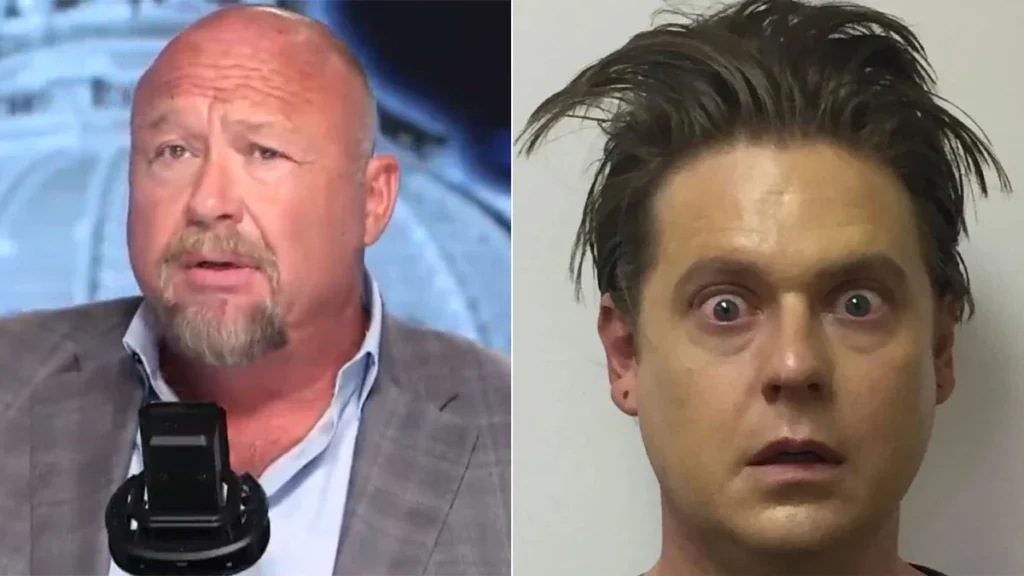
The culmination of Jones’s week-long unraveling came on Friday morning, when he shared a purported "mugshot" of Heidecker on X, accompanied by the note: “Below is an actual mug shot of the creep.” This image was, in fact, a fake headshot from the Adult Swim series On Cinema, specifically an eight-year-old plot point where Heidecker’s character was on trial for murder. The On Cinema universe is a complex, meta-narrative where Heidecker plays a fictionalized, increasingly unhinged version of himself, whose descent into questionable business ventures and legal troubles (including the fictional murder trial related to his "Dr. San" electronic music festival where multiple attendees died from carbon monoxide poisoning) forms the core of the show. Jones’s presentation of this clearly fictional artifact as "actual" evidence underscores his profound detachment from comedic context and his desperate search for "proof" of Heidecker’s supposed criminality. He further extrapolated this to claim that "The Onion newspaper has been rocked by the discovery that their new creative director, produced pro pedo/child kidnapping, torture and murder programs," reiterating his earlier, unfounded accusations.
Tim Heidecker’s Calculated Counter-Performance
Rather than retreating, Tim Heidecker has leaned into the absurdity, actively engaging with Jones’s frenzied reactions and further blurring the lines between satire and reality. In a series of videos posted to Bluesky, Heidecker has adopted an "appropriately Jones-esque length" haircut and is doing his best impression of the Infowars founder. This deliberate mimicry serves to amplify the meta-narrative, turning Jones’s attacks into an integral part of the satirical performance.
Heidecker has also been strategically reposting commentary that highlights the profound interpretive gap between himself and Jones. One notable example, which he shared, humorously observed: “It really isn’t fair to expose Alex Jones to Tim Heidecker like this, the media equivalent of giving a medieval peasant Doritos.” This widely circulated sentiment encapsulates the essence of the confrontation: the collision of a sophisticated, postmodern comedic sensibility with a deeply literal, conspiratorial worldview that lacks the tools to process irony or nuance. Heidecker’s actions suggest a deliberate strategy to not only mock Jones but also to use Jones’s own reaction as a canvas for a broader satirical commentary on the state of media literacy and the vulnerability of certain audiences to misinformation.
Broader Implications: Satire, Misinformation, and the Future of Infowars
The unfolding drama between Alex Jones, The Onion, and Tim Heidecker represents a unique and highly significant moment in contemporary media. The legal maneuver that allowed The Onion to acquire creative control of Infowars is still awaiting final approval from a Texas judge, but TheOnion.Info is already live and operational, signaling the immediate shift in the platform’s content strategy.
The Nature of Satire vs. Misinformation: This confrontation starkly highlights the inherent challenges of satire in an age saturated with misinformation. For satire to be effective, there must be a shared understanding of reality and an ability to decode irony. Jones’s reactions demonstrate what happens when that common ground is absent—satire is perceived as literal truth, leading to confusion, outrage, and further entrenchment of false beliefs. This raises critical questions about media literacy and the responsibility of audiences to discern between fact, fiction, and artistic expression.
Legal and Financial Ramifications: The underlying context of Jones’s bankruptcy and massive defamation judgments cannot be overstated. The Onion‘s takeover is not merely a creative prank but a consequence of legal accountability. It signifies a novel approach to dealing with purveyors of harmful misinformation: rather than simply shutting them down, their platforms are being repurposed to critique the very phenomena they represent. This could set a precedent for how legal systems and creative entities might interact in future cases involving online defamation and the spread of dangerous falsehoods.
The Future of Infowars: The transformation of Infowars into a self-parody holds profound implications for its existing audience. Will Jones’s loyal followers grasp the satirical intent, or will they, like Jones himself, interpret the content literally, perhaps even seeing it as further "proof" of a vast, elaborate conspiracy against their leader? The site’s new direction, under Heidecker’s guidance, promises to be a continuous, evolving performance art piece, challenging the very notion of what constitutes "news" or "truth" in the digital sphere.
The Media Landscape: This event also serves as a potent commentary on the broader media landscape. In an era where "fake news" is both a weapon and a lament, The Onion‘s move is a daring experiment. It tests the boundaries of what journalism—even satirical journalism—can achieve in confronting the proliferation of alternative realities. It forces a re-evaluation of how platforms that once amplified dangerous conspiracy theories might be co-opted and subverted for entirely different purposes.
It is worth noting that Heidecker is also a respected musician, with several folk-rock albums and a recent Consequence Crate Digging interview exploring his favorite concept albums. One can only imagine the additional layers of conspiratorial interpretation Alex Jones might uncover should he delve into Heidecker’s musical oeuvre, searching for hidden messages and clandestine agendas in the lyrics and melodies.
As the legal proceedings conclude and The Onion fully entrenches its creative control over Infowars, the world watches a surreal experiment unfold. The spectacle of Alex Jones, a man who built an empire on fabricating conspiracies, now becoming an unwitting and central character in a grand, ongoing satirical performance orchestrated by the very forces he rails against, is an ironic twist of monumental proportions. It is a powerful reminder of the ever-thinning line between reality and performance, especially in the volatile arena of public discourse.