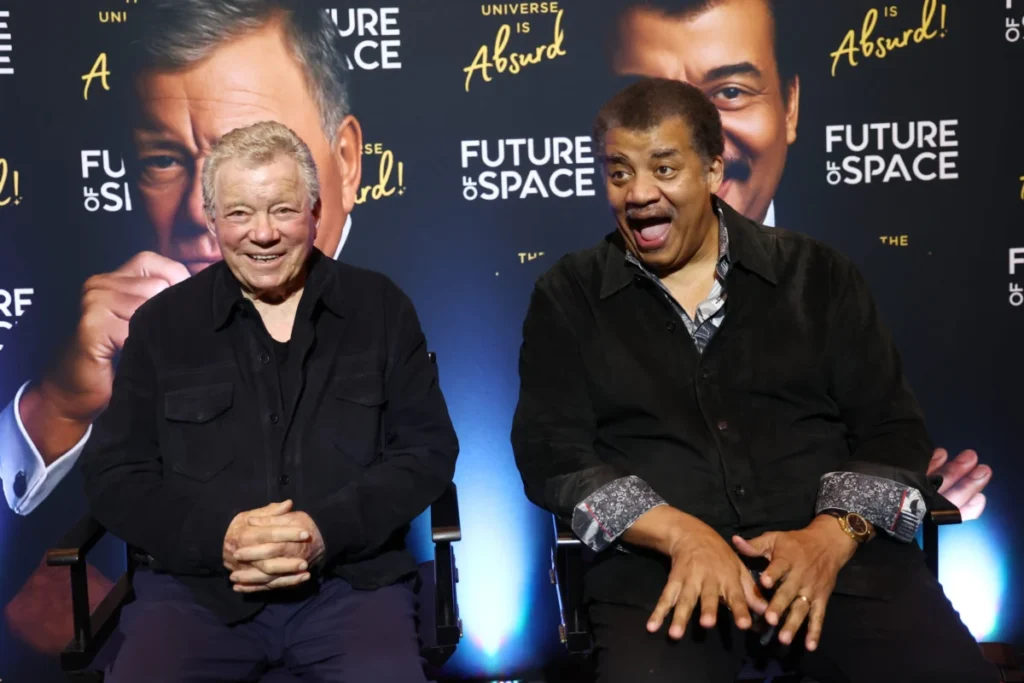

Beverly Hills, CA – In a captivating convergence of pop culture icon and scientific luminary, William Shatner and Neil deGrasse Tyson captivated an eager audience at the Saban Theatre on Wednesday night. Dubbed "The Universe Is Absurd!", the conversation traversed a staggering spectrum of topics, from the esoteric intricacies of quantum physics and the profound experience of spaceflight to the philosophical quest for meaning in the vast cosmos. The event marked the second of a two-night engagement, a testament to the undeniable chemistry and intellectual rapport between the close friends, whose shared adventures include a recent 2024 expedition to Antarctica, where their unique bond first formed. Attendees were not only entertained by their witty banter and personal anecdotes but also enlightened by accessible insights into the wonders of astrophysics.
A Meeting of Minds and Eras: The "Universe Is Absurd!" Dialogues
The Saban Theatre, a historic venue known for hosting a diverse array of performances and cultural events, provided an ideal backdrop for this extraordinary dialogue. Organized by Future of Space, an entity dedicated to curating experiences and events centered around science and space themes, the two-night program underscored the growing public appetite for engaging scientific discourse presented by charismatic figures. The title, "The Universe Is Absurd!", itself hinted at the blend of serious scientific inquiry and the inherent humor and wonder that arises when contemplating the cosmos and humanity’s often-puzzling place within it. The friendship between Shatner, the indelible Captain Kirk from Star Trek, and Tyson, the renowned astrophysicist and science communicator, has blossomed into a compelling partnership that effortlessly bridges the gap between entertainment and education. Their interactions are characterized by mutual respect, playful teasing, and a shared passion for exploration, whether it’s traversing the Antarctic continent or delving into the mysteries of subatomic particles. This dynamic rapport ensures that complex scientific concepts are rendered digestible and relatable, fostering a deeper connection with the audience.
Quantum Leaps and Chronological Markers: Unpacking the Universe’s Smallest Scales
A significant portion of the evening was dedicated to the mind-bending realm of quantum physics, a field that challenges classical understanding of reality. Tyson, with his characteristic clarity, elucidated concepts that often elude the layperson. He began by attempting to convey the incomprehensible scale of an electron. "The electron is so small," Tyson explained, "we do not know how small it is. Every measurement of the electron is smaller than our attempts to measure it. As far as we’re concerned, it’s infinitesimally small." This description highlighted the current scientific understanding that electrons are fundamental particles, believed to be point-like with no discernible internal structure, a concept that pushes the boundaries of human comprehension.
The conversation then took a chronological turn, linking scientific discovery to Shatner’s own remarkable lifespan. The topic of Shatner’s age, noted as 95 years at the event, frequently arose, prompting a blend of awe and humor. Tyson pointed out that Shatner was born in 1931, a year that earned him an appreciative round of applause from the audience. Shatner, ever the showman, bristled playfully at the applause for his longevity, quipping, "I don’t like being applauded for my age. Applaud me for my heavy metal album." Tyson then contextualized Shatner’s birth year within the annals of scientific progress, noting that the neutron, a subatomic particle crucial to atomic structure, was discovered by British physicist James Chadwick just the year after Shatner’s birth, in 1932. This juxtaposition served to illustrate the rapid pace of scientific advancement within a single human lifetime.
Tyson continued his exposition on quantum physics, explaining its foundational principle: "In the 1920s, we learned that the universe is not continually divisible. You reach a point, you have a certain amount of energy, then you have less energy and less and less and less. There’s a point where there’s a unit of energy and you cannot have less than that. That is a quantum of energy." This refers to Max Planck’s groundbreaking work in 1900, which introduced the concept of energy quantization, revolutionizing physics and paving the way for quantum mechanics.
Shatner, embodying the inquisitive skepticism of a true explorer, challenged this assertion, drawing parallels to past scientific paradigms. He argued that scientists had made similar definitive statements about the indivisibility of the atom, only to be proven wrong as further discoveries revealed subatomic particles. "They said it about every new discovery of the entrails of a molecule, of an atom," Shatner contended. When Tyson humorously questioned his use of the word "entrails," the Star Trek icon retorted, "I’m trying to use the language that I understand. It’s not your language because you are a Ph.D." Tyson, quick with a comeback, deadpanned, "Yeah, that word [entrails] didn’t appear in my thesis at all." This lighthearted exchange perfectly encapsulated the dynamic between the two, blending rigorous scientific explanation with relatable, often humorous, layman’s perspective.
From Earth to Orbit: Shatner’s Blue Origin Journey and Its Profound Impact
One of the evening’s most anticipated segments revolved around William Shatner’s historic suborbital flight aboard Jeff Bezos’s Blue Origin New Shepard spacecraft in October 2021. At 90 years old at the time, Shatner became the oldest person to travel to space, a monumental achievement that transcended his fictional portrayal of Captain Kirk. He recounted the ascent to the capsule, a daunting climb of 11 stories up the gantry, which he described with vivid detail. A momentary apprehension struck him when he noticed gas emanating from a vent. Upon being informed it was hydrogen, his mind immediately conjured images of the Hindenburg disaster, adding a layer of trepidation to the already momentous occasion.

Once strapped into the five-point harness, the countdown commenced, only to be punctuated by a ground control announcement of an "anomaly." Shatner recalled his internal reaction, "What the f**k is an anomaly?" The countdown, however, continued, leading to the command, "All right, everybody, we’re removing the gantry. Anybody who wants to get off, get off now." In that pivotal moment, the internal struggle of the man versus the legend surfaced. "And I go, OK. And I think, ‘I can’t, I’m Captain Kirk. I can’t.’" This candid admission resonated deeply, revealing the human vulnerability beneath the iconic persona.
The launch itself was a visceral experience. Shatner described the intense g-force as "an elephant sitting on your chest," a crushing pressure that abruptly ceased as the rocket reached its apogee. "And then suddenly it’s off and suddenly you’re floating," he recounted, detailing the exhilarating sensation of weightlessness. His first impulse in microgravity was not to engage in playful antics like Blue Origin founder Jeff Bezos, who famously had Skittles "thrown at his asshole" by a teenage passenger on a previous flight. "I thought, ‘That’s not gonna be me,’" Shatner joked, emphasizing his more contemplative approach to the brief period of space.
The Overview Effect and Environmental Lamentations
Upon his return to Earth, Shatner was unexpectedly overcome with profound emotion. He recounted landing to find Jeff Bezos and international cameras awaiting him. "Jeff Bezos was there with a microphone and international cameras, and I’m weeping," he shared. "I’m crying uncontrollably, and I don’t know why." After a period of reflection, he realized the source of his tears: "that I’m in grief." This powerful reaction aligns with what astronauts often describe as the "Overview Effect" – a cognitive shift in awareness reported by some space travelers, characterized by a profound understanding of the fragility of Earth and a sense of responsibility for its well-being.
Shatner connected this grief to his experiences filming a show focused on environmental challenges, where he visited "far-flung locales that are in trouble." He cited a visit to the Himalayas, where he was aghast at the sheer volume of garbage left behind by hikers and climbers. "Shit is all over the place in this pristine mountains and it echoes the shit that we’ve left all over the planet with," he lamented. His concerns extended to the insidious spread of microplastics, noting, "Now we’ve learned that microplastics are floating in our blood. As I speak to you, I could drop dead from microplastics. It’s a tragic thing that we’re doing to our planet, and I was in grief for the Earth and the beauty that we see all around us." This poignant testimony served as a stark reminder of the environmental crisis and the unique perspective afforded by viewing Earth from beyond its atmosphere.
Deconstructing Weightlessness and the Human Imperative in Space
Following Shatner’s personal account of spaceflight, Tyson skillfully transitioned to a scientific explanation of weightlessness, a phenomenon often misunderstood. Shatner had observed that the English language lacked an adequate word for the sensation, a reflection of how few people have experienced it. Tyson clarified that weightlessness is not an absence of gravity, but rather a continuous state of freefall. He used a relatable analogy: "He likened it to cutting the cables in an elevator, saying that a person inside it would be falling at the same rate as the elevator, so if they were standing on a scale, the scale would read zero pounds."
Extending this principle to orbit, Tyson explained, "Likewise, if someone is just above the Kármán line, which is recognized as the official boundary of space, they are simply falling toward Earth at the same rate that Earth is curving away from them. So anybody in orbit is weightless because they are continually free-falling toward Earth, not because they’re in space." The Kármán line, set at 100 kilometers (approximately 62 miles) above mean sea level, is the generally accepted demarcation between Earth’s atmosphere and outer space. This scientific demystification provided clarity to a sensation that, for most, remains purely theoretical.
The discussion then shifted to a more philosophical debate: the imperative of sending humans, rather than just robots, into space. Shatner revealed an evolution in his thinking on this topic. He recalled a previous appearance on The Late Show With Stephen Colbert where he questioned the wisdom of sending "vulnerable" humans to explore. However, his own spaceflight experience and subsequent reflections had fundamentally altered his perspective.
"The voyage of exploration, which going to Mars will be needs to be experienced by a human being," Shatner asserted. He emphasized the unique capacity of human consciousness to truly comprehend and interpret discovery. "It takes the human being’s experience, it takes the soul, the brain, the conscious and the unconscious being that we are to experience this magical thing called exploration," he passionately argued. While acknowledging that "a cold robot can send back the facts probably better," Shatner underscored the irreplaceable value of human perception and emotional resonance. "Only a human being can experience that. It’s not the same experience to send mechanical entities. What a marvelous thing for a human being to discover whatever there is to discover on Mars as opposed to a cold robot running along there and running out of power."

Tyson, with his characteristic wit, provided a concise and memorable summary of Shatner’s eloquent argument: "Let’s summarize what you just said. No one has ever given a ticker-tape parade for a robot. No one has ever named a middle school after a robot." This statement perfectly encapsulated the cultural and aspirational significance that human exploration holds, far beyond mere data collection.
A Legacy Beyond the Stars: Shatner’s Enduring Cultural Impact
Towards the conclusion of the evening, Shatner shared a deeply personal reflection on his evolving understanding of his place in the cosmos. "I know I feel an affinity toward this mysterious thing we call the universe and I’m beginning to understand my place in the great unknown," he mused, articulating a sentiment often shared by those who contemplate the vastness of space.
Tyson responded with a poignant and culturally resonant observation that underscored Shatner’s immense and enduring legacy, not just in science fiction, but in real-world social progress. "Do you know what your place in this great unknown is? You lip-kissed a Black woman on television for the first time." Tyson was, of course, referring to the legendary and groundbreaking moment in television history when Captain Kirk (Shatner) kissed Lt. Nyota Uhura (Nichelle Nichols) in the 1968 Star Trek episode "Plato’s Stepchildren."
This iconic kiss, broadcast during a period of significant racial tension and segregation in the United States, was a powerful statement for diversity and equality. It was one of the first interracial kisses depicted on American television, defying network executives who initially feared backlash, particularly from Southern stations. Nichols herself recounted how Shatner insisted on performing the kiss despite network apprehension, ensuring that the scene, crucial to the narrative, was not altered. The moment transcended mere entertainment, becoming a symbol of hope and progress, subtly challenging prevailing societal norms and envisioning a future where racial barriers were dismantled. Tyson’s remark served as a powerful reminder that Shatner’s contributions extend far beyond his fictional voyages, embedding him firmly in the cultural and social fabric of humanity’s journey towards a more inclusive future.
Melodies and Cosmic Quandaries: The Event’s Grand Finale
The evening concluded with a unique blend of intellectual gravitas and artistic expression. Neil deGrasse Tyson offered a reflective close, reading three meaningful quotes along with the final paragraphs of his acclaimed 2007 book, Death by Black Hole: And Other Cosmic Quandaries. His profound words, exploring the wonders and mysteries of the universe, were beautifully underscored by a live pianist, adding an ethereal and contemplative layer to the scientific prose.
William Shatner then took to the stage to perform "Rage," a track from his forthcoming heavy metal album, slated for release in October. Backed by a trumpeter, Shatner’s performance was a testament to his continued artistic experimentation and boundless energy. He acknowledged the audience’s often-amused reaction to his venture into the heavy metal genre, sharing, "So I was asked to do a heavy metal album. That’s generally greeted by some laughter; I’m not sure it’s derisive or not." Shatner has a long history of unconventional musical projects, often characterized by spoken-word delivery and eclectic collaborations, including albums like "The Transformed Man" (1968), "Has Been" (2004), and "Seeking Major Tom" (2011). His foray into heavy metal is yet another fascinating chapter in a career defined by defying expectations and embracing new creative frontiers.
Post-Event Engagement: Connecting with the Cosmos
Following the main event, Shatner and Tyson participated in an exclusive meet-and-greet session for VIP ticket holders, providing an opportunity for closer interaction with their fans. Tyson, in particular, lingered for an extended period, engaging enthusiastically with attendees on a wide array of topics, demonstrating his commitment to public science education. Conversations ranged from speculative discussions about alien life and the ethical considerations of artificial intelligence to deeper dives into specific astrophysical phenomena. This personalized engagement reinforced the accessible and inspiring nature of the event, leaving participants with a sense of wonder and intellectual curiosity.
The success of "The Universe Is Absurd!" highlights the critical role of organizations like Future of Space in fostering public interest and understanding of scientific and cosmic themes. By bringing together figures who can articulate complex ideas with charisma and humor, these events serve as vital platforms for inspiring the next generation of scientists, explorers, and critical thinkers. The Saban Theatre event was more than just a talk; it was a celebration of curiosity, a testament to enduring legacies, and a compelling invitation to ponder humanity’s place in the grand, absurd, and endlessly fascinating universe.