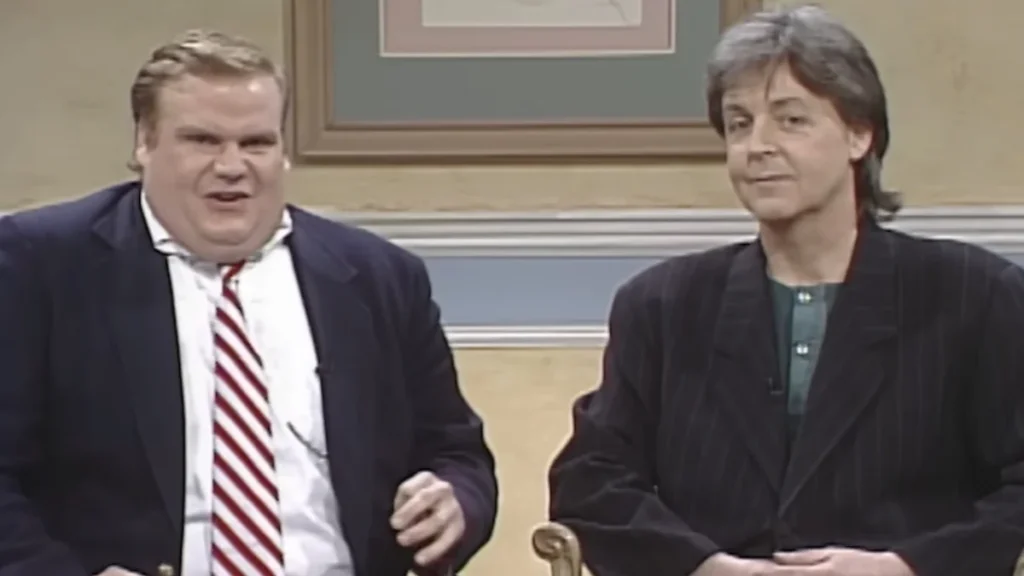

The recent digital release of "The Chris Farley Show with Paul McCartney" sketch onto Saturday Night Live‘s official YouTube channel marks a significant moment for fans of classic comedy and legendary music, coinciding with Paul McCartney’s highly anticipated appearance as the musical guest for SNL‘s Season 51 finale. This upload, long awaited by many, resurfaces a pivotal and profoundly memorable moment from SNL‘s storied past, offering contemporary audiences and nostalgic viewers alike an opportunity to revisit the unique comedic brilliance of Chris Farley alongside one of the world’s most iconic musicians. McCartney’s return to the SNL stage as a musical guest is his first in 14 years, excluding his participation in the show’s 40th and 50th-anniversary specials, making this his fifth overall musical guest appearance. This milestone prompts discussions about his legacy with the show and whether this prolific number of appearances qualifies him for the coveted "Five-Timers Club," a distinction typically reserved for hosts, but often informally extended to other frequent, influential guests.
A Digital Archival Milestone: The Release of an Iconic Sketch
The decision by Saturday Night Live to upload "The Chris Farley Show with Paul McCartney" to its YouTube channel is more than just a promotional move; it represents a commitment to preserving and making accessible its rich comedic history. This particular sketch, which originally aired during Farley’s tenure on the show, encapsulates much of what made his comedic style so beloved and enduring. The premise of "The Chris Farley Show" involved Farley, playing an awkward, star-struck interviewer, stumbling through questions, often interjecting with personal, fawning remarks about his guests, culminating in his signature, self-deprecating line: "Remember when you were in [iconic band/movie/event]? That was awesome."
The episode featuring Paul McCartney, a member of The Beatles, arguably presented the perfect guest for Farley’s character. The sheer magnitude of McCartney’s career provided ample opportunity for Farley’s character to express his overwhelming admiration, leading to some of the sketch’s most memorable moments. Farley, visibly nervous and flustered, asked McCartney questions that were less about his current projects and more about his legendary past, repeatedly marveling at the musician’s iconic status. This self-aware, meta-comedy highlighted Farley’s unique ability to blend physical humor with a deep sense of vulnerability and earnestness, making the audience both laugh at and empathize with his character. The sketch served as a masterclass in comedic timing and character work, with McCartney playing along brilliantly, exhibiting patience and good humor in the face of Farley’s endearing ineptitude.
The delayed upload of this specific sketch, compared to many other popular SNL segments, might be attributed to a myriad of factors common in media archiving, including complex music licensing agreements, rights management for guest appearances, or a strategic release schedule designed to align with current events, such as McCartney’s finale performance. Regardless of the specific reasons, its availability now allows for a fresh appreciation of Farley’s comedic genius and the collaborative spirit that defined SNL during its golden era of the early to mid-1990s.
Paul McCartney’s Storied Relationship with Saturday Night Live
Paul McCartney’s history with Saturday Night Live is extensive and interwoven with some of the show’s most significant moments. His appearance as musical guest for the Season 51 finale marks his fifth time in this capacity, a remarkable achievement for any artist, let alone one whose career spans over six decades. His previous musical guest appearances include dates in 1993, 1999, 2010, and 2012. Each of these performances brought a unique energy and a blend of classic hits and new material, consistently reaffirming his status as a live music icon.
Beyond his direct musical contributions, McCartney has also graced SNL with his presence during monumental anniversary specials. He performed at the 40th Anniversary Special in 2015 and the 50th Anniversary Special in 2025, underscoring his enduring connection to the program and its cultural significance. These appearances often featured him performing alongside other legendary figures, further cementing his place in the show’s pantheon of esteemed guests.
The question of whether McCartney "gets a jacket" for the "Five-Timers Club" is a playful nod to one of SNL‘s most exclusive and celebrated traditions. The club, established in 1990, is typically reserved for individuals who have hosted the show five or more times. Its members include comedy legends like Steve Martin, Tom Hanks, Chevy Chase, and Tina Fey. While musical guests are not traditionally inducted into the club, McCartney’s five musical guest slots, combined with his anniversary appearances, place him in an almost unparalleled category of SNL frequenters. His consistent engagement with the show speaks volumes about his appreciation for its cultural impact and his willingness to participate in live television’s most iconic comedy institution. This unique relationship highlights how SNL has, for decades, served as a crucial platform for both comedic talent and musical legends, bridging generational gaps and cultural divides.
Remembering Chris Farley’s Comedic Genius
Chris Farley’s career, though tragically cut short, left an indelible mark on the landscape of American comedy. Born in 1964, Farley joined Saturday Night Live in 1990, quickly becoming one of the show’s most dynamic and beloved cast members. His comedic style was characterized by a unique blend of high-energy physical comedy, often involving exaggerated movements and shouting, coupled with an underlying vulnerability and self-awareness that made his characters deeply human and relatable.
"The Chris Farley Show" sketch was a recurring segment that perfectly encapsulated his persona. Other memorable characters included Matt Foley, the motivational speaker who lived "in a van down by the river"; Todd O’Connor, one half of the "Bill Swerski’s Superfans" sketch; and Bennett Brauer, a mentally unstable critic who applied "air quotes" to everything. Farley’s ability to commit fully to these larger-than-life characters, often at great personal physical expense, earned him widespread acclaim and a devoted fanbase.
His untimely death in 1997 at the age of 33 sent shockwaves through the entertainment industry, leaving a void that many felt could never be truly filled. Despite his relatively brief time in the spotlight, Farley’s legacy has continued to grow, influencing subsequent generations of comedians and actors. His work on SNL and in films like "Tommy Boy" and "Black Sheep" remains celebrated for its raw energy, genuine heart, and fearless approach to comedy. The digital re-release of sketches like "The Chris Farley Show with Paul McCartney" serves not only as a nostalgic trip for those who witnessed it live but also as an essential introduction for newer audiences to the enduring brilliance of Chris Farley. It underscores the profound impact he had and continues to have, reminding us of the laughter and poignant humanity he brought to every performance.
SNL’s Evolving Digital Strategy and Archival Access
Saturday Night Live‘s approach to its vast archive of content has significantly evolved with the digital age. For decades, access to classic sketches was largely limited to syndicated reruns, DVD box sets, or rare broadcast specials. However, the rise of platforms like YouTube has revolutionized how audiences interact with historical television content. SNL‘s official YouTube channel has become a crucial hub for fans, offering a curated selection of sketches from its nearly five-decade history.
This digital strategy serves multiple purposes. Firstly, it acts as a promotional tool, generating buzz for current episodes by reminding viewers of the show’s rich legacy. Secondly, it allows the show to engage with a global audience, making its content accessible beyond traditional broadcast territories. Thirdly, it is a vital archival effort, preserving classic moments and making them readily available for cultural and academic study, as well as pure entertainment.
The decision to upload "The Chris Farley Show with Paul McCartney" specifically, especially in conjunction with McCartney’s current appearance, highlights a sophisticated understanding of audience engagement. Such releases capitalize on nostalgia while simultaneously generating interest in contemporary programming. It also addresses a long-standing demand from fans who often express a desire to see specific, beloved sketches made available digitally. The challenges of managing such a vast archive, particularly regarding rights and clearances for music and celebrity appearances, are considerable, making each new upload a strategic decision. By making these classic moments available, SNL reinforces its position not just as a weekly comedy show, but as a living museum of American popular culture.
The Significance of McCartney’s Season 51 Finale Appearance
Paul McCartney’s role as musical guest for Saturday Night Live‘s Season 51 finale is a testament to his unparalleled enduring appeal and the show’s ability to consistently attract top-tier talent. Season finales are typically high-stakes episodes, often featuring the season’s most anticipated hosts and musical acts, designed to leave a lasting impression and build momentum for the following season. McCartney’s presence elevates the finale, promising a performance that will undoubtedly draw a massive viewership.
His appearance is not merely a concert slot; it’s a cultural event. For millions, McCartney represents not just a musician but a living legend, a connection to a transformative era in music history. His performances on SNL have always been characterized by a blend of nostalgia for his Beatles and Wings catalogue and excitement for his newer material, demonstrating his continuous artistic vitality. This finale performance will likely be a poignant moment, connecting the raw, energetic comedy of the past (as seen in the Farley sketch) with the polished, enduring artistry of one of the 20th and 21st centuries’ most significant cultural figures.
Broader Cultural Resonance and Implications
The convergence of these events—the digital release of a classic Chris Farley sketch featuring Paul McCartney and McCartney’s current SNL finale performance—carries significant cultural resonance. It underscores the power of digital platforms to resurrect and recontextualize cultural touchstones, bridging the gap between generations of viewers. Younger audiences, who may be unfamiliar with Farley’s work or the specific era of SNL, are now introduced to a piece of comedic history through a familiar digital medium, often spurred by the enduring fame of Paul McCartney. Conversely, older fans are given a chance to relive cherished memories with enhanced accessibility.
This strategic archival release also speaks to the enduring legacy of Saturday Night Live itself. The show has maintained its relevance for nearly five decades by adapting to changing media landscapes while staying true to its core mission of topical sketch comedy and live performance. By actively curating and releasing its historical content, SNL ensures that its influence continues to permeate popular culture, fostering a continuous dialogue between its past and present.
Ultimately, the uploading of "The Chris Farley Show with Paul McCartney" is more than just a video release; it is a moment that celebrates the intertwining legacies of two extraordinary talents, one a comedic force whose light burned brightly and briefly, and the other a musical titan whose star continues to shine. It is a reminder of the unique magic that happens when iconic figures meet on the hallowed stage of Studio 8H, creating moments that resonate far beyond their original broadcast.