
The figure of the Gentleman Usher of the Black Rod, resplendent in black ceremonial robes and wielding an ebony staff crowned with a golden lion, stands as one of the most visually striking and enigmatic personalities in the British public sphere. Each year, during the State Opening of Parliament, millions observe a meticulously choreographed ritual that underscores a fundamental tenet of the United Kingdom’s constitutional monarchy: the independence of the elected House of Commons from the Crown. The dramatic moment when the doors of the Commons are slammed shut in the face of this royal official, only to be struck thrice with his staff before admission, has become an indelible symbol in the tapestry of British political tradition. However, behind this centuries-old spectacle lies an office with a lineage stretching back to the very foundations of parliamentary governance, embodying a rich history of service and evolving responsibilities within the Royal Household and Parliament.
A Role Forged in Medieval England
The office of the Gentleman Usher of the Black Rod, officially designated as such, traces its origins to the mid-14th century, during the reign of King Edward III. Established around 1348, its initial purpose was multifaceted, reflecting the complex relationship between the monarch and the burgeoning parliamentary system. The first recorded individual to hold this esteemed position, William Whitehorse, was formally appointed in 1361 through Letters Patent, a testament to the office’s early recognition and importance.
Initially, the duties of the Black Rod were intrinsically linked to the Sovereign and the prestigious Order of the Garter, the United Kingdom’s highest order of chivalry. The Gentleman Usher was tasked with guarding the meetings of the Order’s Knights Companions and carrying a ceremonial rod before the monarch during significant royal processions. This role underscored a direct connection to the royal court and its most exclusive circles. While these ceremonial duties persist to this day, particularly during the annual Garter Day procession at Windsor Castle, where the Black Rod remains an integral officer of the Order, the office’s association with Parliament has become its most prominent and widely recognized function.
The Black Rod’s Parliamentary Mandate
In its parliamentary capacity, the Black Rod serves as the Sovereign’s representative within the House of Lords. This appointment bestows upon the holder significant responsibilities concerning the order, security, and ceremonial protocol of the upper chamber. For centuries, the Black Rod has been the custodian of the House of Lords’ internal affairs, ensuring the smooth conduct of proceedings and acting as a direct link between the monarch and the Parliament.
A pivotal moment in the formalization of this role occurred in 1971 when the office of Black Rod and that of the Lords Serjeant at Arms were officially merged. This consolidation aimed to streamline administrative and security functions within the House of Lords, reinforcing the Black Rod’s authority and responsibilities.
The State Opening of Parliament: A Symbolic Confrontation
The most dramatic and publicly visible manifestation of the Black Rod’s role occurs during the annual State Opening of Parliament. This grand occasion, marking the formal commencement of the parliamentary year, is steeped in tradition and symbolism. It is during this ceremony that the Sovereign, typically the monarch, delivers the King’s or Queen’s Speech, outlining the government’s legislative agenda for the coming session.
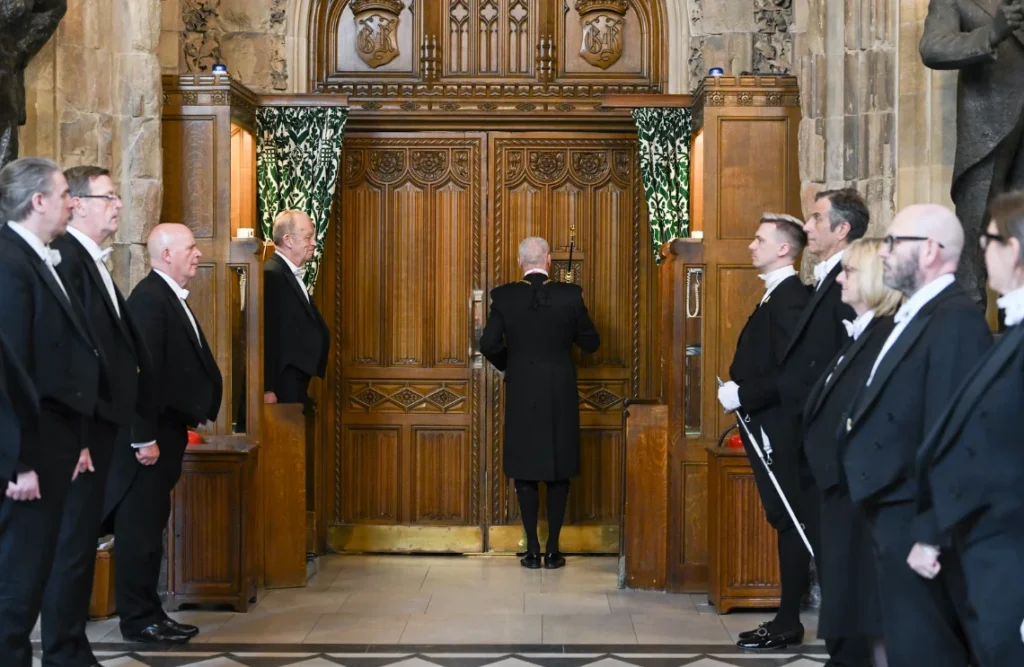
However, before the monarch can address both Houses of Parliament, the Black Rod is dispatched from the House of Lords to the House of Commons. This summons is not a mere formality; it is a carefully orchestrated demonstration of parliamentary sovereignty. As tradition dictates, the doors of the House of Commons are deliberately and forcefully slammed shut just moments before the Black Rod’s arrival. This act, while seemingly a snub, is a profound symbolic assertion by the elected Members of Parliament (MPs) that they are an independent body, not subject to the direct entry or commands of the monarch within their own chamber.
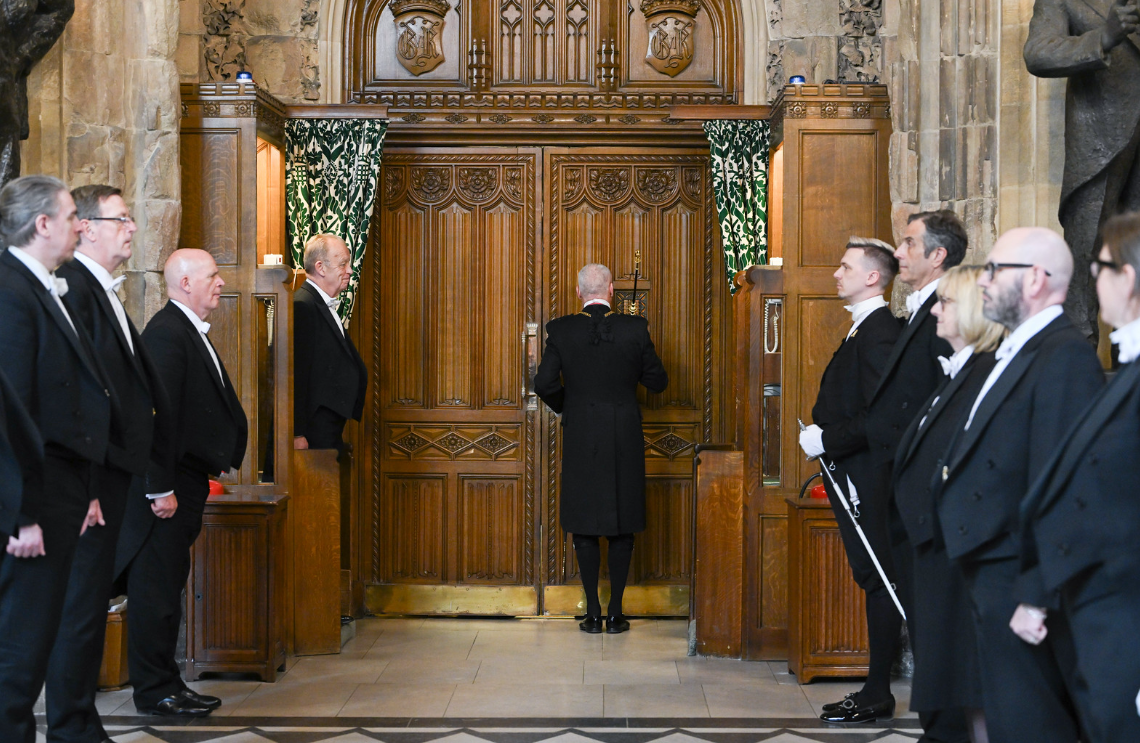
Following this dramatic rejection, the Black Rod approaches the closed doors and strikes them three times with his ebony rod. This percussive signal signifies his authority and the Sovereign’s desire to be heard. Upon being admitted, the Black Rod proceeds to the centre of the Commons chamber, bows three times to the assembled MPs, and then formally delivers the summons for them to attend the Sovereign in the House of Lords. This ritual, repeated year after year, serves as a potent reminder of the delicate balance of power within the British constitution – the Crown’s authority is acknowledged, but the independence of the elected representatives is unequivocally asserted.
A Robe of Honour and Tradition
The distinctive ceremonial uniform worn by the Gentleman Usher of the Black Rod is as steeped in history as the office itself. The ensemble typically comprises a black tunic, knee breeches, silk stockings, buckled shoes, and a lace jabot, often accompanied by a sword. This attire visually connects the wearer to centuries of tradition and formal court dress.
The ebony rod, the very symbol of the office, is a substantial ceremonial staff. Its upper finial is adorned with a gilded lion, a powerful heraldic symbol, beneath which is inscribed the royal cypher of King Edward VII, surmounted by a crown. This intricate design further emphasizes the rod’s connection to the monarchy and its historical provenance. The rod is not merely a prop; it is a tangible link to the past, carried by each successive holder as a symbol of their office and its enduring significance.
A New Custodian for an Ancient Office
The most recent incumbent to assume the venerable role of Gentleman Usher of the Black Rod is Lieutenant General Edward Davis, who was appointed by His Majesty King Charles III in 2025. Lieutenant General Davis brings a distinguished career of military and diplomatic service to this historic position. His previous appointments include serving as the Commandant General of the Royal Marines and Governor of Gibraltar, experiences that have undoubtedly equipped him with the leadership and gravitas required for such a prominent public role.
The 2025 State Opening of Parliament marked a significant milestone for Lieutenant General Davis, as it was his first in office as the Gentleman Usher of the Black Rod. This inauguration into the role underscores the ongoing tradition of appointing individuals with substantial experience and a proven record of public service to uphold and represent the ancient customs of the monarchy and Parliament.
The Enduring Significance of the Black Rod
The office of the Gentleman Usher of the Black Rod, while often perceived through the lens of its dramatic parliamentary ritual, is far more than a historical curiosity. It represents a continuity of service, a living embodiment of tradition, and a subtle yet powerful reminder of the checks and balances inherent in the United Kingdom’s constitutional framework.
The annual State Opening of Parliament, with its inherent drama, serves to educate the public about the historical evolution of parliamentary power. The Black Rod’s role, while seemingly subordinate to the elected representatives in the Commons, is crucial in maintaining the symbolic integrity of both the Crown’s prerogative and Parliament’s independence. The continued appointment of distinguished individuals to this office suggests that its historical resonance and symbolic weight remain highly valued, ensuring that this ancient role will continue to play its part in the unfolding narrative of British governance for generations to come. The very act of the doors being slammed shut, and the subsequent, dignified insistence of the Black Rod, encapsulates a dynamic tension that is fundamental to the functioning of a constitutional monarchy – a delicate dance between historical authority and democratic mandate, forever enshrined in this unique and enduring tradition.