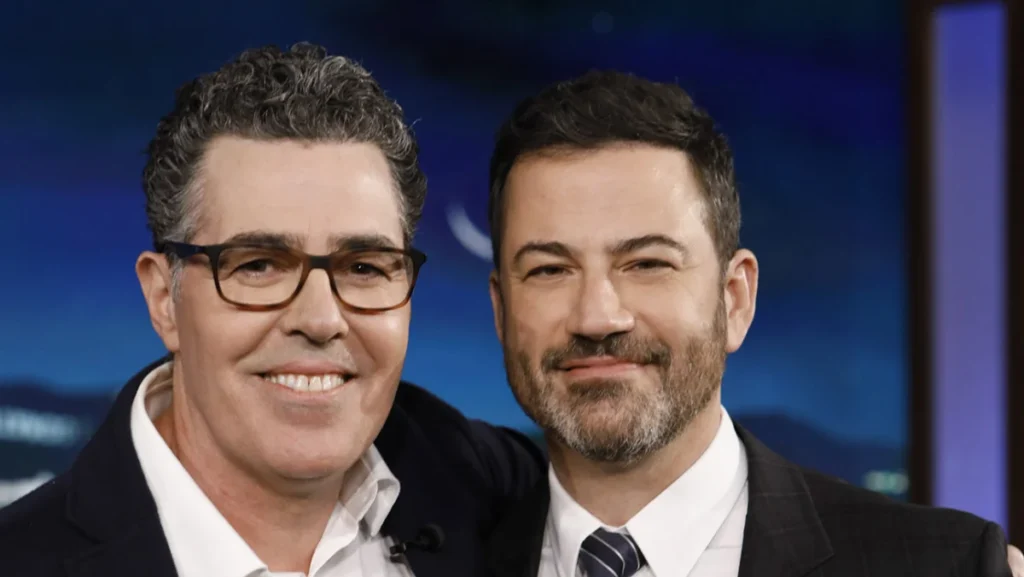

Comedian Adam Carolla has staunchly defended his long-time friend and colleague Jimmy Kimmel, who faced severe criticism and calls for his termination following a controversial joke referencing Melania Trump as an "expectant widow." The joke, delivered during Kimmel’s faux White House Correspondents’ Dinner remarks, ignited a firestorm of outrage from former President Donald Trump and the former First Lady, leading to an early review by the Federal Communications Commission (FCC) into Disney’s broadcast television licenses, and reigniting discussions about the boundaries of political humor, media responsibility, and freedom of speech in a polarized landscape.
The Controversial Remark and Its Immediate Context
The incident unfolded on a Thursday, when Jimmy Kimmel, host of ABC’s Jimmy Kimmel Live!, presented a series of mock remarks intended for the White House Correspondents’ Dinner. These satirical comments, a staple of late-night television, often involve lighthearted jabs at prominent political figures. However, one particular line directed at former First Lady Melania Trump quickly transcended typical political jest and became a flashpoint. Kimmel stated, "Look at Melania, so beautiful. Mrs. Trump, you have a glow like an expectant widow." The remark was intended as a comedic observation on the age difference between Donald and Melania Trump, a common trope in roast-style comedy that often plays on speculative scenarios, albeit in a dark humorous vein. Kimmel himself prefaced his remarks by noting he would approach the topic "from a comedic standpoint," indicating his intention for the humor to be understood within a specific comedic framework.
The Unrelated Incident: White House Correspondents’ Dinner Shooting Attempt
The comedic intent of Kimmel’s joke became tragically entangled with a real-world event that occurred just two days later, on Saturday. An individual attempted to enter the ballroom of the White House Correspondents’ Dinner, reportedly armed with a shotgun, a handgun, and multiple knives. While authorities quickly apprehended the suspect and no one was harmed, the incident cast a pall over the event and created a heightened sense of vulnerability. Crucially, Kimmel’s joke was made before this security breach. This temporal disconnect would later become a central point in the ensuing debate, particularly in Adam Carolla’s defense of Kimmel, who argued that linking the joke to the subsequent violence was illogical and opportunistic.
Trump’s Fiery Retaliation and Calls for Termination
The former President, Donald Trump, and former First Lady Melania Trump swiftly condemned Kimmel’s joke, interpreting it as far more than mere satire. On Monday, following the shooting attempt, Trump took to his social media platform, Truth Social, to launch a scathing attack on Kimmel. He quoted the joke directly, then dramatically linked it to the weekend’s security incident: "A day later a lunatic tried entering the ballroom of the White House Correspondents’ Dinner, loaded up with a shotgun, handgun, and many knives. He was there for a very obvious and sinister reason. I appreciate that so many people are incensed by Kimmel’s despicable call to violence, and normally would not be responsive to anything that he said but, this is something far beyond the pale. Jimmy Kimmel should be immediately fired by Disney and ABC."
Melania Trump echoed these sentiments, publicly calling for Kimmel’s cancellation and termination. The Trumps’ reaction transformed a late-night comedy segment into a political controversy, leveraging the recent security scare to amplify their accusations that Kimmel’s joke constituted a "despicable call to violence." This framing immediately escalated the situation beyond a simple critique of taste, placing it into the realm of inciting harm, a charge typically reserved for far more explicit threats. Their demands put immense pressure on ABC and its parent company, Disney, to take disciplinary action against one of its prominent late-night personalities.
Adam Carolla’s Stalwart Defense: A Comedian’s Perspective
Amidst the growing chorus of criticism, Adam Carolla, a long-time friend and former collaborator of Kimmel’s from their days on The Man Show, emerged as one of the comedian’s most vocal defenders. Speaking on The Adam Carolla Show, Carolla dismissed the outrage as an overreaction, firmly placing Kimmel’s joke within the established conventions of comedic roasts. "That’s a pretty typical roast joke," Carolla asserted. "It is also a trope: Any younger, beautiful woman who’s married to an older guy, especially if the guy’s rumored to be sort of a douchey, you would make that joke at any roast."
Carolla’s defense hinged on several key arguments. Firstly, he emphasized the traditional nature of such humor, suggesting it was a common and accepted form of comedic banter, particularly when directed at public figures in a roast setting. He argued that the joke’s content, while potentially provocative, was not inherently malicious or a genuine call for violence. Secondly, and most critically, Carolla highlighted the chronological disconnect between the joke and the shooting attempt. He analogized the situation: "When you make a joke and then nothing happens, like there was no shooting, no one made a thing about it before the shooting. So then it’s kind of a thing where you go, like, ‘Oh, that Elisha Krauss, I hate that bitch, I hope she dies!’ And then two days later, you get in a car crash, and you die, then everyone looks at me and goes, ‘Now I’m angry at you.’ But I’m like, if she never got in a car crash, you never said anything." Carolla underscored that the joke was entirely unrelated to the subsequent security incident and that the outrage was largely a retroactive imputation of intent, fueled by the tragic timing.
Furthermore, Carolla addressed the common defense that a host merely delivers jokes written by others. While acknowledging that Kimmel might not have personally penned the line, Carolla dismissed this as largely irrelevant to the broader point, stating, "It’s not like he wrote that joke, but he said that joke, but he didn’t write that joke. Somebody wrote that joke and he said it." He reiterated that the joke’s appropriateness should be judged on its own merits and within its original context, not through the lens of unforeseen future events. He concluded by asserting that such a joke would be acceptable at any roast, regardless of whether the subject was a former president, reinforcing the idea that political figures, like other celebrities, are fair game for this style of humor. Carolla, often identifying as a "right-leaning comedian," frequently criticizes what he perceives as excessive political correctness and "cancel culture," making his defense of Kimmel consistent with his broader public stance on comedic freedom.
Kimmel’s Unapologetic Stance and Network Loyalty
On the Monday episode of Jimmy Kimmel Live!, the host directly addressed the controversy without offering an apology. Instead, Kimmel met the demands for his firing with characteristic sarcasm and defiance. "You know how sometimes you wake up in the morning and the first lady puts out a statement demanding you be fired from your job? We’ve all been there, right?" he quipped, deflecting the severity of the accusations with humor. His response signaled an unwillingness to back down, aligning with his history of engaging in political commentary and standing firm against conservative criticism. This unwavering stance indicated that both Kimmel and potentially ABC were prepared to weather the storm, trusting in the network’s commitment to artistic freedom and the host’s track record.
Regulatory Scrutiny: The FCC’s Involvement
The controversy took a more serious turn when, on Tuesday, the Federal Communications Commission (FCC) announced it had launched an "early review" of Disney’s broadcast TV licenses. The FCC is an independent agency of the United States government that regulates interstate and international communications by radio, television, wire, satellite, and cable. While the FCC primarily focuses on issues like indecency, obscenity, and compliance with public interest obligations, a review of broadcast licenses, especially in response to political pressure, can be seen as a significant escalation. It implies that the content of the joke might be scrutinized for potential violations of broadcast standards, or that the overall conduct of the licensee (Disney/ABC) could be called into question.
A Disney spokesperson quickly responded to the FCC’s announcement, expressing confidence in their position. "We are confident that record demonstrates our continued qualifications as licensees under the Communications Act and the First Amendment and are prepared to show that through the appropriate legal channels. Our focus remains, as always, on serving viewers in the local communities where our stations operate," the spokesperson stated. This response highlighted the legal and constitutional protections afforded by the First Amendment, suggesting Disney was prepared to defend its programming on grounds of free speech. The FCC’s review, while not immediately punitive, cast a shadow of regulatory uncertainty over ABC and its affiliates, adding a layer of corporate and legal complexity to the comedic dispute.
Precedent of Past Controversies: The September Incident
This was not the first time Jimmy Kimmel had faced significant backlash and corporate pressure over his politically charged commentary. Just months prior, in September, Jimmy Kimmel Live! experienced a temporary suspension from some affiliated stations due to controversial remarks he made concerning a politically charged murder case. In that instance, Kimmel had commented on the murder of Ruby Garcia, stating, "We hit some new lows over the weekend with the MAGA gang desperately trying to characterize this kid who murdered [Ruby Garcia] as anything other than one of them and doing everything they can to score political points from it." This remark, which linked a perpetrator’s alleged political affiliation to a heinous crime, drew sharp criticism from conservative media and some affiliates.
On September 17, Jimmy Kimmel Live! was temporarily pulled from the air by several stations owned by Nexstar and Sinclair, two major broadcast groups, who threatened to keep the show off their schedules. The show returned a few days later, on September 23, following negotiations, but the incident demonstrated the real-world impact that political content from late-night hosts can have on network-affiliate relationships and viewership. Adam Carolla also defended Kimmel during this prior controversy, noting at the time, "The right and the left are always sort of misinterpreting things. He was inaccurate about something… He was trying to dump it on Trump and inaccurate about it." Carolla’s consistent defense underscores a pattern of support for Kimmel’s right to engage in political humor, even when it is perceived as inaccurate or inflammatory by some segments of the audience.
Broader Discourse: Comedy, Politics, and "Cancel Culture"
The entire saga surrounding Kimmel’s "expectant widow" joke and the subsequent reactions has significantly broadened the ongoing discourse regarding comedy, politics, and the phenomenon often labeled as "cancel culture." It highlights the precarious position of late-night hosts, who are expected to entertain, critique, and comment on current events, often blurring the lines between comedian and political commentator.
This incident exemplifies several key tensions in contemporary media and political landscapes:
- Freedom of Speech vs. Public Outcry: The First Amendment protects free speech, but broadcast licensees are also expected to operate in the public interest. The Trump administration’s direct appeals to the FCC and Disney underscore a political strategy of leveraging public outrage to pressure media outlets into self-censorship or punitive actions against personalities perceived as hostile.
- The Nature of Political Satire: Carolla’s defense emphasizes that certain types of humor, like "roast jokes," operate under different conventions. However, in an era of heightened political sensitivity and polarization, the boundaries of what is considered acceptable satire are constantly being redrawn, and intentions are often secondary to perceived impact.
- The Weaponization of Outrage: The swift and severe reaction from the Trumps, particularly linking a joke to an unrelated act of violence, demonstrates how outrage can be strategically deployed to discredit political opponents and exert pressure on media organizations.
- Network Autonomy vs. Affiliate Pressure: The previous incident with Nexstar and Sinclair pulling Jimmy Kimmel Live! illustrates the delicate balance between a network’s editorial control and the commercial interests of its local affiliates. Disney’s steadfastness in the face of FCC review indicates a strong commitment to its talent, but the financial implications of such disputes can be substantial.
- The Role of Comedians: The debate questions whether comedians should be held to the same standards as journalists or politicians, especially when their platforms are as large and influential as a network late-night show.
The controversy surrounding Jimmy Kimmel’s joke and Adam Carolla’s defense serves as a potent microcosm of the challenges facing media and free expression in an increasingly fragmented and politicized society. As political figures continue to engage directly with media content and regulatory bodies, the boundaries of comedy and the responsibilities of those who deliver it will remain a subject of intense public and legal scrutiny. The outcome of the FCC’s review and the long-term implications for Kimmel’s show will undoubtedly contribute to the evolving narrative of entertainment, politics, and the enduring power of a joke.