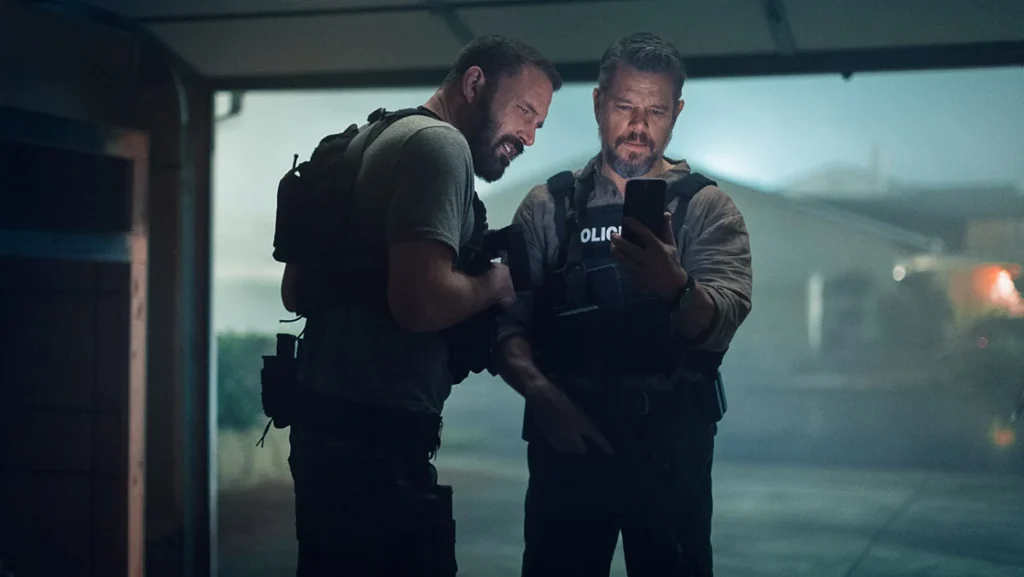

In a move poised to reshape compensation paradigms within the entertainment industry, the 1,200-person team behind the crime drama The Rip has received additional compensation in the form of performance bonuses. This significant development, announced by Artists Equity, the production banner founded by Ben Affleck and Matt Damon, underscores a deliberate effort to redistribute success and value more equitably among those who bring cinematic projects to life. The bonus payout stems from a distinctive agreement Artists Equity forged with Netflix, a structure that deviates markedly from the streaming giant’s conventional upfront fee model by incorporating viewership-based incentives.
This initiative is not merely a gesture of goodwill but a tangible manifestation of Artists Equity’s foundational philosophy. Launched in 2022 with substantial backing from Gerry Cardinale and RedBird Capital Partners, the company was established on the explicit principle that all individuals contributing to a film project should partake in its financial success. This vision directly addresses a growing concern within Hollywood regarding talent compensation in the streaming era, where the traditional "backend" participation and residual payments that once provided long-term financial security for cast and crew have largely eroded in favor of one-time buyouts.
The Genesis of Artists Equity and its Vision for Equitable Compensation
The formation of Artists Equity by Affleck and Damon was a calculated response to what they perceived as an increasingly imbalanced industry landscape. Both seasoned veterans of Hollywood, with decades of experience spanning acting, directing, writing, and producing, they witnessed firsthand the shifts brought about by the ascendancy of streaming platforms. Historically, successful films and television series often yielded significant backend profits for key talent, producers, and even some crew members through a complex system of gross and net participations, as well as residuals from syndication and home video sales. This system, while imperfect and often criticized for its opaqueness, offered a potential pathway to long-term earnings, particularly for projects that proved enduringly popular.
However, the streaming revolution, spearheaded by companies like Netflix, disrupted this traditional model. Streamers typically acquired content rights for a fixed, often substantial, upfront fee. While this guaranteed immediate payment, it decoupled the financial success of a show or film from the ongoing compensation for its creators and contributors. A series that became a global phenomenon, watched by hundreds of millions, might generate immense value for the platform, but its cast and crew would receive no additional compensation beyond their initial contracts. This shift became a central grievance for talent guilds, including the Writers Guild of America (WGA) and the Screen Actors Guild – American Federation of Television and Radio Artists (SAG-AFTRA), whose recent strikes prominently featured demands for improved streaming residuals and performance-based compensation.
It was against this backdrop that Affleck and Damon articulated their mission for Artists Equity. In their own words, "We built Artists Equity on the belief that filmmakers should share in the value they bring to a project." This statement, reinforced by their actions with The Rip, encapsulates a desire to re-align the financial incentives within the production process, fostering a more collaborative and equitable environment. Affleck had previously underscored this commitment in January when the initial deal structure for The Rip was revealed, stating, "We wanted to institute fairness and address some of the real issues that are present and urgent for our business." This indicates a conscious effort to challenge established norms and set a precedent for future industry practices.
"The Rip": A Pioneering Test Case for a New Model
The Rip, a crime drama directed by Joe Carnahan, served as the inaugural and highly visible test case for Artists Equity’s innovative compensation model. Released in January, the film quickly garnered significant attention, achieving 41.6 million views globally within its first three days on Netflix. This robust viewership performance was not just a measure of the film’s immediate appeal but also the critical trigger for the unique compensation agreement.
The deal negotiated between Artists Equity and Netflix represented a significant departure from Netflix’s standard operating procedure. Typically, Netflix’s content acquisition strategy revolves around a lump-sum payment for global streaming rights, covering all production costs and talent fees upfront. This model offers creative freedom and financial security to producers but, as noted, historically excluded performance-based bonuses for the wider cast and crew. The Rip agreement, however, included specific viewership thresholds, stipulating that if the film achieved a certain level of engagement, a performance bonus pool would be activated and distributed among the 1,200 individuals involved in its production.
This hybrid model – combining an upfront commitment with a backend incentive – suggests a willingness on Netflix’s part to experiment, particularly when dealing with high-profile creators like Affleck and Damon, who bring both artistic vision and significant star power to the table. For Artists Equity, securing such a deal with a dominant streamer like Netflix was a crucial validation of its business model and a powerful demonstration of its commitment to its workforce.
The Payout and Official Endorsement
The announcement on Wednesday confirmed that The Rip had indeed met the predetermined viewership thresholds, triggering the performance bonus payout. This news was met with enthusiasm, particularly from Affleck and Damon, who released a joint statement reiterating their core philosophy and expressing gratitude:
"We built Artists Equity on the belief that filmmakers should share in the value they bring to a project," said Affleck and Damon. "The incredible cast and crew of The Rip are no exception. They each played a critical role in making this film the success that it is. We are grateful for their work and glad to see it connecting so deeply with audiences. We’d also like to thank Netflix for their belief in this project and the unique structure around it. This is a great proof point for our new partnership, and we’re confident it will be just the first in many shared hits."
Their statement highlights several key aspects. Firstly, it reaffirms the company’s foundational principle, emphasizing that every individual, regardless of their role, contributes to a project’s success. Secondly, the phrase "great proof point for our new partnership" indicates that this is not an isolated incident but rather a template for future collaborations. It suggests that Artists Equity aims to institutionalize this model across its slate of productions, potentially influencing how other studios and streamers approach talent compensation. The acknowledgment of Netflix’s "belief in this project and the unique structure" also implicitly suggests Netflix’s satisfaction with the outcome, both in terms of viewership and the positive public relations generated by the bonus payout.
Historical Context and Evolving Industry Dynamics
To fully appreciate the significance of Artists Equity’s move, it’s essential to understand the historical context of compensation in Hollywood and the dramatic shifts brought about by the streaming era. For decades, profit participation and residuals were cornerstones of talent compensation, particularly for successful projects. Major stars, directors, and writers often negotiated for a percentage of a film’s gross or net profits. While "net profit" deals frequently drew criticism for their susceptibility to creative accounting by studios, even a small percentage of a blockbuster’s gross could translate into life-changing earnings. Below-the-line crew members, while less likely to receive profit participation, benefited from robust residual systems, particularly in television, which provided ongoing income from reruns, syndication, and later, home video sales.
The advent of streaming services profoundly altered this landscape. Netflix, pioneering the subscription video-on-demand (SVOD) model, revolutionized content consumption. Its global reach and direct-to-consumer model eliminated many of the traditional revenue streams (box office, DVD sales, network syndication) that underpinned residual payments. Instead, Netflix offered large, upfront buyouts for content, essentially purchasing all rights for a fixed sum. While this provided immediate financial security for creators, it also meant that a show or film that became a cultural phenomenon and generated billions in subscriber value for Netflix would not translate into additional earnings for its creators beyond the initial payment. This "all-you-can-eat" model, while convenient for subscribers, created a disconnect between a project’s actual performance and the compensation received by those who made it.
This growing disparity fueled significant discontent, culminating in the WGA and SAG-AFTRA strikes of 2023. A central demand of both unions was a fairer share of streaming revenue, specifically through improved residual formulas and performance-based bonuses tied to viewership metrics. Artists Equity’s proactive implementation of such a model, even before the strikes reached their peak, demonstrates a keen awareness of these industry-wide grievances and a commitment to addressing them from within the production company framework. It positions Affleck and Damon not just as creators but as advocates for a more equitable system.
The Business Model of Artists Equity: A Disruptive Approach
Artists Equity’s business model is explicitly designed to be disruptive. By touting a system where "everyone who worked on a movie would receive a piece of the profits," it aims to foster a greater sense of ownership and collective success among all contributors. This extends beyond the marquee talent to include the often-overlooked below-the-line crew—cinematographers, editors, costume designers, set decorators, gaffers, grips, and countless others—who are crucial to a film’s creation but rarely benefit from backend deals. For these individuals, a performance bonus can represent a significant and unexpected financial boon, acknowledging their vital role in a project’s commercial success.
The financial viability of this model for Artists Equity, and its investors like RedBird Capital Partners, hinges on several factors. Firstly, by offering potential backend participation, AE can attract top-tier talent and crew who might otherwise gravitate towards projects with more traditional, albeit less potentially lucrative, upfront deals. This allows AE to assemble high-caliber teams. Secondly, by aligning the financial interests of its workforce with the success of the project, AE aims to foster greater commitment, creativity, and efficiency, potentially leading to higher quality films that resonate more strongly with audiences. Lastly, the model relies on securing unique deals with distribution partners like Netflix, who are willing to experiment with variable compensation structures.
The company’s strategy appears to be built on producing commercially viable, star-driven projects that have a strong likelihood of hitting viewership targets. The first-look deal with Netflix, established in March following the success of The Rip, is a testament to the streamer’s confidence in Artists Equity’s ability to deliver such content. This partnership is already yielding fruit, with the upcoming Affleck-directed film Animals, starring Steven Yeun, Kerry Washington, and Gillian Anderson, also slated for Netflix. The continued collaboration suggests that Netflix sees value in this innovative approach, perhaps recognizing its potential to attract high-quality projects and talent in an increasingly competitive content landscape.
Netflix’s Strategic Calculus and Broader Industry Implications
For Netflix, agreeing to a performance-based bonus structure for The Rip likely involved a strategic calculus beyond simple goodwill. While Netflix has historically resisted such variable compensation models, the current environment—marked by intense competition from other streamers, ongoing industry labor disputes, and a constant need to attract top-tier talent and content—may be prompting a re-evaluation of its traditional stance.
By partnering with Artists Equity on this model, Netflix gains several advantages:
- Attraction of Premium Content: Affleck and Damon bring significant creative and commercial weight. Offering a more attractive compensation structure can secure exclusive access to their projects and potentially other high-caliber filmmakers.
- Positive Public Relations: In an era where streamers are often criticized for their compensation practices, this move generates positive publicity, showcasing Netflix as a partner willing to innovate and share success.
- Talent Retention and Engagement: A model that rewards success can foster greater loyalty and engagement among the creative community, potentially making Netflix a more desirable platform for future collaborations.
- Data-Driven Decisions: Tying bonuses to viewership data aligns incentives with measurable success, offering a clear metric for evaluating a project’s impact and value to the platform.
The implications of this development extend far beyond Artists Equity and Netflix. It raises fundamental questions for the broader entertainment industry:
- Will other production companies adopt similar models? If Artists Equity proves that such a model is not only feasible but also beneficial for attracting talent and delivering successful content, it could pressure other independent production houses to follow suit.
- Will traditional studios and other streamers be forced to reconsider their compensation structures? The success of The Rip‘s bonus model, particularly in the wake of recent labor strikes, could create a precedent that talent and their representatives will increasingly demand. This could lead to a broader industry shift towards more performance-based compensation, blending upfront payments with backend incentives.
- How will "success" be defined and measured? While viewership numbers are a clear metric for streaming, the industry may need to develop more nuanced ways to quantify a project’s value, particularly for niche content or critical darlings that might not achieve blockbuster viewership.
- The Role of Star Power: Affleck and Damon’s considerable influence and negotiating leverage undoubtedly played a role in securing this unique deal. The challenge will be for smaller production companies or less established creators to replicate such agreements. However, if the model gains traction, it could democratize access to such deals over time.
Conclusion
The bonus payout to the cast and crew of The Rip by Artists Equity represents a pivotal moment in the ongoing evolution of compensation in the entertainment industry. It is a tangible demonstration of a new production company’s commitment to its founding principle: that those who create the value should share in its rewards. By successfully negotiating a unique, viewership-dependent compensation structure with Netflix, Artists Equity has not only delivered on its promise but also established a compelling "proof point" for a more equitable future. This initiative challenges the status quo of the streaming era and signals a potential paradigm shift, where performance-based incentives may increasingly become a standard component of talent compensation, fostering a more aligned and ultimately more sustainable ecosystem for creators and distributors alike. The industry will undoubtedly watch closely to see if this pioneering model becomes the norm, ushering in a new chapter of fairness and shared success in Hollywood.