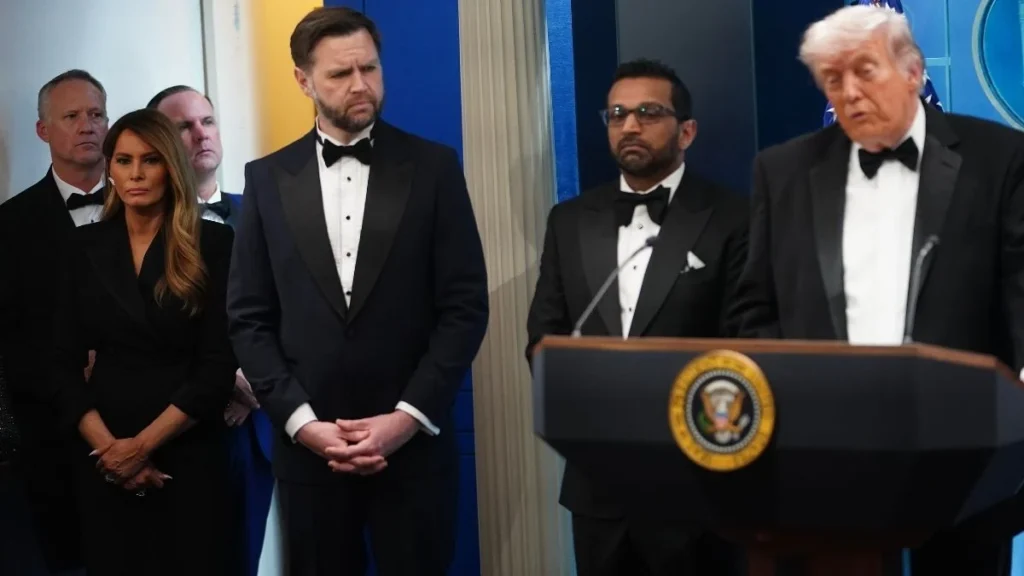

During a high-profile gathering in the White House Rose Garden held in honor of National Police Week, former President Donald Trump engaged in an informal assessment of the Republican Party’s future trajectory. Addressing a crowd primarily composed of law enforcement officials and their families, the former president utilized the platform to gauge the popularity of two prominent figures within the conservative movement: Senator J.D. Vance of Ohio and Senator Marco Rubio of Florida. The spontaneous polling of the audience has reignited discussions regarding the long-term leadership of the GOP and the potential for a new generation of political alliances as the party looks toward the 2024 general election and beyond to 2028.
The event, which was part of the annual commemorations for National Police Week, provided a backdrop of "law and order" rhetoric, a cornerstone of the Trump political platform. While the primary purpose of the dinner was to honor the sacrifices of law enforcement officers, the atmosphere quickly shifted toward political strategy when Trump posed direct questions to the attendees. “Who likes J.D. Vance?” Trump asked, eliciting a robust wave of applause. Shortly thereafter, he followed with, “Who likes Marco Rubio?” which garnered a similarly enthusiastic response. Rather than signaling a preference for one over the other, Trump described the positive reception for Rubio as “very nice” and floated the possibility of the two politicians forming a “dream team” for the party’s future.
The Evolution of the Trump-Vance Relationship
The inclusion of J.D. Vance in this informal poll underscores his rapid ascent within the Republican hierarchy. Vance, who joined the 2024 Republican ticket as the vice-presidential nominee, has undergone a significant political transformation over the last decade. Before his entry into the United States Senate, Vance was best known as the author of the best-selling memoir Hillbilly Elegy, a book that sought to explain the socio-economic struggles of the white working class in Appalachia and the Rust Belt.
During the 2016 presidential election cycle, Vance was a vocal critic of Donald Trump. His opposition was documented in various high-profile media outlets. In an op-ed for USA Today, Vance characterized Trump’s policy proposals as ranging from “immoral to absurd.” Furthermore, in a 2016 piece for the New York Times, he explicitly stated that Trump was “unfit for our nation’s highest office.” During a televised interview with Charlie Rose that same year, Vance went as far as to label himself a “Never Trump guy.”
However, the political landscape shifted during the 2022 midterm elections. Seeking the Republican nomination for Ohio’s open Senate seat, Vance aligned his platform with the "Make America Great Again" (MAGA) movement. Following a crucial endorsement from Trump, Vance won a crowded primary and eventually the general election. Since then, he has become one of Trump’s most steadfast defenders in Congress, frequently appearing at rallies and advocating for a populist-nationalist agenda that emphasizes trade protectionism, a restrained foreign policy, and a focus on the American worker.
Marco Rubio: From Primary Rival to Strategic Ally
Senator Marco Rubio’s presence in Trump’s "dream team" commentary is equally noteworthy given their contentious history. During the 2016 Republican primaries, Rubio was considered the standard-bearer for the party’s traditional conservative wing. The rivalry between the two was marked by sharp personal and professional attacks. Rubio frequently questioned Trump’s business acumen and his lack of traditional political experience, while Trump famously disparaged Rubio with the moniker “Little Marco.”
Despite the initial animosity, the relationship began to stabilize following Trump’s 2016 victory. Rubio, a seasoned member of the Senate Foreign Relations Committee and the Select Committee on Intelligence, became an influential figure in shaping the administration’s policies toward Latin America, particularly regarding Venezuela and Cuba. Over the years, Rubio has successfully navigated the transition of the Republican Party, maintaining his standing with the institutional wing of the GOP while increasingly aligning with Trump on issues such as China and industrial policy.
The fact that Trump highlighted Rubio alongside Vance suggests a recognition of Rubio’s enduring appeal within the party, particularly among Hispanic voters and the more traditional conservative donor base. Rubio’s ability to bridge the gap between the old-guard GOP and the modern MAGA movement makes him a central figure in any discussion regarding the party’s future.
A Chronology of Alignment: 2016 to the Present
The current synergy between Trump, Vance, and Rubio is the result of a multi-year realignment within the Republican Party. To understand the significance of the Rose Garden comments, one must look at the timeline of their interactions:
- 2016: Vance and Rubio both actively oppose Trump’s first presidential bid. Rubio competes against him in the primary, while Vance criticizes him from a media platform.
- 2017–2020: Rubio transitions from a critic to a legislative ally, working with the Trump administration on the Tax Cuts and Jobs Act of 2017 and foreign policy initiatives.
- 2021: Vance begins his shift toward the MAGA movement, distancing himself from his previous criticisms as he prepares for a Senate run.
- 2022: Trump endorses Vance in the Ohio Senate primary, cementing Vance’s status as a key figure in the party’s populist wing. Rubio wins re-election in Florida by a historic margin, demonstrating his strength in a state that has trended increasingly Republican.
- 2024: Vance is selected as the vice-presidential nominee. Rubio is frequently mentioned as a top-tier surrogate and a potential Cabinet member or future presidential contender.
- National Police Week Event: Trump publicly floats the idea of Vance and Rubio as a "dream team," signaling a potential succession plan or a strategic partnership for the 2028 election cycle.
Supporting Data and Political Implications
The enthusiasm shown by the crowd at the law enforcement dinner is reflective of broader trends within Republican polling. Recent data suggests that the GOP base is increasingly supportive of candidates who mirror Trump’s combative style and policy priorities. According to internal party metrics and public opinion surveys, J.D. Vance holds high favorability ratings among self-identified "very conservative" voters, while Marco Rubio continues to perform well among moderate Republicans and independent voters in key swing states like Florida.
The concept of a "dream team" featuring both men presents a geographically and ideologically diverse front. Vance provides a direct connection to the industrial Midwest—states like Ohio, Pennsylvania, and Michigan—which are critical to any Republican path to the White House. Rubio, meanwhile, offers deep roots in Florida and a proven track record of appealing to the growing demographic of conservative-leaning Latino voters.
From a policy perspective, a Vance-Rubio partnership would likely represent a synthesis of two distinct but overlapping schools of thought. Vance represents the "New Right," which is often more skeptical of corporate power and international intervention. Rubio represents a more traditional brand of hawk-like foreign policy combined with a modern focus on "common good" capitalism. Together, they would represent a formidable attempt to solidify the various factions of the Republican coalition.
Official Responses and Reactions
While neither Vance nor Rubio has issued a formal statement regarding the "dream team" comment, their recent actions suggest a high degree of coordination with the Trump campaign. Vance has been a constant presence on the campaign trail, often serving as a surrogate in media appearances to explain the administration’s "America First" agenda. Rubio has similarly increased his visibility, often defending the former president against legal challenges and criticizing the current administration’s handling of the border and the economy.
Political analysts suggest that Trump’s casual polling is a calculated move to keep his supporters engaged and to maintain his role as the party’s primary kingmaker. By publicly praising both men, Trump ensures their continued loyalty while also keeping the media’s focus on the future of his movement.
Broader Impact on the 2028 Presidential Race
Though the 2024 election remains the immediate priority for the Republican Party, the comments made during National Police Week have inevitably cast a spotlight on 2028. If the Trump-Vance ticket were to be successful in 2024, Vance would be the presumptive heir to the MAGA movement. However, the inclusion of Rubio in the conversation suggests that the path to the 2028 nomination remains open and competitive.
The dynamics of the Republican Party have fundamentally changed since 2016. The era of the "Never Trump" Republican has largely faded, replaced by a party that is more ideologically aligned with the populist and nationalist themes championed by the former president. The potential collaboration between a former critic like Vance and a former rival like Rubio illustrates the gravity of the Trump influence.
As the Republican Party continues to evolve, the relationship between its top figures will be crucial in determining its ability to win over a diverse electorate. The Rose Garden event, while informal, served as a reminder that the future of the GOP is being shaped not just by policy debates in Washington, but by the personal endorsements and strategic musings of its most influential leader. Whether the "dream team" of Vance and Rubio eventually comes to fruition remains to be seen, but the groundwork for such a partnership has clearly been laid in the eyes of the party’s base.