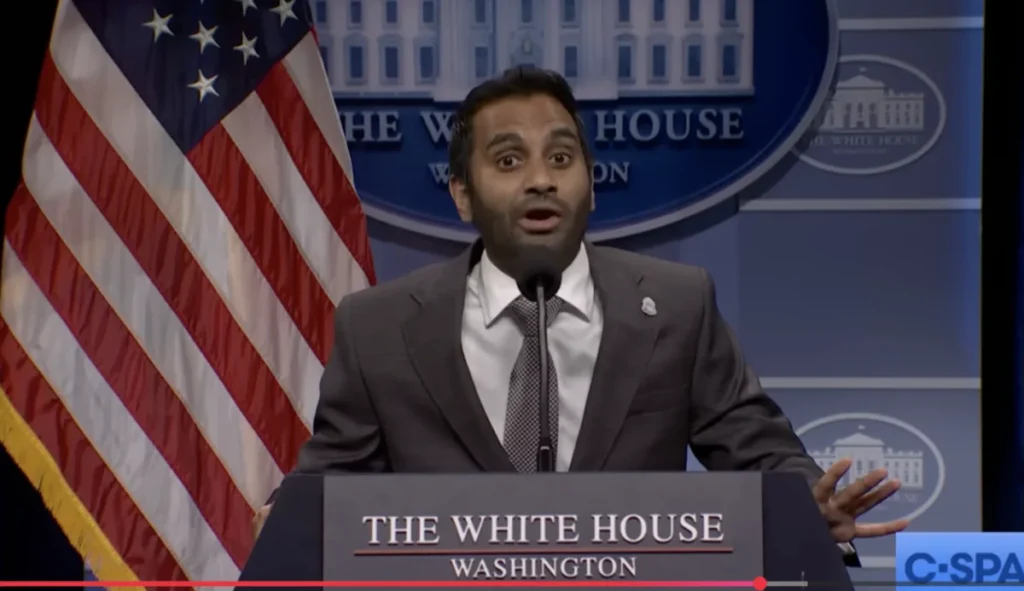

The latest installment of Saturday Night Live featured a notable surprise during its cold open, with comedian Aziz Ansari stepping into the role of FBI Director Kash Patel. The sketch, titled "Hegseth and Patel Iran Press Briefing Cold Open," aired on Saturday, May 2, and immediately garnered attention for its pointed political satire and Ansari’s unexpected appearance. The segment placed Ansari alongside cast members portraying prominent political figures in a mock press briefing setting, offering a comedic yet critical lens on recent events and public perceptions.
The cold open commenced with Ashley Padilla, impersonating Press Secretary Karoline Leavitt, announcing her departure for maternity leave. This transition paved the way for Colin Jost, embodying Defense Secretary Pete Hegseth, to take the podium and field questions from a simulated press corps. The initial exchanges quickly delved into controversial territory, touching upon Hegseth’s previous public statements and actions.
One of the early questions directed at Jost’s Hegseth persona concerned a prior incident where he recited a fabricated Bible verse from the film Pulp Fiction, and whether he was aware it was not part of genuine Christian scripture. In character, Jost responded with a defiant and religiously charged retort, stating, "Yeah! But also, I do believe that someday it will be… Now I’m not going to apologize because I wear my religion on my sleeve, literally. I have a tattoo on my forearm of Jesus choking out Jimmy Kimmel." This response was designed to mock a perceived performative religiosity and to highlight a willingness to conflate popular culture with deeply held beliefs. The inclusion of the Jimmy Kimmel reference served as a specific jab, referencing ongoing public feuds and rivalries within the entertainment and political spheres.
Following this exchange, Jost, still in character as Hegseth, delivered a remark that aimed to satirize the perceived justifications for ongoing military engagements and the prolonged nature of conflicts. He quipped, "OK, everyone’s always asking me, when is this war gonna be over? That’s like asking when is sex gonna be over? Answer: When the man is done." This line, characterized by its provocative and somewhat crude analogy, was intended to comment on the perceived male-dominated decision-making processes in foreign policy and the potential for ego to influence protracted military actions.
The narrative then shifted dramatically with the introduction of Aziz Ansari as FBI Director Kash Patel. Ansari’s entrance marked the highly anticipated surprise cameo, bringing a distinct comedic energy to the sketch. Patel, as portrayed by Ansari, immediately adopted a tone of confident self-assurance, even as he addressed criticisms of his performance. His opening statement was designed to be a thinly veiled jab at the perceived effectiveness and transparency of intelligence agencies. "For those of you saying I’m doing a bad job running the FBI, well, what if I told you this agency is only six weeks away from pinpointing the exact location of Osama bin Laden?" he declared. This line directly referenced a significant intelligence achievement from the past, implicitly suggesting a disconnect between current administrative claims of progress and actual operational effectiveness, or perhaps a humorous exaggeration of potential future successes.
Further into his monologue, Ansari’s Patel character leaned into self-deprecating humor with a twist of social commentary. He proclaimed himself a "trailblazer" for being "the first Indian person to suck at their job." He elaborated on this point, stating, "Everyone says Indian people are smart, hardworking, incredibly intelligent. I prove without a shadow of a doubt that we can be just as incapable and incompetent as the whites." This segment was a bold attempt to subvert stereotypes and to satirize the concept of diversity in leadership positions, suggesting that competence, or lack thereof, transcends racial and ethnic lines. The implication was that under his tenure, the FBI would be an equal-opportunity employer of incompetence, a commentary on perceived failures in various governmental departments.
The sketch continued to probe the character of Patel, addressing his reported relationship with former President Donald Trump. When questioned about potential nervousness regarding Trump’s alleged anger towards him, Ansari’s Patel responded with bravado: "Hell no! President Trump loves me. Everybody loves me, even the Correspondents’ Dinner shooter said, ‘Kill everyone, but Mr. Patel.’ You get a shout-out like that in a psycho’s manifesto, you must be doing something right." This line was a dark and provocative attempt to satirize the perceived loyalty and immunity enjoyed by certain individuals within political circles, while also referencing a real-life event—the 2017 Las Vegas shooting—in a highly controversial manner, linking it to a fictional manifesto. The humor here stems from the audacious claim of being a target of a mass shooting but framing it as a positive endorsement.
The satirical commentary extended to alleged personal habits and the use of taxpayer funds. Ansari’s Patel character addressed reports of his drinking by denying specific instances of inebriation. However, he then proceeded to describe, in vivid detail, a concoction he called a "Kash-tini," implying a penchant for alcohol. He further detailed extravagant and questionable uses of official resources, including taking a private jet to visit multiple Buffalo Wild Wings locations to "taste the difference" and a highly public display in a nightclub where he allegedly offered "the nuclear codes." These fabricated anecdotes were designed to paint a picture of a leader characterized by excess, poor judgment, and a flagrant disregard for public funds and national security protocols, all while attempting to deflect direct accusations of wrongdoing through elaborate denials.
The segment concluded with a final, outlandish claim about his supposed lack of possession of the nuclear codes, reinforcing the sketch’s overall theme of governmental absurdity and perceived incompetence at the highest levels. The recurring motif of the nuclear codes serves as a hyperbolic representation of power and its potential misuse or frivolous handling.
Background and Context of the Sketch
The "Hegseth and Patel Iran Press Briefing Cold Open" appeared in the context of a period marked by heightened geopolitical tensions, particularly concerning Iran, and ongoing scrutiny of various governmental figures and their public statements. The choice to parody a press briefing, a staple of political communication, allowed the show to directly engage with current events and the public’s perception of them.
Kash Patel, a former federal prosecutor and aide to former President Donald Trump, has been a figure of interest in discussions surrounding Trump’s administration and subsequent legal challenges. His appointment as FBI Director, though brief and controversial, placed him in a position of significant authority and public scrutiny. The sketch capitalized on this, using his name and perceived association with Trump to generate comedic material.
Pete Hegseth, a Fox News host and prominent conservative commentator, has often been a subject of satire for his outspoken views and public persona. His portrayal in the sketch, particularly the Pulp Fiction Bible verse incident, reflects actual public statements and has been a point of discussion regarding the intersection of faith, media, and politics. The Pulp Fiction reference specifically plays on the film’s use of a doctored passage from the Book of Ezekiel.
The broader context of SNL’s cold opens is to set a comedic tone for the evening’s broadcast while often addressing topical political or cultural events. These sketches are frequently designed to be provocative and to tap into public sentiment, whether critical or supportive, of the figures and issues they portray. The inclusion of a surprise guest like Aziz Ansari, known for his own brand of observational and sometimes controversial comedy, adds an extra layer of anticipation and engagement for viewers.
Analysis of Implications and Reception
The sketch’s implications are multifaceted. By portraying both Hegseth and Patel in such unflattering and absurd lights, SNL aimed to comment on a perceived lack of seriousness and competence within certain political factions. The satire suggests a critique of the way political figures communicate, the authenticity of their public personas, and the potential consequences of their actions and statements on national and international affairs.
The sketch’s humor, particularly in its more extreme exaggerations, can be seen as a reflection of public anxieties and frustrations surrounding the political landscape. The depiction of an FBI director making outlandish claims and engaging in frivolous behavior taps into broader concerns about trust in institutions and the qualifications of those in power.
The reception of such a sketch can be varied. Supporters of SNL’s political satire likely found the episode to be sharp and timely, offering a cathartic release through humor. Critics, particularly those who identify with the figures being parodied, may view the sketch as unfair, biased, or simply unfunny. The use of dark humor, such as the reference to the mass shooting, is particularly divisive and can elicit strong reactions.
The inclusion of Aziz Ansari in a prominent role underscores SNL’s strategy of leveraging celebrity cameos to boost viewership and add star power to its topical sketches. Ansari’s comedic style, which often involves observational humor and social commentary, made him a suitable choice to embody a character designed to be both absurd and, in its own way, insightful.
Ultimately, the "Hegseth and Patel Iran Press Briefing Cold Open" served as a typical example of Saturday Night Live’s approach to political satire: using humor, exaggeration, and surprise appearances to comment on contemporary events and public figures, sparking conversation and reflecting, albeit through a comedic lens, the prevailing moods and opinions of the time.
Official Statements and Reactions (Inferred)
As is typical with SNL sketches, direct official statements from the individuals or organizations parodied are rare. However, the nature of the satire itself often elicits commentary from political figures and media personalities.
It is plausible that figures associated with the depicted political viewpoints would likely dismiss the sketch as partisan mockery or an inaccurate portrayal. They might emphasize their actual contributions and public service, distancing themselves from the caricatured versions presented on television.
Conversely, political opponents or critics of the individuals and policies satirized might view the sketch as an accurate, albeit comedic, reflection of reality. They may use the sketch as a talking point to reinforce their own criticisms and to highlight perceived flaws in the figures portrayed.
The production team and cast of Saturday Night Live, through their involvement, implicitly endorse the comedic and satirical intent of the sketch. While individual cast members and writers rarely issue explicit statements about specific sketches beyond promotional materials, the show’s long-standing tradition of political commentary suggests a deliberate engagement with public discourse.
Broader Impact and Implications
The broader impact of such a sketch lies in its contribution to the ongoing public discourse surrounding political figures and governance. By presenting caricatures, SNL can simplify complex issues and highlight perceived absurdities in a way that is accessible and entertaining to a wide audience. This can influence public perception, even if indirectly, by reinforcing certain narratives or raising questions about the characters being parodied.
In an era where political polarization is significant, SNL’s cold opens often serve as a cultural touchstone, reflecting and shaping conversations across the political spectrum. The use of surprise guests like Aziz Ansari further amplifies the reach and impact of these sketches, drawing in viewers who might not regularly tune into the show.
The recurring theme of questioning governmental competence and the authenticity of political figures within these sketches speaks to a broader societal concern. The show, through its humor, taps into and amplifies these sentiments, making it a relevant, albeit often controversial, voice in contemporary media. The long-form nature of this analysis, extending beyond the immediate comedic impact, underscores the role of satire in political commentary and its potential to influence how the public perceives its leaders and institutions.