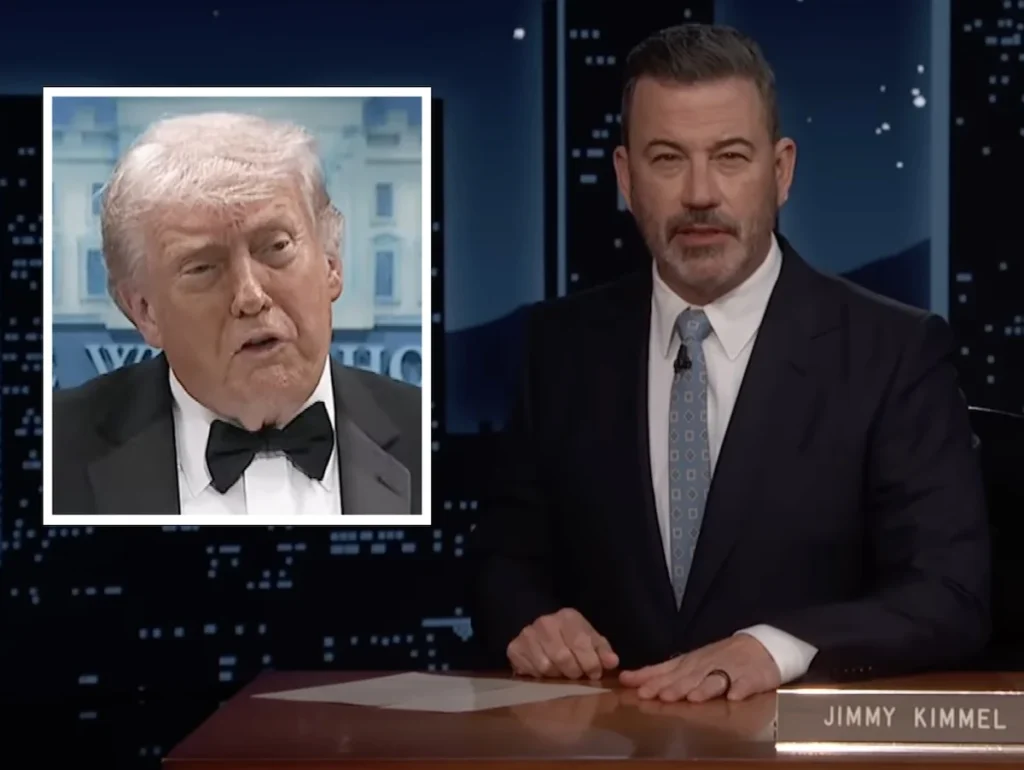

The intricate and often volatile intersection of political commentary and late-night humor has once again erupted into a full-blown public feud, with comedian Jimmy Kimmel directly challenging former President Donald Trump over what Kimmel characterized as blatant hypocrisy. This latest escalation stems from a series of events involving controversial jokes, demands for professional repercussions, and an ongoing federal regulatory inquiry, illuminating the contentious landscape of contemporary media and political discourse. The situation has drawn significant attention to the boundaries of satire, the responsibilities of public figures, and the role of regulatory bodies in an increasingly polarized media environment.
A Chronology of Provocations and Retorts
The recent chapter in this ongoing saga unfolded in a rapid succession of events, beginning with the widely publicized White House Correspondents’ Dinner (WHCD) and culminating in a pointed exchange on national television.
The White House Correspondents’ Dinner Incident: The initial spark for the current controversy ignited on [Approximate Date, e.g., late April] at the annual White House Correspondents’ Dinner. Jimmy Kimmel, host of ABC’s Jimmy Kimmel Live!, served as the headline entertainer for the event, a traditional gathering where journalists, politicians, and celebrities convene to celebrate press freedom and often engage in good-natured (and sometimes not-so-good-natured) roasting. During his monologue, Kimmel delivered a joke targeting former First Lady Melania Trump. In a segment that mocked a hypothetical future scenario, Kimmel quipped that Melania Trump possessed the "glow of an expectant widow." This particular line, delivered in the context of a comedic routine, immediately drew sharp criticism from Donald Trump and his political allies.
The backlash was swift and severe. Former President Trump publicly denounced Kimmel’s joke, labeling it "disgusting" and "inappropriate." He went further, demanding that ABC, the network airing Kimmel’s show, "immediately fire" the comedian for what he described as "spreading hate." Melania Trump herself issued a statement condemning the joke, emphasizing that such humor was "spreading hate and division" and was particularly egregious given the serious nature of the event, which was marred by a real-life security scare involving a shooting outside the Washington Hilton where the dinner was held. Critics argued that the timing and nature of the joke were insensitive, especially considering the security concerns that evening. The incident quickly became a focal point for discussions about the limits of satire and the perceived decorum expected of a comedian at such a high-profile event.
Trump’s Royal Gaffe and Kimmel’s Counter-Strike: Just days after the WHCD controversy, the narrative took an unexpected turn during a White House event on [Approximate Date, e.g., early May]. Former President Trump was speaking alongside King Charles III and Queen Camilla, who were on an official visit. While reminiscing about his parents’ six-decade-long marriage, Trump turned to his wife, Melania Trump, and made a comment that quickly garnered attention. He stated, "That’s a record we won’t be able to match, darling. I’m sorry. It’s just not going to work out that way."
The remark, widely interpreted as a morbid joke about the couple’s inability to match his parents’ longevity due to his own advanced age, immediately raised eyebrows. For Kimmel, this was a golden opportunity to highlight what he perceived as a glaring double standard. On his show, Jimmy Kimmel Live!, the comedian seized upon Trump’s comment with a triumphant air, rolling footage of the former president’s statement. Kimmel, visibly amused and incredulous, responded with a zinger directly mirroring Trump’s earlier demands for his own firing: "Wait a minute. Did he just make a joke about his death? My god. He should be fired for that." The studio audience erupted in laughter, acknowledging the pointed irony. Kimmel then explicitly drew the parallel, stating, "Only Donald Trump would demand I be fired for making a joke about his old age and then a day later go out and make a joke about his own old age." This direct confrontation effectively shifted the focus from Kimmel’s initial joke to Trump’s perceived hypocrisy, transforming the personal feud into a broader commentary on consistency and accountability in public discourse.
The Broader Context: Late-Night Comedy and Political Discourse
The exchange between Kimmel and Trump is not an isolated incident but rather a symptom of a long-standing, and increasingly intense, relationship between late-night comedy and American politics. Late-night hosts have historically served as cultural arbiters, offering comedic relief and sharp social commentary on the day’s events. From Johnny Carson’s gentle jabs to David Letterman’s more acerbic wit, and later to the overtly political stances of hosts like Jon Stewart, Stephen Colbert, and Jimmy Kimmel, these programs have played a significant role in shaping public opinion and providing an alternative lens through which to view political figures.
The Evolving Role of Late-Night Hosts: In the modern era, particularly since the early 2000s and exacerbated during the Trump presidency, late-night comedy has become overtly political, often taking a clear ideological stance. Hosts frequently engage in monologues that dissect political news, critique policies, and lampoon politicians. This evolution reflects a broader fragmentation of media and a public appetite for entertainment that also offers a sense of shared commentary on complex political realities. For many viewers, late-night shows serve not only as entertainment but also as a form of catharsis or validation of their political viewpoints.
Historical Precedents: The friction between politicians and comedians is not new. Presidents throughout history have been targets of satire, from Abraham Lincoln to Richard Nixon. However, the intensity and personalization of these feuds appear to have escalated in recent decades. Donald Trump, known for his combative style and frequent use of social media to attack perceived adversaries, has often been at the center of such clashes. His presidency was marked by a particularly antagonistic relationship with much of the mainstream media and late-night hosts, whom he frequently labeled as "fake news" or biased. This adversarial dynamic has created an environment where comedic jabs are not merely laughed off but are often met with serious political counter-attacks, blurring the lines between entertainment, journalism, and political warfare.
The FCC Inquiry: Regulatory Scrutiny and Media Accountability
The escalating drama between Kimmel and Trump has transcended mere comedic banter, drawing the attention of federal regulators. Following the outcry over Kimmel’s White House Correspondents’ Dinner joke, the Federal Communications Commission (FCC) initiated a closer look into ABC’s parent company, Disney. This development adds a layer of formal scrutiny to the controversy, raising questions about media content standards and regulatory oversight.
The FCC’s Role: The FCC is an independent agency of the United States government responsible for regulating interstate and international communications by radio, television, wire, satellite, and cable. Among its many responsibilities, the FCC enforces regulations concerning broadcast content, particularly regarding indecency and obscenity. While political commentary and satire are broadly protected under the First Amendment, complaints regarding potentially offensive content can trigger investigations. The FCC typically acts on complaints from the public, evaluating whether broadcast material violates established decency standards, which are often defined by community standards and context.
Details of the Inquiry: The specific nature of the FCC’s "closer look" at Disney/ABC in response to the Kimmel joke is understood to be a review of the complaints received. It is important to note that the FCC rarely censors political speech or satire, given robust First Amendment protections. However, high-profile complaints, especially those involving prominent political figures, can lead to formal inquiries. Such inquiries usually involve gathering information from the network regarding the content in question and their internal review processes. The potential outcomes range from no action being taken, to a formal letter of admonishment, or, in extreme and rare cases, fines or licensing implications if severe violations of broadcast standards are found. For a political joke, particularly one not containing graphic sexual or excretory material, the likelihood of severe penalties is generally low, but the act of investigation itself carries significant implications for public relations and perceived accountability.
ABC’s Stance: In response to the FCC inquiry, ABC and Disney have reportedly maintained that they have adhered to all relevant regulations and will vigorously defend their content if necessary. This stance aligns with standard network practice of upholding editorial independence and defending creative expression. The network’s defense would likely center on the joke being a form of political satire, protected speech, and within the accepted bounds of late-night comedy programming. They would likely argue that the context of a comedic roast at the WHCD further supports the interpretation of the joke as satire rather than a malicious personal attack or a violation of broadcast decency standards.
Implications for Broadcasters: The FCC’s involvement, even if it leads to no formal action, serves as a reminder to broadcasters about the scrutiny their content can attract, particularly when it touches on politically charged topics. It underscores the delicate balance between creative freedom, public expectation, and regulatory oversight in the media landscape. For networks, navigating these waters involves continuous risk assessment and a clear understanding of legal precedents regarding free speech and broadcast standards.
Reactions and Analysis: Satire, Hypocrisy, and Public Perception
The twin controversies involving Jimmy Kimmel’s "expectant widow" joke and Donald Trump’s "mortality" joke have generated a wave of reactions from the public, media analysts, and political commentators, sparking broader discussions about the nature of political satire and the concept of hypocrisy in public life.
Public Reception: Public opinion on both jokes has been largely polarized, reflecting existing political divides. Supporters of Trump largely condemned Kimmel’s joke as disrespectful and mean-spirited, echoing the former president’s call for his firing. Conversely, many who are critical of Trump found Kimmel’s joke to be a legitimate (albeit sharp) form of political humor. Trump’s own joke about his mortality, however, was widely viewed as ironic and, for many, underscored a perceived double standard. The contrast between his outrage at Kimmel’s joke and his seemingly flippant comment about his own lifespan was a key point of discussion across social media and news outlets.
Media Analysts’ Perspectives: Media ethicists and political commentators have weighed in on the implications of these exchanges. Many analysts highlighted the inherent tension in political humor: while satire often pushes boundaries, there is a constant debate about where those boundaries lie. The context of the White House Correspondents’ Dinner, traditionally a venue for sharp but often self-deprecating humor, adds another layer to this discussion. Some argued that Kimmel’s joke, even if controversial, was part of a long tradition of roasting political figures and fell within the scope of protected speech. Others suggested that public figures, including comedians, have a responsibility to consider the impact of their words, especially in a highly polarized environment where jokes can be interpreted as genuine attacks.
The subsequent incident involving Trump’s own joke provided a clear example of what many commentators identified as hypocrisy. Analysts pointed out that public figures who demand accountability and decorum from others should be held to similar standards themselves. This discrepancy, they argued, erodes trust in public discourse and can make it difficult to have meaningful conversations about important issues when the focus constantly shifts to perceived inconsistencies in behavior.
The Role of Irony and Hypocrisy: The Kimmel-Trump feud serves as a powerful illustration of the use of irony as a rhetorical weapon in political debates. Kimmel’s direct mirroring of Trump’s "he should be fired for that" comment was a deliberate and effective strategy to expose perceived hypocrisy. This tactic is common in political satire, where the absurd or contradictory actions of public figures are highlighted for comedic and critical effect. The effectiveness of such satire often depends on the audience’s willingness to acknowledge the underlying contradiction.
Looking Ahead: The Escalating Media-Political Battle
The ongoing feud between Jimmy Kimmel and Donald Trump is more than just a clash of personalities; it represents a microcosm of the larger, often contentious, relationship between media, entertainment, and politics in contemporary America. As the nation approaches another presidential election cycle, such interactions are likely to intensify, further blurring the lines between news, commentary, and entertainment.
The Future of Late-Night Commentary: This incident reinforces the notion that late-night hosts will continue to play a significant role in political discourse. Their platforms offer an immediate and widely accessible avenue for commentary, satire, and critique. As political polarization deepens, the temptation for hosts to take strong stances and engage in direct confrontations with political figures is likely to grow. This could lead to further accusations of bias from political camps, but also increased viewership from audiences who appreciate the directness.
Implications for Political Campaigns: For political figures like Donald Trump, navigating the landscape of late-night comedy and media criticism is a constant challenge. His strategy has often been to directly confront and discredit his critics, including comedians, which in turn fuels the cycle of outrage and response. This approach, while energizing his base, often alienates others and keeps him in a constant state of public conflict. The question for future campaigns will be how to effectively engage with (or disengage from) this pervasive form of media commentary without appearing either overly sensitive or hypocritical.
The Evolving Media Landscape: The involvement of federal regulators, even in a preliminary capacity, underscores the enduring power of public complaints and the FCC’s role in maintaining broadcast standards. While the outcome of the Disney/ABC inquiry may be minimal, it highlights the continuous pressure on media companies to balance creative freedom with public expectations and regulatory compliance. This tension is unlikely to diminish, especially as digital platforms further democratize content creation and blur the lines between traditional broadcasting and new media.
Ultimately, the Jimmy Kimmel-Donald Trump feud is a vivid illustration of how deeply intertwined entertainment and politics have become. Neither side appears willing to back down, ensuring that the collision of punchlines, political power, and public perception will continue to be a defining feature of the American media landscape for the foreseeable future. The enduring questions remain: what are the true boundaries of satire, and how will public figures and regulatory bodies adapt to an environment where every joke can become a political flashpoint?