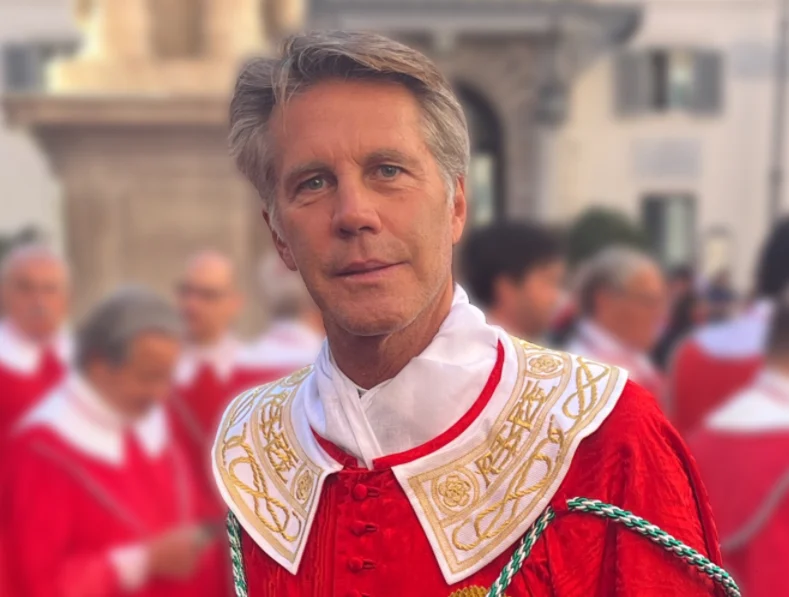

Emanuele Filiberto, a prominent figure within the House of Savoy and a claimant to the defunct Italian throne, has officially confirmed the conclusion of his nearly quarter-century marriage to French actress Clotilde Courau. The announcement, made in a recent interview with the Italian publication Oggi, signals the formal dissolution of a union that began with public scrutiny and has now entered its final legal stages. The couple had initially announced their separation in 2025, though reports suggest their paths diverged several years prior, around 2021.
The Prince of Venice, grandson of Umberto II, Italy’s last reigning monarch, wed Courau in 2003. Their marriage, which took place at the historic Church of Santa Maria degli Angeli e dei Martiri in Rome, immediately drew considerable attention, partly due to Courau’s outspoken left-wing political stances, which contrasted with the traditional expectations often associated with royal consorts. Despite these early debates, the couple welcomed two daughters: Princess Vittoria, born in Switzerland in December 2003, and Princess Luisa, born in 2006. Courau, prior to her marriage, enjoyed a successful acting career, marked by three nominations for the prestigious César Award.
The confirmation of the divorce proceedings comes at a time when Emanuele Filiberto has been seen publicly with a new companion, Adriana Abascal, a Mexican television host and philanthropist. This personal development occurs against the backdrop of a complex dynastic claim and the enduring legacy of the Italian monarchy.
A Royal Lineage and a Contested Claim
Emanuele Filiberto’s claim to the Italian throne is derived from his father, Vittorio Emanuele, who was the eldest son of King Umberto II and Queen Marie José. The lineage connects him to other European royal houses, including the King of the Belgians and the Grand Duke of Luxembourg through his grandmother. The brief reign of Umberto II and Queen Marie José, lasting only about a month, followed the abdication of Umberto II’s father, Vittorio Emanuele III, on May 9, 1946. This act was intended to bolster the monarchy’s chances of survival by transferring the crown to his more popular son amidst a turbulent post-war political climate. However, a national referendum held in June 1946 definitively ended the Italian monarchy, leading Umberto II and his family into exile in Portugal.
The post-monarchy era saw the 1948 Italian constitution impose restrictions on male heirs of the defunct throne residing in Italy. These restrictions were eventually lifted in 2002, paving the way for members of the House of Savoy, including Emanuele Filiberto, to return to Italy and establish residency.
The claim to the headship of the House of Savoy is not without its internal disputes. Emanuele Filiberto is one of two principal claimants. The other is Amedeo, Duke of Aosta, who asserts that Emanuele Filiberto’s father, Vittorio Emanuele, forfeited any right to the succession by marrying without the explicit consent of Umberto II. This long-standing dynastic controversy adds another layer of complexity to the public perception of the House of Savoy and its remaining members.
A Timeline of the Union and its Dissolution
The marriage of Emanuele Filiberto and Clotilde Courau, while seemingly solid for many years, has followed a trajectory that mirrors the dissolution of many modern unions, albeit with the added weight of royal tradition.
- 2003: Emanuele Filiberto of Savoy, Prince of Venice, marries French actress Clotilde Courau in Rome. The wedding is a significant event, attracting international media attention due to the couple’s backgrounds and Courau’s political views.
- 2003: Their first daughter, Princess Vittoria, is born in Switzerland.
- 2006: Their second daughter, Princess Luisa, is born.
- Circa 2021: Reports begin to surface suggesting the couple has been living separately for some time, indicating a growing distance in their relationship.
- 2025: Emanuele Filiberto and Clotilde Courau officially announce their separation, confirming the end of their public marital status.
- 2026: Emanuele Filiberto, speaking to the Italian newspaper Oggi, confirms that divorce proceedings have been initiated, marking the formal legal dissolution of their marriage.
This timeline highlights a period of nearly 25 years of marriage, during which the couple navigated public life, raised a family, and maintained their respective public profiles. The eventual separation and divorce, while perhaps anticipated by some, represent the definitive closure of a significant chapter in their lives.
Supporting Data and Broader Context
The decision to divorce, while a private matter, inevitably draws attention when it involves figures with royal lineage. The House of Savoy, though no longer in power, retains a certain historical and symbolic significance in Italy. The family’s history is marked by periods of immense power, political upheaval, and ultimately, exile. The return of the Savoy family to Italy in 2002, after decades of constitutional prohibition, was a symbolic moment, allowing for a re-engagement with their ancestral homeland and a reassertion of their historical narrative.
Emanuele Filiberto has actively engaged in public life in Italy since his return. He has participated in television programs, launched business ventures, and maintained a presence in public discourse. His role as a claimant to the throne, while not carrying political power, allows him to engage with those who still hold an interest in the monarchy’s legacy. The public nature of his personal life, therefore, is amplified by his familial and historical position.
The financial and legal aspects of royal divorces can be complex, often involving intricate settlements of assets and the establishment of provisions for any children involved. While specific details of the Filiberto-Courau divorce settlement are unlikely to be made public, it is reasonable to assume that considerable thought and legal counsel would have been involved in ensuring a fair resolution for both parties and their daughters. The financial implications can also extend to the management of any inherited wealth or assets associated with the House of Savoy, although the extent of these is often opaque to the public.
Official Responses and Inferred Reactions
Direct official statements from Clotilde Courau regarding the divorce proceedings have not been widely reported. However, the initial announcement of their separation in 2025 was presented as a mutual decision, suggesting a desire for privacy and an amicable conclusion to their marital journey. It is common in such situations for individuals to issue brief, carefully worded statements to manage public perception and protect their families.
The broader reaction from within the House of Savoy, particularly from the rival Aosta branch, remains unstated publicly. Dynastic disputes can often be characterized by a degree of reserve and strategic silence. Any public commentary from Amedeo, Duke of Aosta, or his supporters, might be perceived as capitalizing on the situation, which could be counterproductive to their own claims. Therefore, a lack of overt reaction is not necessarily indicative of indifference but could be a calculated approach.
The public in Italy, while no longer under monarchical rule, maintains a historical fascination with its royal past. News concerning prominent members of the House of Savoy, even in their private lives, often generates discussion and interest. The divorce of Emanuele Filiberto, a figure who embodies the modern iteration of this historical lineage, is likely to be met with a range of reactions, from disinterest to sympathetic observation.
Analysis of Implications
The formal end of Emanuele Filiberto’s marriage has several implications, both personal and symbolic. On a personal level, it signifies the conclusion of a significant relationship and the commencement of a new phase in his life, potentially marked by his relationship with Adriana Abascal. This transition is a natural progression for any individual, regardless of their background.
Symbolically, the divorce underscores the challenges of maintaining traditional marital structures within the context of modern public life, even for those with royal connections. It highlights that personal relationships, even those that have endured for decades, are subject to the same complexities and pressures as any other.
Furthermore, the ongoing dynastic dispute between Emanuele Filiberto and Amedeo of Aosta means that any significant personal events involving Emanuele Filiberto can be indirectly viewed through the lens of this rivalry. While the divorce itself is a private matter, it can, in some circles, be interpreted as a personal development that might, however tangentially, affect the perception of his suitability or standing as a claimant. However, it is crucial to emphasize that dynastic claims are typically based on historical precedent and lineage, not on marital status.
The continued engagement of Emanuele Filiberto in public life, despite the dissolution of his marriage, suggests his commitment to maintaining his familial legacy and his public profile. His activities and public appearances will likely continue to be observed, providing a unique lens through which to view the enduring, albeit changed, presence of the House of Savoy in contemporary Italy. The confirmation of his divorce brings a degree of finality to a long-standing union, allowing for a clear delineation of past and future for the Prince of Venice.