
In the exclusive enclave of Palm Beach, Florida, where Mediterranean Revival and Neoclassical estates often lean toward the formal and the prescriptive, a recent residential transformation has challenged the status quo by prioritizing "magic" over museum-like rigidity. The project, a collaborative effort between the AD100 interior designer Monique Gibson and the esteemed architectural firm Ferguson & Shamamian Architects, represents a significant shift in the luxury residential market: the move toward highly personalized, narrative-driven spaces that cater to the whims of a young family without sacrificing architectural integrity.

The residence, originally a circa-1950s structure built in the style of the legendary Maurice Fatio—an architect whose work defined the "Palm Beach Look" during the early 20th century—was recently overhauled to accommodate a new, youthful spirit. The project’s inception was marked by an unusual request from the clients’ daughter: she wanted her bedroom to possess genuine magic. This prompt led to a brainstorming session involving Gibson, architects Thomas McManus and Jason Bibens, and the young resident, where "serious matters" such as secret doors and enchanted artifacts were discussed with the same gravity as structural load-bearing requirements.
The Mechanics of Whimsy and Professional Collaboration
The centerpiece of this "magic" brief is a custom-engineered cabinet in the daughter’s bedroom. Far from a simple decorative piece, the cabinet features doors that glide open upon the wave of a bejeweled baton. This element required a unique synergy between the design team and the builders at Mouw Associates. Gibson noted that the construction team, typically focused on the logistical complexities of septic systems and hurricane-grade structural reinforcements, became deeply invested in the mechanical "sparkle" of the wand.

This level of detail underscores a broader trend in high-end residential construction where the boundaries between furniture design, toy engineering, and architecture are increasingly blurred. The success of the "magic wand" cabinet served as a catalyst for the rest of the home’s design, signaling that the project would not be a standard restoration but a playful reimagining of a historic style.
Architectural Reorientation and Spatial Reconfiguration
Architecturally, the project required a fundamental rethinking of how a mid-century Palm Beach estate functions for a modern family. Ferguson & Shamamian, a firm renowned for its traditionalist expertise, worked with Gibson to reorient the home’s layout. Historically, many Fatio-style homes were designed with a focus on interior courtyards and formal entertaining sequences. However, for this family, the priority was the ocean.

"It’s a symbolic gesture of a new, youthful spirit entering the design of the project," explained Thomas McManus. The design team redirected furniture plans and sightlines toward the Atlantic, ensuring that the water remained the primary visual anchor of the home.
The spatial reconfiguration included several notable changes:

- The Formal Dining Room: Recast as a vibrant family room, the space was stripped of its stiff formality to become a hub for daily interaction.
- The Guesthouse: Converted into a state-of-the-art gym, reflecting the modern emphasis on wellness and lifestyle integration within the home.
- The Great Room: Originally scaled for large-scale socialite gatherings, the room was evolved into a more intimate, dual-purpose living and dining space.
- The Kitchen: The team implemented a "split-kitchen" model. A compact, aesthetically pleasing hub was designed for everyday family use, while a professional-grade kitchen was concealed behind the scenes for the family’s chef.
A Departure from the "Winter of Gray"
The interior palette represents a decade-long evolution in the clients’ tastes. Having worked with Monique Gibson on five previous homes—a relationship that began after they saw her work on Meg Ryan’s SoHo loft—the clients had previously favored a more subdued, "wintery" aesthetic dominated by grays and neutrals.
For this Palm Beach retreat, Gibson observed a "shedding of their winter coats." The transition to vibrant color and whimsical patterns is most evident in the great room. Taking inspiration from a rug created by Christian Bérard for Nelson Rockefeller’s Fifth Avenue apartment, Gibson amplified gestural floral patterns in a custom carpet and extended the motif to the walls.

The furnishings throughout the home read like a catalog of 20th-century design excellence, blended with "cheeky" contemporary pieces. Notable items include:
- Mattia Bonetti’s "Buttocks" chairs: Adding a touch of surrealist humor to the dining area.
- Gio Ponti furnishings: Vintage armchairs and consoles that ground the home in Italian modernism.
- Paavo Tynell lighting: An "egg" pendant and other vintage fixtures that provide a soft, sculptural glow.
- Patrice Dangel coffee table: Described by Gibson as having the "weight of a whisper," providing a delicate counterpoint to the more robust architectural elements.
Narrative Artistry: The Murals of Humberto Ramirez
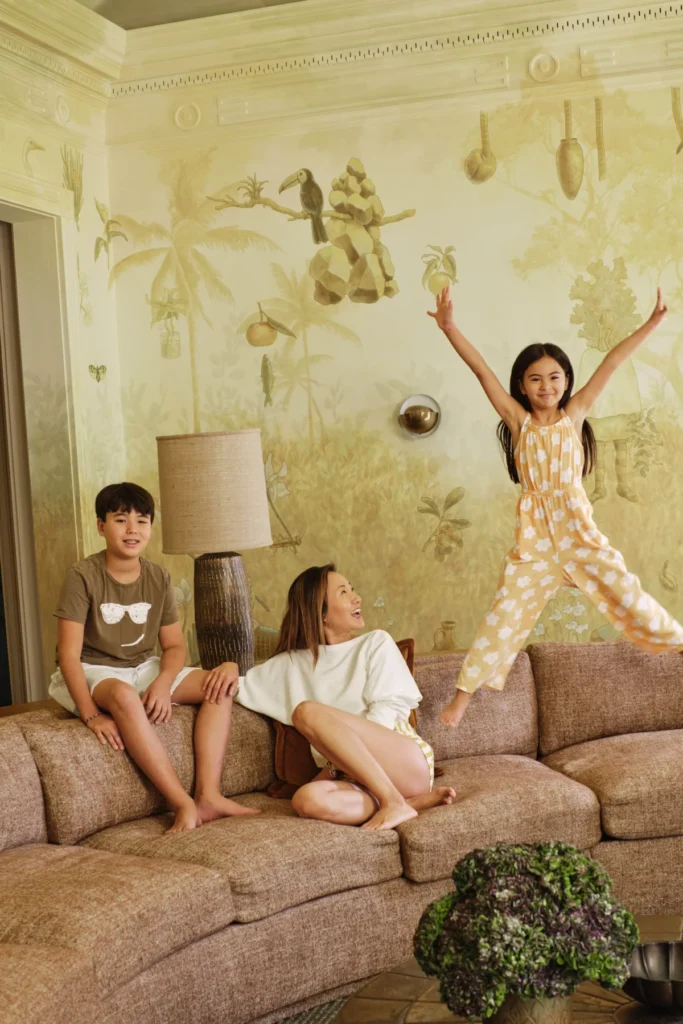
Perhaps the most vivid expression of the home’s narrative is found in the family room. To meet the client’s request to "be surprised every time he walked in," Gibson commissioned artist Humberto Ramirez to transform the walls into a fantastical landscape.

The murals are a collaborative tapestry of the family’s imagination. With input from the children, Ramirez painted a dancing iguana beside a mirrored Gio Ponti table, a monkey riding a deer, and baby sharks drifting across the ceiling. A recurring character—a mischievous cat borrowed from the daughter’s bedroom mural—appears in different rooms, sometimes clutching a pink ball that "travels" between spaces.
This use of site-specific, hand-painted art serves a dual purpose. It honors the tradition of grand estate murals common in the 1920s and 30s while subverting it with modern, playful subject matter. As Ramirez noted through Gibson, "Delight should be a family affair."

Materiality and Technical Specifications
The project’s luxury is defined not just by its whimsy, but by its rigorous attention to materiality. The team utilized a sophisticated palette of paints and finishes to create different "moods" throughout the home:
- Paint Finishes: Benjamin Moore’s "Polished Slate" and "Scenic Drive" were used in the stair hall to create a sense of depth, while "Burlap" provided a neutral, textured backdrop for the family kitchen. The primary bedroom features the warm, sandy tones of "Ipanema."
- Flooring and Surfaces: The everyday kitchen features a floor designed by Ferguson & Shamamian in stone from Banda Stone, which was also utilized for the countertops and backsplash.
- Textiles: High-end fabrics from Pierre Frey, Dedar, and Rogers & Goffigon were used for custom upholstery and drapery, balancing durability for a young family with the tactile luxury expected in a Palm Beach estate.
- Outdoor Elements: The pool area was reshaped from a kidney-style to a clean rectangle at the husband’s request. It is lined with green glazed Moroccan tiles from Mosaic House, a choice that mimics the verdant tropical landscape.
Broader Impact and Design Analysis
The Monique Gibson and Ferguson & Shamamian collaboration in Palm Beach reflects a significant turning point in the "Platinum Coast" design vernacular. For decades, Palm Beach was synonymous with a very specific type of old-world decorum. This project suggests that the new generation of wealthy homeowners is less interested in preserving a "period room" and more interested in creating a "life room."

The inclusion of "secret doors and magic wands" is more than a novelty; it is a rejection of the idea that high-end design must be humorless. By integrating professional-grade engineering with child-like wonder, the project sets a precedent for how historic homes can be modernized. It also highlights the importance of long-term designer-client relationships. The fact that this is the clients’ sixth project with Gibson allowed for a level of trust that made the "magic wand" brief possible.
Chronology of the Transformation
- Initial Acquisition: The clients purchased the circa-1950s Maurice Fatio-style home, which had previously undergone minor improvements overseen by McManus and Bibens.
- The "Magic" Brief: Early in the planning stages, the daughter’s request for "magic" reoriented the design goals.
- Architectural Phase: Ferguson & Shamamian reconfigured the layout to emphasize ocean views and split the kitchen into functional and professional zones.
- Artistic Commission: Humberto Ramirez was brought in to begin the months-long process of hand-painting the home’s narrative murals.
- Construction & Engineering: Mouw Associates executed the complex mechanical elements, including the wand-activated cabinet and the pool reshaping.
- Curation & Installation: Monique Gibson sourced a mix of 19th-century antiques, mid-century modern masters, and contemporary sculptural pieces to fill the reconfigured spaces.
Conclusion: The Home as a Portrait
The project concludes with a philosophy echoed by Gibson, citing the legendary decorator Jacques Grange: a home should resemble its owner more than any portrait ever could. In this Palm Beach retreat, the portrait is one of a family that values joy, playfulness, and the ocean.

By successfully navigating the demands of a historic architectural style while meeting the imaginative needs of a young family, Gibson and the Ferguson & Shamamian team have created a residence that is both a technical marvel and a poetic narrative. The project serves as a reminder that in the world of luxury design, the most valuable "finish" is often a sense of wonder.