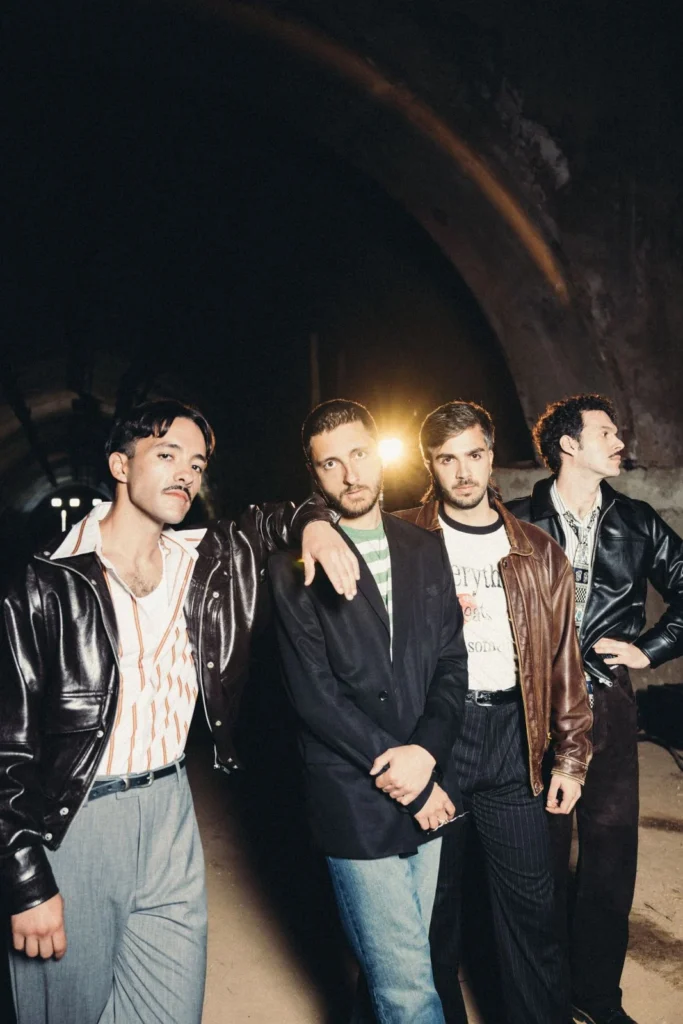

For many international acts, the path to global recognition follows a well-trodden, predictable blueprint: migrate to a major music hub like Los Angeles, sign with a cross-over producer, and pivot toward an English-language soundscape to maximize radio play and streaming potential. However, the trajectory of the Spanish rock quartet Arde Bogotá has consistently defied such industry conventions. Following the monumental success of their 2023 sophomore album, Cowboys de la A3, the band has opted for a counterintuitive approach to international expansion: traveling to California not to dilute their heritage, but to lean into it.
Their third studio effort, Manufacturas del Club de la Gente Sola, was recorded in Los Angeles under the stewardship of Joe Chiccarelli, the legendary producer known for his work with The Strokes, My Morning Jacket, and Beck. Rather than seeking a "globalized" rock aesthetic, the band utilized the distance from their home country to sharpen their identity, resulting in a project that is arguably the most culturally resonant and distinctly Spanish record of their career.
A Strategic Departure from the Norm
The decision to work with an American producer who was unfamiliar with the nuances of the Spanish music scene was, according to lead singer Antonio García, a calculated artistic risk. "Our ambition was to work with someone who didn’t know our environment, our circumstances," García explained. By removing the pressure of local expectations, the band allowed themselves to be judged purely on the sonic merits of their composition.
This objective lens revealed layers in their music that even the band members had previously overlooked. Under Chiccarelli’s guidance, the band explored textures and rhythms rooted in flamenco and pasodoble—genres that are intrinsic to the Spanish experience but were previously treated as background elements. Chiccarelli, acting as an external, neutral ear, helped the band codify these sounds, effectively stripping away the "foreign" veneer that often plagues international bands trying to adapt to U.S. markets.
The Evolution of Arde Bogotá: A Chronology
The rise of Arde Bogotá has been one of the most significant phenomena in the Spanish-speaking music industry over the last three years. The band’s timeline reflects a rapid ascent from regional club circuits to national stadium status:
- 2023: The release of Cowboys de la A3 cemented the band’s position as the leading voice of contemporary Spanish rock. The album achieved double-platinum status, a rare feat for a rock record in an era dominated by reggaeton and urban pop.
- Late 2023–2024: The band embarked on an extensive tour, culminating in a historic sold-out performance at Madrid’s Movistar Arena, marking them as the premier act in the domestic rock scene.
- Early 2025: The band received two Latin Grammy nominations, validating their critical and commercial success on a broader stage.
- Late 2025–2026: Pre-production for Manufacturas del Club de la Gente Sola began, leading to the recording sessions in Los Angeles.
- November 2026: The launch of the U.S. promotional tour, signaling a transition from headline stadium shows in Spain to intimate club performances in the United States.
The Dynamics of Market Re-Entry
For a group accustomed to selling out arenas in Spain, the shift toward U.S. venues—such as The Hall at Elsewhere in Brooklyn and ZeyZey in Miami—presents a psychological and technical shift. Drummer José Ángel "Jota" Mercader views this change in scale as a "fantasy" that allows the band to reconnect with the intimacy of their early years. However, this transition is not without its operational challenges.
The logistics of international touring involve navigating smaller crews and, in some cases, less comfortable production environments than the band has grown accustomed to in Europe. Despite these hurdles, the band maintains that the "start-up" nature of their U.S. endeavor is vital. Their experience in Latin America serves as a blueprint for this expansion; in markets like Mexico, the band has observed a compound growth pattern, where each successive visit results in larger, more engaged crowds who have moved from casual listeners to devoted fans.

Linguistic Integrity in a Global Market
Perhaps the most significant question surrounding Arde Bogotá’s expansion is the viability of a non-English-speaking rock act in the United States. While the global music market has seen an increase in consumption of non-English content, the rock genre remains a stronghold of English-language dominance.
García is resolute in his commitment to Spanish, viewing the language not as a barrier, but as a vessel for necessary vulnerability. "As a singer, I’ve always been interested in the idea that singing involves a certain kind of nudity," he notes. He argues that performing in a language that is not one’s native tongue creates a barrier between the performer’s truth and the audience. For García, the act of singing in Spanish is essential to the "magic" of the performance, refusing to compromise the emotional authenticity of the lyrics for the sake of accessibility.
Broader Implications for Spanish-Language Rock
The success of Arde Bogotá provides a case study in modern cultural exports. By resisting the urge to adapt to American commercial norms, the band has successfully maintained a "Spanish essence" that has become their greatest selling point. This approach suggests that global audiences are increasingly seeking authenticity over assimilation.
Industry analysts note that the rise of digital streaming platforms has flattened the barriers that previously required artists to sing in English to find success. If a band can cultivate a "cult" following through social media and digital algorithms, the need for radio-friendly, English-language hooks is diminished. Arde Bogotá’s strategy of leveraging the prestige of an American producer while maintaining the integrity of their native language is a blueprint that may well be adopted by other international acts in the coming decade.
Looking Ahead: The 2026/2027 Tour Cycle
The band’s upcoming tour itinerary is a testament to their dual reality: they are a powerhouse on the Iberian Peninsula and a rising discovery in North America. Their 2027 schedule includes a string of dates in Spain, including high-profile stops at the Parc del Fòrum in Barcelona and a series of performances at the Cuesta del Batel in Cartagena.
These dates demonstrate that, even as they attempt to break into the U.S. market, they remain deeply anchored in their home country. The ability to balance the logistical demands of massive Spanish summer festivals with the intimate, tactical nature of their U.S. club tour is the defining challenge of their current career phase.
As Arde Bogotá navigates this expansion, they remain an anomaly: a band that has achieved massive popularity by being aggressively, unapologetically themselves. By bringing their "Spanish essence" to the global stage, they are not merely performing music; they are asserting that their cultural identity is a competitive advantage rather than a liability. Whether they can replicate their Spanish dominance in the competitive landscape of the United States remains to be seen, but their approach—rooted in artistic integrity rather than calculation—provides a refreshing narrative in an industry often driven by trend-chasing.