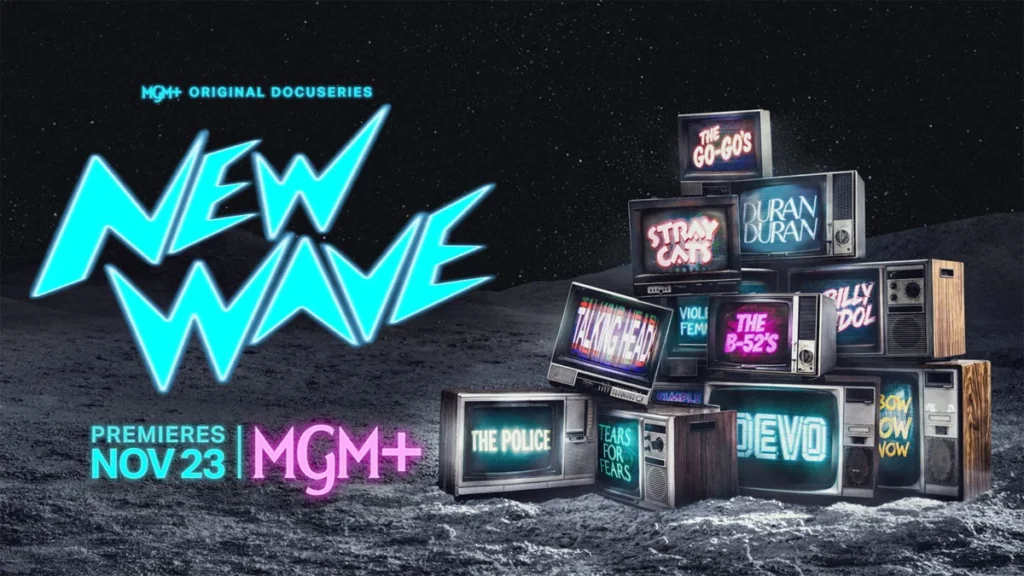

MGM has officially announced the upcoming release of New Wave, an expansive four-part documentary series directed by acclaimed filmmaker Douglas Tirola that examines the seismic shift in popular music and culture between 1977 and 1987. Scheduled to premiere on the MGM+ streaming service on November 23, 2026, the project is produced by This Machine Filmworks in association with 4th Row Films and Polygram Entertainment. The docuseries promises a comprehensive look at how a fractured, rebellious underground movement transformed into a global mainstream phenomenon, reshaping not only the sound of popular music but also fashion, technology, and cultural identity.
Main Facts and Production Overview
The announcement was accompanied by the release of the official trailer and promotional poster, highlighting a star-studded lineup of music legends who shaped the era. Among the iconic acts featured in the series are Billy Idol, The Police, DEVO, Duran Duran, and Oingo Boingo, alongside archival footage and contemporary interviews with the artists who lived through the movement.
At its core, New Wave charts the decade-long evolution from the ashes of 1970s punk rock to the synthesizer-driven explosion of the 1980s MTV era. The series is spearheaded by director Douglas Tirola, whose previous documentary credits include Drunk Stoned Brilliant Dead: The Story of the National Lampoon, Bernstein’s Wall, and Hey Bartender. The executive producer roster boasts a powerhouse team of industry veterans, including Elise Pearlstein, RJ Cutler, Trevor Smith, Mark Blatty, and Margaret Yen of This Machine Filmworks, alongside Tirola, Susan Bedusa of 4th Row Films, and David Blackman, Madeline Post, and Tess Ranahan of Polygram Entertainment.
Chronology of a Musical Revolution: 1977–1987
To understand the scope of New Wave, the documentary traces a deliberate chronological path across a decade defined by rapid technological and social change.

The timeline effectively begins in 1977, a watershed year marked by the commercial exhaustion of mainstream corporate rock and the violent, abrasive eruption of punk. While punk provided the destructive impulse—tearing down the bloated stadium-rock paradigm of the mid-1970s—New Wave emerged as its more art-conscious, intellectually curious sibling. Bands in London, New York, Akron, and Athens, Georgia, began combining the DIY ethos of punk with elements of art rock, electronic experimentation, and pop sensibilities.
By the early 1980s, the movement had evolved from a subterranean club phenomenon into a dominant commercial force, catalyzed largely by the 1981 launch of MTV. The 24-hour music video network provided a visual platform tailor-made for New Wave acts, whose distinctive visual aesthetics, theatrical makeup, gender-fluid fashion, and avant-garde music videos captured the imaginations of a disaffected youth demographic.
The documentary’s endpoint of 1987 signifies the close of the classic New Wave era. By the late 1980s, the genre’s foundational DIY and underground aesthetics had been largely institutionalized by the mainstream music industry, giving way to the sprawling alternative rock explosion of the 1990s and the corporate consolidation of commercial radio formats.
Supporting Data and Cultural Impact
The cultural footprint of the New Wave movement extends far beyond its chart-topping singles and synthesizer hooks. According to historical analyses of the era, the 1977–1987 window represented one of the most commercially diverse periods in modern music history, characterized by an unprecedented fusion of high art and lowbrow pop culture.
Crucially, the documentary explores how New Wave acted as a vital incubator for inclusivity during a politically conservative decade in Western politics. As the trailer and production notes emphasize, the genre opened doors for demographics historically marginalized in the rock-and-roll landscape. Women found unprecedented prominence not merely as vocalists, but as instrumentalists, bandleaders, and primary songwriters—exemplified by artists like Debbie Harry of Blondie, Chrissie Hynde of The Pretenders, Annie Lennox of Eurythmics, and Kate Pierson and Cindy Wilson of The B-52’s.

Furthermore, the movement embraced the queer community and alternative subcultures, fostering an aesthetic environment where traditional notions of masculinity and femininity were routinely subverted. This ethos was neatly encapsulated by the famous quote highlighted in the series’ promotional campaign: "It opened up an era of ‘weird is okay.’"
Technologically, the era marked the democratization of sound. The proliferation of affordable synthesizers, drum machines, and electronic sequencers—such as the Roland TR-808 and the Minimoog—allowed independent artists to produce studio-quality, futuristic soundscapes outside the expensive confines of traditional major-label recording studios.
Industry Context and the Rise of the Archival Music Docuseries
The release of New Wave follows a significant trend within the modern entertainment industry toward multi-part, premium documentary series that chronicle entire musical movements rather than single artist biographies. In the streaming era, platforms have found substantial audience engagement in nostalgia-driven, deeply researched cultural histories that contextualize the soundtrack of past generations.
By leveraging the resources of MGM+ and Polygram Entertainment, the production team has positioned New Wave as a definitive historical document. The involvement of This Machine Filmworks—known for producing high-profile, critically acclaimed non-fiction content—lends further journalistic and artistic credibility to the project. The decision to structure the narrative into four distinct chapters allows the filmmakers to bypass the superficial skimming common to feature-length music docs, offering instead a granular examination of socio-political backdrops, regional scenes, and individual artistic struggles.
Broader Implications and Audience Reception
As the November 23, 2026 premiere date approaches, anticipation among music historians and pop culture enthusiasts has steadily grown. The series arrives at a time when Gen Z and Millennial audiences are showing a sustained appetite for 1980s aesthetics, fashion, and sound design, evidenced by the retro-synth pop revivals in contemporary popular music.

From an analytical perspective, New Wave serves as a timely reminder of how popular culture absorbs and normalizes the underground. By tracing the journey of alternative culture from the dingy clubs of CBGB or the Marquee to stadium tours and heavy rotation on global television networks, Douglas Tirola’s series provides a masterclass in cultural evolution. It highlights the friction between artistic experimentation and commercial viability—a tension that continues to define the music industry today.
MGM+ will make all four episodes of New Wave available for streaming globally starting November 23, 2026. As viewers prepare to dive back into the synthesizer-heavy, visually striking world of the late 1970s and 1980s, the series stands ready to cement the enduring legacy of an era that forever altered the DNA of modern popular music.