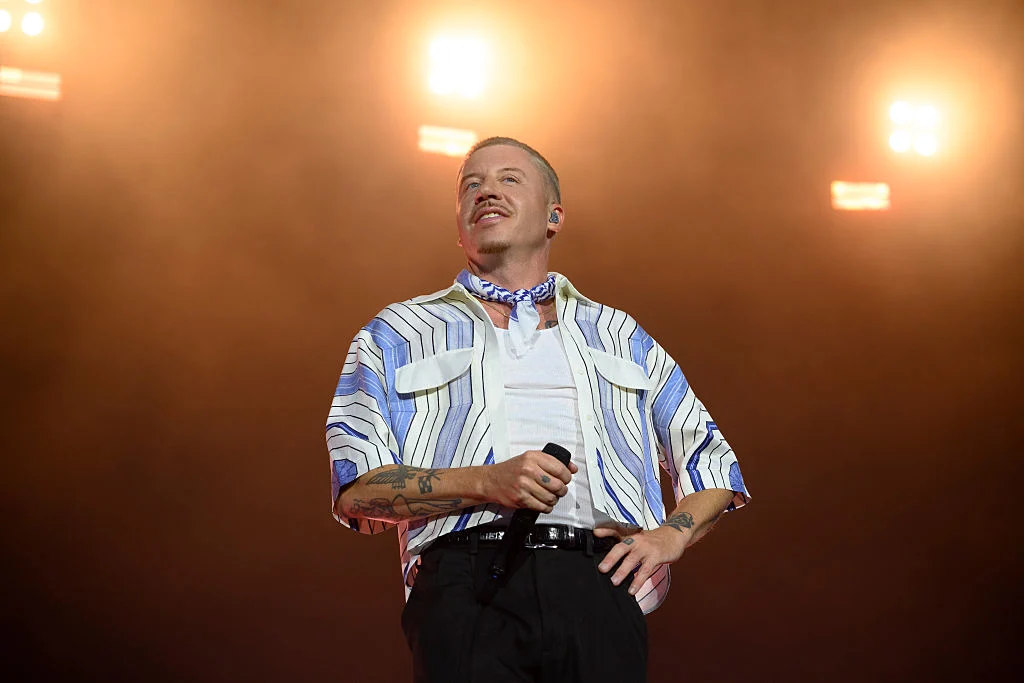

Rapper Macklemore returned to the live performance circuit on Thursday night (October 22), taking the stage at Colorado’s famed Red Rocks Amphitheatre for a 17-song set that made it abundantly clear he has no intention of softening his political stance. The concert marked his first live appearance since a contentious separation from Ed Sheeran’s Loop Tour in September, an event triggered by his vocal activism and the performance of his protest track, “Hind’s Hall.” Addressing the capacity crowd between songs, Macklemore doubled down on his global human rights platform, calling for a "free Palestine" while broadening his appeal to encompass humanitarian crises across multiple continents.
The Red Rocks performance served as a major litmus test for how mainstream concert audiences would receive the rapper following weeks of intense media scrutiny, tour cancellations, and polarized public debate. Rather than steering clear of the controversy, Macklemore leaned directly into the discourse, contextualizing his activism not as partisan politics, but as a fundamental obligation of human empathy.
The Red Rocks Address: A Global Humanitarian Appeal
Midway through his energetic 17-song performance at the iconic open-air venue, Macklemore paused the music to address the audience directly. Speaking into the microphone against the backdrop of the illuminated Colorado rock formations, the artist framed contemporary global crises through a lens of basic human morality.
“Being a human being in this moment is not complicated,” Macklemore told the crowd, according to concert footage. “It is not political. It is human to have a heart, to watch others suffering and to say, ‘Not anymore!’ So I say, free Palestine. I say, free Palestine!”
Expanding his scope beyond the Middle East, the rapper connected the struggles of Palestinians to systemic issues and conflicts worldwide. He continued his address by advocating for populations facing displacement, violence, and institutional fear across the globe: “I say, free Sudan. I say, free Congo, Lebanon, to Haiti, to all the people that are affected by ICE in America, who are afraid to leave their houses.” He concluded his remarks with a simple, unifying sentiment, telling the audience, “The message will always be love.”
Chronology of a Controversy: From MetLife Stadium to Red Rocks
The return to the stage at Red Rocks follows a tumultuous period that upended Macklemore’s fall touring schedule. The friction began in September during a high-profile stint as a supporting act on Ed Sheeran’s Loop Tour.
During two consecutive performances at MetLife Stadium in New Jersey, Macklemore used his platform to voice support for Palestinian sovereignty and performed his 2024 protest anthem, “Hind’s Hall,” accompanied by striking visual imagery from Gaza. The performances drew immediate backlash from advocacy groups, most notably the Israeli-American Council, which criticized the rhetoric and imagery as inflammatory.
The fallout was swift. Tour promoter Messina Touring Group announced that subsequent venues on the U.S. itinerary had informed organizers they were unwilling to host shows featuring Macklemore on the lineup. Robert Kraft, whose Kraft Group owns Gillette Stadium in Massachusetts, subsequently confirmed that he had barred the rapper from appearing at the venue, citing concerns over rhetoric and imagery that he stated were offensive and hurtful to members of the Jewish community.
Ed Sheeran quickly addressed the situation, clarifying that the decision to remove Macklemore originated from promoters and venue management rather than himself. “I respect Macklemore’s strength of purpose to stand up and shout for what he believes,” Sheeran stated at the time, while outlining his own preference for diplomacy and maintaining open lines of communication.
In response to his removal from the tour, Macklemore pledged the entirety of his $1 million earnings from the stint to humanitarian organizations providing aid to Palestinians. Shortly thereafter, Robert Kraft announced a separate $2 million contribution toward humanitarian aid in the region.

The controversy also caused broader disruptions within the tour’s ecosystem. Several other supporting acts—including Finneas, Aaron Rowe, and Lukas Graham—alongside Sheeran’s backing band, Beoga, subsequently withdrew from their scheduled appearances, reflecting the deep polarization surrounding the tour’s lineup changes.
Chart Impact and Streaming Surge
While the tour removal created logistical challenges, the associated controversy generated an unprecedented wave of public interest, translating into a massive surge in digital consumption of Macklemore’s catalog.
According to early data from Luminate analyzed by Billboard, official on-demand U.S. streams of Macklemore’s solo catalog experienced a dramatic escalation in mid-September. Solo streams climbed from 282,000 on September 13 to 767,000 just two days later on September 15, representing a staggering 172% increase. Total catalog streams, which include his collaborative work with producer Ryan Lewis, nearly doubled over the same timeframe, jumping 97% from just over 1 million streams to nearly 2 million daily streams.
The most dramatic acceleration was observed for the catalyst of the movement, “Hind’s Hall.” The protest track saw its daily U.S. streams skyrocket from just over 5,000 on September 13 to nearly 87,000 on September 15—its highest single-day streaming total in more than two years. The surge demonstrated how polarizing cultural moments can galvanize digital audiences, driving traffic toward socially conscious and politically charged music.
Independent Ventures: The Free Palestine Tour
Undeterred by his removal from major arena tours, Macklemore rapidly pivoted to independent production, organizing his own headlining venture titled the Free Palestine Tour. The European leg of the tour achieved immediate commercial success, with tickets for venues in Dublin (scheduled for October 26), Paris (October 29), and London (October 30) selling out almost instantly.
Organizers confirmed that proceeds generated from these concerts are earmarked for a coalition of humanitarian and relief organizations supporting Palestinians. Beneficiaries include the Gaza Soup Kitchen, Medical Aid for Palestinians, and the Palestine Children’s Relief Fund.
By bypassing traditional mainstream tour structures and taking direct control of his performance schedule, Macklemore has established a direct pipeline between his artistic platform and on-the-ground philanthropic efforts.
Industry Implications and Broader Precedents
The events surrounding Macklemore’s autumn tour schedule highlight a growing intersection between mainstream pop culture, geopolitical activism, and corporate venue management. In an era where artists increasingly utilize major platforms to voice personal convictions regarding international conflicts, venue operators, promoters, and corporate stakeholders face difficult decisions regarding liability, community relations, and artistic expression.
Industry analysts note that while taking explicit political stances carries commercial risks—such as lost tour revenue and venue bans—it can simultaneously foster deeply loyal consumer bases and drive digital engagement, as evidenced by Macklemore’s streaming metrics. Furthermore, the willingness of supporting acts to withdraw from tours in solidarity or protest underscores a shifting dynamic among touring musicians, where ideological alignment with supporting personnel is becoming an increasingly critical factor in tour logistics.
As Macklemore continues his independent touring schedule and maintains his outspoken advocacy on international human rights issues, the music industry watches closely. The rapper’s ability to successfully transition from a traditional stadium opening act to an independently viable, politically driven headliner suggests that artist-led activism will remain a potent, disruptive force in contemporary popular music for the foreseeable future.