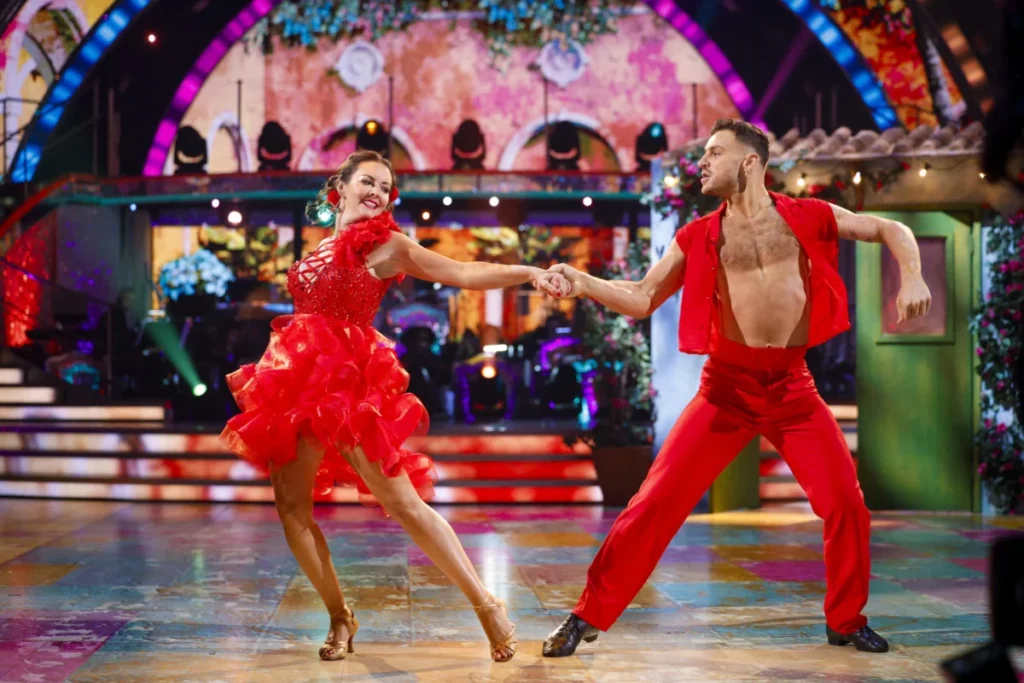

The battle for the coveted Glitterball Trophy intensified on Saturday night as the remaining 13 couples returned to the Strictly Come Dancing ballroom, marking a pivotal moment in the series. Following the high-stakes elimination of celebrity hairstylist Chris Appleton and professional partner Amy Dowden during the previous week—the first pair to be ousted by the public vote—the pressure on the remaining contestants reached a palpable fever pitch. With the competition narrowing, each performance has taken on increased significance, as celebrities aim to demonstrate technical growth and audience rapport to avoid the precarious bottom two.
A Night of High Stakes and Technical Precision
The Saturday night broadcast featured a diverse array of dance styles, ranging from the rhythmic complexity of the samba and the fast-paced footwork of the cha-cha-cha to the elegance of the waltz and the dramatic flair of the tango. The primary objective for each celebrity was clear: secure high marks from the judges’ panel—comprising Shirley Ballas, Motsi Mabuse, Craig Revel Horwood, and Anton Du Beke—to insulate themselves from the dreaded Sunday night dance-off.
Australian singer and former Neighbours actor Delta Goodrem emerged as the evening’s standout performer. Paired with professional dancer Kai Widdrington, Goodrem delivered a high-energy salsa that left the judges visibly impressed. Dressed in a shimmering silver disco ensemble that paid homage to the genre’s golden era, the pair executed a routine that garnered scores of 8, 9, 8, and 8.
This total of 33 points represents not only the highest score of the third week but also the highest single-performance score of the current series. Anton Du Beke, reflecting on the quality of the routine, noted that Goodrem is “setting a very high bar” for her competitors, while the notoriously stringent Craig Revel Horwood offered a rare moment of praise, describing the performance as “amazing.” This marks the second consecutive week that Goodrem and Widdrington have topped the leaderboard, establishing them as early favorites for the title.
The Competitive Landscape: Leaderboard Dynamics
While Goodrem and Widdrington enjoyed a comfortable lead, the rest of the field saw significant variance in performance. Following closely in second place were British Olympic skeleton racer Tabby Stoecker and her partner Mark Karmalita, whose command of the tango earned them 31 points. They were joined at the 31-point mark by Cach Mercer and Maddie Ingoldsby, indicating that the competition for the top spots remains fluid.
Further down the rankings, the scores reflected the inconsistent nature of learning complex choreography under pressure. Graeme Hall and Lauren Oakley, who had previously occupied the second-place position, slipped to a score of 25 for their jive. Similarly, YouTuber John Nellis and partner Katya Jones, who have faced significant scrutiny, were awarded 20 points for their cha-cha-cha.
At the lower end of the spectrum, former professional footballer Shaun Wright-Phillips faced a difficult evening. Known for his illustrious career with Chelsea and QPR, Wright-Phillips struggled to translate his athleticism into the nuance required for ballroom dance. Alongside partner Alexis Warr, he scored 15 points, placing him at the bottom of the night’s rankings. Despite the low score for his quickstep, judge Anton Du Beke offered words of encouragement, asserting that Wright-Phillips possesses “all the components to be a super, super dancer,” provided he can refine his technique.
Gavin and Stacey actress Melanie Walters, partnered with Aljaz Skorjanec, narrowly avoided the bottom spot for the second consecutive week. Scoring 17 points, they managed a slight improvement of two points over their previous performance, illustrating the incremental progress that characterizes the early stages of the competition.

Comprehensive Leaderboard: Week Three Rankings
| Couple | Total Score |
|---|---|
| Delta Goodrem & Kai Widdrington | 33 |
| Tabby Stoecker & Mark Karmalita | 31 |
| Cach Mercer & Maddie Ingoldsby | 31 |
| Jamie Winstone & Carlos Gu | 28 |
| Bethany Antonia & Nancy Xu | 27 |
| Dani Dyer & Nikita Kuzmin | 27 |
| Lacey Turner & Vito Coppola | 26 |
| Graeme Hall & Lauren Oakley | 25 |
| Will Best & Diane Buswell | 25 |
| John Nellis & Katya Jones | 20 |
| Lawrence Robb & Jowita Przystal | 20 |
| Dame Sarah Storey & Julian Caillon | 20 |
| Melanie Walters & Aljaz Skorjanec | 17 |
| Shaun Wright-Phillips & Alexis Warr | 15 |
The Mechanics of Elimination and Public Influence
The structural integrity of the competition relies on a hybrid system of judge scoring and public participation. While the judges provide the technical critique that dictates the leaderboard, the public vote serves as a check on popularity and audience engagement. This dual-input system ensures that even those who perform well technically must maintain a strong connection with the voting public to ensure their safety.
The process for the Sunday night results show is strictly regulated. Following the aggregation of the judges’ scores and the public vote, the two couples with the lowest combined totals are required to perform their routines again in a head-to-head dance-off. The four judges then cast their votes on who to save, with the panel focusing on technical improvement and consistency in the second performance. In the event of a tie—a scenario where the panel is split two-to-two—Head Judge Shirley Ballas holds the casting vote, though the protocol dictates that Anton Du Beke may be called upon to deliver a deciding vote if specific criteria are met during the deliberation.
Historical Context and Strategic Implications
Strictly Come Dancing, now in its twenty-second year, has evolved from a simple celebrity dance competition into a cultural institution. The current season has already demonstrated a heightened level of difficulty, with professional partners pushing their celebrity counterparts toward more complex choreography earlier in the series than in previous years.
The elimination of Chris Appleton in week two served as a stark reminder that no celebrity is immune to the public vote. Historically, high scores in the early weeks do not guarantee a trajectory toward the final. Audience engagement, often driven by the "journey" of the celebrity—their emotional growth, physical transformation, and public persona—is frequently as influential as the technical scores themselves.
For the contestants currently at the bottom of the table, such as Shaun Wright-Phillips and Melanie Walters, the upcoming week of rehearsals is critical. The "Strictly" training regime is notoriously grueling, involving long hours of physical repetition that can lead to fatigue and injury. The ability to manage this physical toll while maintaining mental focus is often the differentiator between those who survive the early rounds and those who depart prematurely.
Professional Analysis of Performance Trends
Industry observers have noted that the judging panel has been particularly rigorous this season. By awarding scores in the lower-to-mid range, the judges have left themselves room to reward improvement in the coming weeks. The high score of 33 for Delta Goodrem, while record-breaking for this series, is significantly lower than the "perfect" 40s often seen in the later stages of the competition. This suggests that the judges are pacing their scoring to accommodate a longer, more demanding season.
The reliance on diverse dance styles—such as the salsa, which demands stamina and rhythm, versus the waltz, which demands poise and frame—forces contestants to showcase different facets of their ability. Those who prove versatile across these disparate styles are statistically more likely to reach the final stages.
Looking Ahead to the Results
As the production shifts toward Sunday’s broadcast at 7:10 PM on BBC One, the focus turns to the public. With the leaderboard providing a clear hierarchy of performance, the question remains whether the public will align with the judges’ rankings or if a surge in support for a lower-scoring couple will force a surprise result.
The impending dance-off represents the most nerve-wracking aspect of the show, where the pressure of live performance often leads to errors. For the couples in the bottom tier, the goal is simple: deliver a mistake-free performance that highlights their technical growth. For the leaders, the challenge is to maintain the momentum and avoid complacency. As the ballroom lights dim and the week three results are tabulated, the competition enters a phase where every small mistake carries the potential to end a journey toward the Glitterball Trophy. The outcome of the next 24 hours will define the narrative for the coming weeks, setting the stage for what is shaping up to be one of the most competitive seasons in the show’s history.