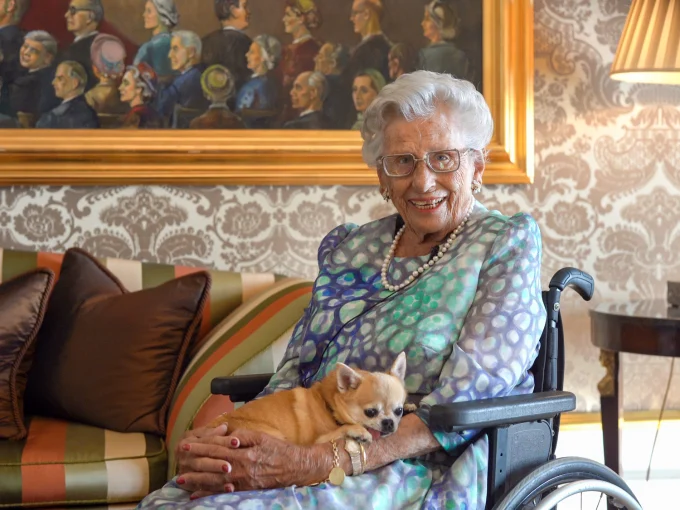

The Norwegian Royal Court has confirmed the passing of Wilma, the twelve-year-old dog belonging to the late Princess Astrid of Norway. The poignant loss comes mere days after the beloved princess was laid to rest during a solemn and moving ceremony at Ris Church in Oslo. Wilma, a familiar and comforting presence to the Norwegian public, died just one day after her owner’s funeral, closing a chapter on a companionship that defined the final decade of the princess’s extraordinary life.
The confirmation of Wilma’s death was provided to the Norwegian public broadcaster NRK by officials at the Royal Court. For more than a decade, the small dog had been a fixture in the daily life of Princess Astrid, accompanying her to official engagements, resting comfortably in her lap, and famously featuring in nearly every official birthday portrait released by the palace in recent years.
A Chronicle of Grief and Loss
The passing of Princess Astrid on September 11 marked the end of an era for the House of Glücksburg. Her death occurred just two days after the state funeral of her younger brother, King Harald, who passed away on August 28 at the age of 89. The siblings had shared an exceptionally close bond, forged through decades of shared public service, national trials, and familial devotion. Astrid had stood staunchly by Harald’s side, serving as one of his most trusted confidantes and supporters throughout his 35-year reign.
The chronology of late summer and early autumn 2024 brought unprecedented sorrow to the Norwegian royal family:
- August 28: King Harald passes away peacefully at the age of 89, plunging the nation into official mourning.
- August-September: Princess Astrid, visibly frail but resolute, pays her final respects, mourning her brother alone as his coffin lies in state in the chapel at the Royal Palace in Oslo.
- September 9: Princess Astrid attends King Harald’s state funeral at Oslo Cathedral, flanked by other members of the royal family.
- September 11: Following a rapid decline in her health compounded by profound grief, Princess Astrid passes away peacefully at the age of 94.
- Mid-September: A moving funeral service is held at Ris Church in Oslo, where Princess Astrid is laid to rest in the Ris graveyard beside her late husband, Johan Martin Ferner.
- Day After the Funeral: The Royal Court confirms the death of Wilma, noting that the twelve-year-old canine companion could not be separated from her master’s memory for long.
A Lifetime of Duty and Resilience
To understand the depth of Princess Astrid’s connection to her final years and her companions, one must look back at a life spanning nine decades of profound historical transformation. Born in 1932, Princess Astrid grew up at the epicenter of the Norwegian monarchy, experiencing the traumas of the Second World War firsthand. When Nazi Germany occupied Norway in 1940, the royal family faced immediate mortal danger. To ensure their safety, Crown Princess Märtha and her children—including young Astrid—fled into exile, finding refuge in the United States, where Astrid spent her formative childhood years.
Following the Allied victory and the restoration of peace in Europe, the princess returned to her homeland. After completing her education, which included studies at Oxford, she immediately stepped into a life of public service. Her duties intensified dramatically in 1954 following the untimely death of her mother, Crown Princess Märtha. At a remarkably young age, Astrid stepped forward to assume the duties of Norway’s first lady, a demanding role she performed with grace and poise for fifteen years.
During this period, she served as the primary female representative of the court through the final years of her grandfather King Haakon VII’s reign, and into the initial years of her father King Olav V’s reign. She only stepped back from the formal responsibilities of first lady when her brother, then-Crown Prince Harald, married Sonja Haraldsen in 1968. Despite relinquishing that specific title, Princess Astrid never truly retired. She continued to undertake a robust schedule of patronages, charity work, and public engagements well into her nineties, earning widespread admiration for her sharp wit, geniality, and unwavering dedication to Norwegian society.
Wilma’s Place in the Royal Narrative
In her later years, as mobility challenges necessitated the use of a wheelchair, Princess Astrid’s public appearances took on a uniquely endearing quality thanks to Wilma. The little dog became an ambassador of sorts for the princess’s warm personality. It was entirely customary for the nonagenarian royal to arrive at high-profile events, charity bazaars, or cultural exhibitions with Wilma quietly resting in her lap.
Photographers and journalists quickly came to expect the canine’s presence, and official milestone portraits—such as those released for the princess’s 90th birthday—invariably featured Wilma posed beside her. Palace observers noted that Wilma provided not only physical comfort to the princess as her health fluctuated, but also a comforting sense of normalcy and companionship. The bond between the royal and her pet reflected a softer, deeply human side of the institution, resonating deeply with animal lovers across Scandinavia and beyond.
Broader Implications and Institutional Reflection
The simultaneous loss of a monarch, an iconic princess, and her faithful companion marks a profound psychological transition for the Norwegian monarchy. King Harald’s death and Princess Astrid’s subsequent passing close the book on a generation of royals who directly remembered the ravages of World War Two and the rebuilding of modern Norway.
While the administrative continuity of the Norwegian crown remains secure under the reign of King Harald and Queen Sonja’s descendants, the cultural loss is immeasurable. Princess Astrid represented a living bridge to the mid-20th century, embodying resilience through her wartime exile and decades of unblemished public duty.
Public reaction in Norway has been one of collective mourning, tempered by fond remembrance. Tributes from civic leaders, charitable organizations, and ordinary citizens have highlighted the princess’s accessibility, her keen sense of humor, and her tireless work on behalf of marginalized communities. The subsequent news of Wilma’s death has added a deeply emotional postscript to the national grieving process, prompting widespread expressions of sympathy across social media and traditional news outlets alike.
Princess Astrid now rests permanently in the Ris graveyard, entombed beside her husband, Johan Martin Ferner, whom she married in 1961 in a union that captured the nation’s heart. As the Norwegian Royal Court and the nation process these historic losses, the story of Princess Astrid and Wilma will long be remembered as a testament to loyalty, companionship, and a lifetime dedicated to public service.