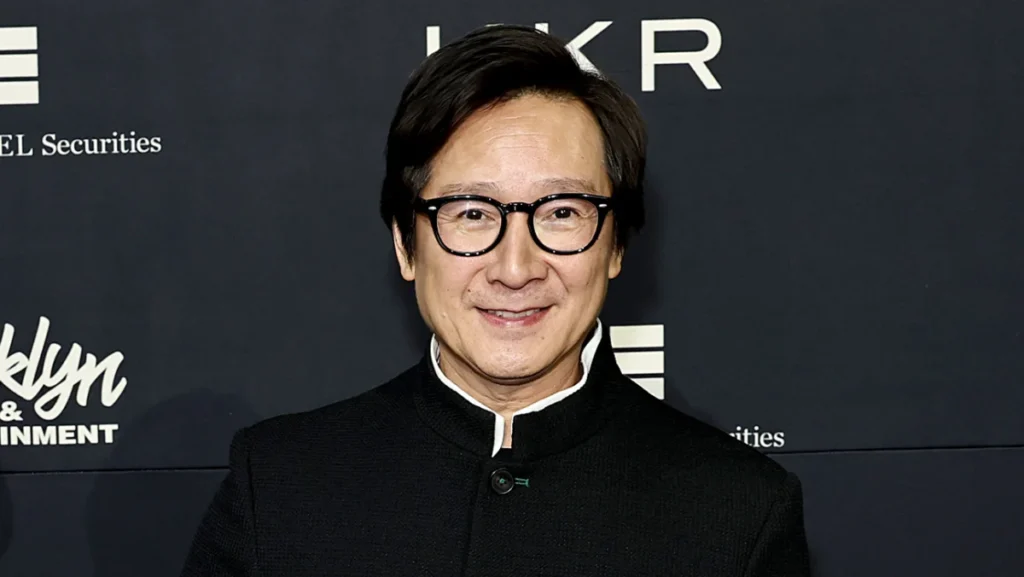

The evolution of Hollywood talent financing, childhood stardom, and the enduring legacy of 1980s blockbuster cinema have once again been cast into the spotlight through the personal revelations of Academy Award winner Ke Huy Quan. In his newly released memoir, Never Say Die, which hit bookshelves on Tuesday, Quan offers an intimate look at the financial realities of breaking into the film industry as a pre-teen. Among the most striking disclosures in the book is the actor’s recollection of receiving his very first residual check for his iconic role as Short Round in Steven Spielberg’s 1984 adventure classic, Indiana Jones and the Temple of Doom. The check, totaling nearly $100,000, arrived during a formative period in Quan’s youth and served as a profound financial turning point for his immigrant family.
The revelation provides a rare glimpse into the behind-the-scenes mechanics of compensation deals orchestrated by industry titans Steven Spielberg and George Lucas during an era when profit-participation clauses were strictly reserved for established A-list adults. Quan’s account not only underscores the unexpected generosity of two of Hollywood’s most influential filmmakers but also highlights the complex financial pressures and emotional realities faced by child actors navigating the turbulent waters of the entertainment industry.
An Unlikely Discovery in the Family Kitchen
The moment unfolded quietly in the kitchen of the Quan family home in Southern California. Quan was only 12 years old when he was cast as Short Round, the quick-witted, fiercely loyal sidekick to Harrison Ford’s Indiana Jones in the highly anticipated follow-up to 1981’s Raiders of the Lost Ark. Having already received his initial base salary for the production, the young actor possessed little understanding of industry conventions, let alone the concept of residual payments—compensation issued to performers when a film is re-broadcast, syndicated, or distributed across secondary home video and television markets.
As detailed in Never Say Die, Quan walked into the family kitchen to find his parents standing together by the table, staring at an envelope with an expression of mingled shock and disbelief. Upon handing the contents to their son, the envelope revealed a document and a check issued by Lucasfilm. The numerical value written on the paper was nearly $100,000.
At 12 years old, the figure was entirely abstract to the young performer. In his memoir, Quan admits that he fundamentally could not comprehend how additional funds could suddenly materialize for work he had already completed and been paid for. It was only as he grew older and gained a deeper understanding of the entertainment business that he realized the significance of the payment. The inclusion of a residuals clause for a child actor on his very first feature film was an extraordinary anomaly in Hollywood history.
The Generosity of Spielberg and Lucas
To fully appreciate the magnitude of the $100,000 check, industry analysts must examine the standard compensation structures of the mid-1980s. During this period, backend participation, profit-sharing, and robust residual agreements were heavily guarded perks. Studios typically reserved such financial incentives for marquee movie stars capable of driving massive box office ticket sales independently. Newcomers, particularly child actors playing supporting roles, were paid flat, upfront fees with virtually no stake in the long-term commercial success of the project.
Furthermore, Indiana Jones and the Temple of Doom was not an obscure independent art-house film or a risky venture; it was the guaranteed blockbuster sequel to one of the most successful adventure films ever made. Expectations for commercial profitability were stratospheric. For Spielberg and Lucas to deliberately ensure that a 12-year-old newcomer shared in the financial upside of the film’s downstream revenues was, as Quan describes it, a quiet and deeply generous gesture.
This financial cushion proved to be entirely life-changing for the Quan family. Having immigrated to the United States as refugees from Vietnam, the family faced substantial economic hardships while attempting to establish stability in a new country. The influx of $100,000 provided immediate relief, security, and breathing room during a critical phase of their assimilation into American society.
A Storied Career and Triumphant Return
The release of Never Say Die arrives at a time of remarkable professional renaissance for Ke Huy Quan. Following his breakout success in the 1980s—which also included his unforgettable portrayal of Data in Richard Donner’s 1985 adventure comedy The Goonies—Quan faced the systemic industry barriers that frequently confront child actors as they age out of juvenile roles. With limited opportunities for Asian American actors in mainstream Hollywood during the late 20th century, Quan eventually stepped away from acting entirely, spending decades working behind the scenes as a stunt coordinator and assistant director.
Decades later, inspired by the critical and commercial success of 2018’s Crazy Rich Asians, Quan made the courageous decision to return to the front of the camera. The gamble paid off exponentially. In 2023, he captured the Academy Award for Best Supporting Actor for his role as Waymond Wang in Daniels’ multiverse-spanning sci-fi comedy Everything Everywhere All at Once.
During his triumphant award season run, which included a Golden Globe Award, a Screen Actors Guild Award, and an Oscar, Quan consistently expressed profound gratitude to the mentors who had launched his career decades earlier. While accepting his Golden Globe, Quan took a deliberate moment to thank Steven Spielberg directly from the podium, acknowledging the foundational role the legendary director played in shaping his life.
In subsequent interviews and reflections tied to his memoir, Quan has also spoken candidly about the lingering psychological hurdles of early success. For years following the release of Temple of Doom and The Goonies, he harbored a persistent anxiety that his early achievements were merely a stroke of blind luck, and that he would never again reach the cultural heights of his childhood stardom.
Broader Implications for Child Actors and Industry Standards
Quan’s revelation regarding his Temple of Doom residuals opens a broader conversation about the ethical and financial treatment of minor performers in the modern entertainment landscape. Historically, child actors have been vulnerable to financial exploitation, mismanagement of earnings, and the psychological fallout of intense, transient fame. While legislative frameworks such as California’s Coogan Law were established to protect a percentage of a minor’s earnings in a blocked trust account, issues surrounding backend compensation, long-term residuals, and labor protections remain heavily debated topics among labor unions like SAG-AFTRA.
The deliberate choice by Spielberg and Lucas to extend profit-sharing privileges to a juvenile actor serves as a notable historical exception to standard corporate policy. It highlights how influential filmmakers could leverage their creative authority to advocate for the welfare of vulnerable cast members. While modern studio contracts have evolved significantly—partly due to continuous union negotiations regarding streaming residuals and digital distribution—the fundamental financial vulnerability of child performers persists in the digital age.
As Never Say Die continues to climb bestseller lists and generate widespread discussion across literary and cinematic circles, Quan’s reflections offer readers more than just nostalgic anecdotes from the golden age of 1980s blockbuster filmmaking. The book stands as a testament to resilience, the enduring bonds forged on iconic movie sets, and the quiet acts of kindness that can permanently alter the trajectory of a young life. For Ke Huy Quan, a surprise envelope in a family kitchen decades ago was not merely a financial windfall, but an early validation of his worth in an industry where he would eventually make a historic, triumphant return.