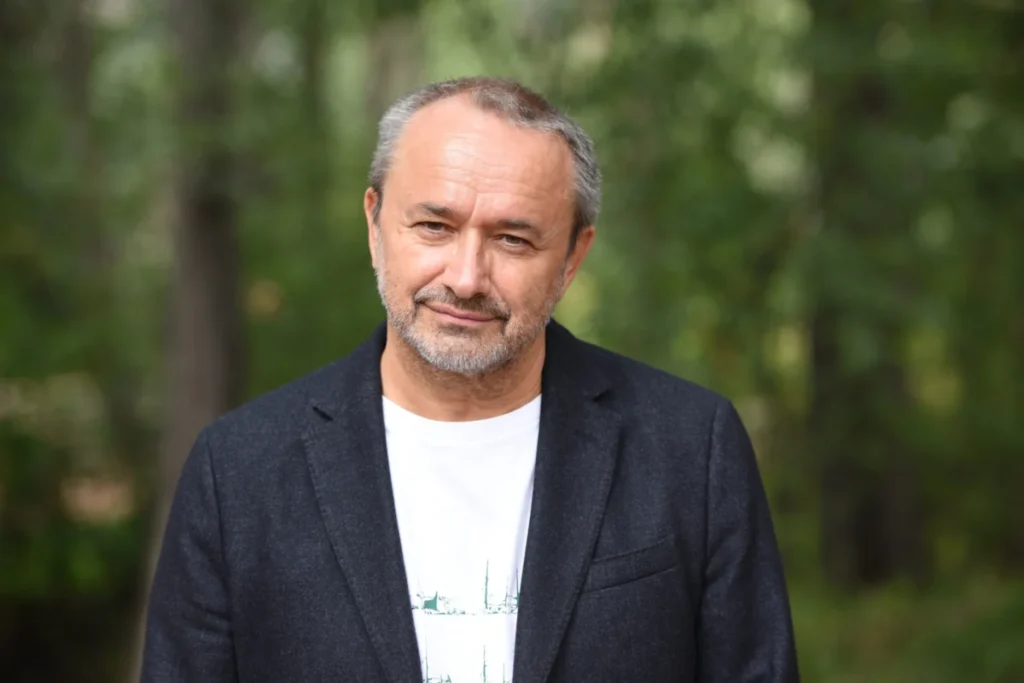

The familiar rhythm of the international film festival circuit is one that celebrated Russian auteur Andrey Zvyagintsev knows intimately. Years ago, his piercing, uncompromising critiques of contemporary Russian society—namely Leviathan (2014) and Loveless (2017)—followed a well-worn path from triumphant premieres and prizes at the Cannes Film Festival to rapturous receptions at the Telluride Film Festival. These critical darlings subsequently positioned him as a heavyweight contender in the North American awards race, culminating in Academy Award nominations for Best Foreign Language Film.
Today, Zvyagintsev finds himself navigating this prestigious trajectory once again with his latest masterwork, Minotaur. Seated in a Beverly Hills hotel lobby following a high-profile tastemaker screening, the director cuts a calm and collected figure. Having already earned critical acclaim at Cannes and a roaring reception at Telluride, Minotaur is officially storming the American awards season. Yet, beneath the surface of this familiar ritual lies a radically altered reality. Minotaur represents a profound departure for Zvyagintsev: it is his first feature film produced entirely outside of Russia.
A Production Forged in Exile and Near-Tragedy
Following Russia’s full-scale invasion of Ukraine in 2022, Zvyagintsev—a vocal critic of the Kremlin’s military aggression—relocated his life to France. Consequently, the production of Minotaur shifted to Latvia, which stood in visually and thematically for a brutally frank portrait of his homeland at the dawn of a geopolitical crisis.
This dramatic relocation is compounded by an arduous personal timeline that nearly cut the director’s career short. Zvyagintsev faces the release of Minotaur after a nearly decade-long hiatus from filmmaking. Earlier this year, he revealed a harrowing battle with long COVID that left him physically incapacitated and unable to move for a full 12 months. Surviving a near-death experience while simultaneously losing his physical homeland makes his triumphant return to cinema all the more remarkable.
The film’s journey to the Academy Awards has also taken an unprecedented route. Because Minotaur was produced outside Russia and directed by an expatriate, it is ineligible to represent Russia in the international feature film category—a category where Leviathan and Loveless previously secured their Oscar nominations. Instead, Minotaur has been placed on the French Oscar shortlist, with a national committee finalizing its selection to determine if France will submit the Russian-born director’s work as its official entry.
Adapting Chabrol for the Geopolitical Present
Minotaur is adapted from French New Wave master Claude Chabrol’s 1969 psychological drama The Unfaithful Wife (La Femme infidèle), a property previously adapted into Adrian Lyne’s 2002 erotic thriller Unfaithful. Zvyagintsev’s adaptation remains cannily faithful to Chabrol’s structural DNA while sharply updating the narrative for the contemporary geopolitical landscape. Notably, the director deliberately avoided watching Lyne’s Hollywood adaptation to prevent outside cinematic influences from muddying his creative vision.
Set against the tense backdrop of 2022, the film follows Gleb, a powerful corporate CEO played by Dmitriy Mazurov, as he discovers the mounting signs of his wife Galina’s infidelity (portrayed by Iris Lebedeva). As Gleb tracks hidden smiles, secret text messages, and afternoon escapes, his professional life collapses under external pressures. He faces mounting political demands to support the state war effort, even as his colleagues flee the country in droves.
By intertwining an intimate domestic betrayal with a bleak geopolitical backdrop, Zvyagintsev continues a thematic tradition that has defined his career. A decade ago, the release of Leviathan—a scathing indictment of municipal corruption and moral decay in provincial Russia—provoked furious reactions from Russian state officials and conservative activists, who famously denounced the film as "evil" and "beyond all limits." Minotaur expands on this critical lens by examining how systemic corruption at the state level permeates the psychological and moral fabric of everyday domestic life.
Expanding the Narrative: Office Politics and Female Agency
Zvyagintsev’s adaptation diverges from Chabrol’s original work in two critical ways: the integration of institutional office dynamics and the elevation of female agency.

"Chabrol completely left out life in the office," Zvyagintsev notes, highlighting his primary narrative intervention. "What was this relationship that the main character had with his colleagues? What exactly is happening there? I needed to create it."
Furthermore, while the film is predominantly framed through the perspective of the aggrieved husband, Zvyagintsev deliberately breaks with traditional domestic noir tropes by granting Galina the space to articulate her own interiority and autonomy before the narrative unravels entirely. As heard in the film’s trailer, Galina confronts her husband directly, declaring, "I’m tired of being your shadow."
"She is looking for love, sex, compassion, tenderness," Zvyagintsev explains. "I wanted to show Galina’s tragedy, what exactly was happening with her on the inside—what pushed her to cheat."
Critical Reception and Unexpected Humor
Despite the grim thematic weight of betrayal, corruption, and societal collapse, Minotaur has surprised audiences and critics alike with moments of dark, subtle humor. Zvyagintsev recalls a pivotal, wordless centerpiece sequence running for more than 15 minutes that drastically shifts the film’s tone. During screenings at the Telluride Film Festival, the director observed American audiences responding with unexpected levity to the meticulously crafted mise-en-scène.
"I didn’t really expect it—at that point, the American audience really started to laugh," Zvyagintsev remarks. "Just because of the mise-en-scène. And then they laughed again!"
This ability to elicit complex emotional reactions underscores the universal language of Zvyagintsev’s cinema. While Minotaur is deeply anchored in the anxieties of Eastern Europe in 2022, its incisive exploration of human frailty resonates globally.
The Implications of Representing France
As Minotaur prepares for its theatrical release and its high-profile screening at the Toronto International Film Festival, the cultural and political implications of its awards campaign continue to unfold. The final decision by the French Oscar selection committee carries symbolic weight, bridging national boundaries and artistic displacement.
"I do understand: How will it feel for France to give their place to a Russian director?" Zvyagintsev reflects on the historic nature of his current position. "Me not yet being a French citizen, in the sense of not having a passport, but representing them—I would be very proud, and very grateful."
Minotaur is scheduled to open in theaters on November 20, marking the official return of one of modern cinema’s most uncompromising voices.